








New Delhi: Modi “endorsed” Trump’s plans for Gaza, according to a report in Haaretz by Noa Shpigel and Liza Rozovsky.
Modi, speaking on the war with Gaza and the 7 October attack by Hamas, said Trump’s peace plan “holds the promise of a just and durable peace for all the people in the region, including by addressing the Palestine issue”, Haaretz reports.
Preceded by days of deliberations by the Opposition on whether to boycott the Knesset session, Modi also became a witness to the country’s political turmoil at the session.
Most of the Opposition attended Modi’s speech but left during remarks by Benjamin Netanyahu and Knesset Speaker Amir Ohana because Ohana refused to invite Supreme Court President Isaac Amit to the session. It is “customary” to send an invitation.
However, Israel’s Supreme Court, which oversees Netanyahu’s ongoing corruption trial, and the Israeli government haven’t seen eye to eye in a while.
At the session, Modi spoke on the Israel-India partnership in defence, quantum technologies, and artificial intelligence. “We are working with Israel on creating cross-border financial linkages and digital public infrastructure,” he said, according to Haaretz.
Modi’s visit to Israel becomes significant because India maintains a fragile balance in the region—both Haaretz and a BBC report highlights this.
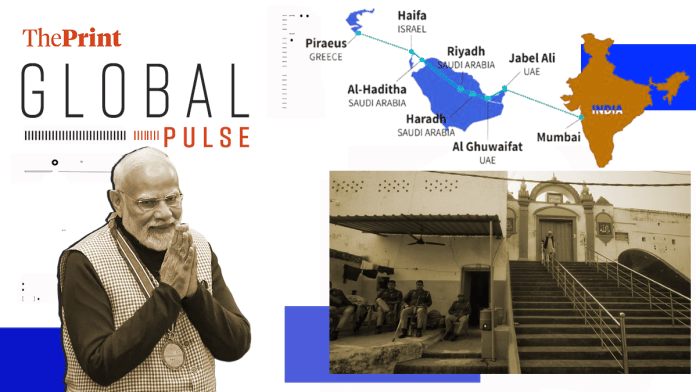
Haaretz reports, “Modi referenced the IMEC initiative—the India-Middle East-Europe Economic Corridor, which includes shipping, energy and underwater internet infrastructure”—a project delayed since late 2023 largely due to regional instability.
For the BBC, Nikita Yadav and Abhishek Dey write that the visit comes at a time of “heightened regional tensions” and “US President Donald Trump’s threat of military action against Iran and fears that any escalation could trigger a wider regional conflict”.
The US has increased its military presence in the region in recent weeks—one of its largest buildups in decades—to pressure Iran over its nuclear programme, says the BBC.
In an analytical news piece, Mujib Mashal and Suhasini Raj of The New York Times write about how the Hindu Right has become “unstoppable” in India over the past decade, since the Modi-led BJP came to power.
Referencing the 2024 riots in Uttar Pradesh’s Sambhal, Mashal and Raj make a case for how “the arms of the State that once tried to play the role of referee now increasingly serve as the muscle of the forces, recasting India’s secular Republic as a Hindu-first nation”.
In late 2024, violence erupted in Sambhal after a court ordered an inspection of the 16th-century Shahi Jama Masjid. When an angry crowd gathered to defend the mosque, police responded with batons, tear gas, and gunfire, leaving at least five people dead, the NYT notes.
For Muslims in northern India, the mosque is a symbol of identity. For Hindu nationalists, it represents a legacy of “foreign invasions”, and they have sought to challenge its status in court, claiming it had been built on a sacred Hindu site, the NYT further reports.
They also write that Yogi Adityanath is “setting the tone from the top”.
“Ruling in a monk’s saffron-robe, he defines the law, the boundaries of the new reality where full display of Hindu religiosity is the norm. Meanwhile, vigilantes—often unchecked by the police—frequently suppress other public religious expression.”
In an analytical opinion piece, Yamini Aiyar writes for Foreign Affairs about how India—despite a steady economic growth of seven percent every year—has largely failed to provide jobs to its youth.
“In December 2025, newspapers in India carried an arresting, dystopian image: scores of young people sitting obediently in rows on an airstrip in the eastern state of Odisha to take an exam. Over 8,000 test takers had lined up under the sun to compete for 187 posts in the police service. That so many people were willing to take an exam in such inhumane conditions is revealing,” she reports.
Aiyar writes that India has “struggled” to deliver “broad-based prosperity”. While India’s economic model has undergone multiple transitions, it has “failed to engender a deeper economic transformation”. Its per capita GDP, Aiyar notes, is less than a quarter of Brazil’s and about one-sixth of Turkey’s—two other emerging middle powers.
The benefits of growth have been deeply uneven. India is now home to 205 billionaires, according to a 2025 Forbes estimate, more than any country except the United States and China.
Although the country has experienced both socialist and liberal approaches to the market economy, Aiyar highlights that the problem does not lie at the level of economic policy. Rather, it is “in the very nature of the Indian State”—a democracy.
Electoral politics in the nasent stages of development “created pressures that, on the one hand, precluded many of the radical changes needed for economic development (for instance, meaningful land reform) and, on the other, burdened a fledgling state and economy with a plethora of demands from all segments of society for access to subsidies, tax breaks, and regulatory protections”.
The result is what the Aiyar calls India’s “durable disappointment”—a failure to convert democratic success into an economic model that generates jobs, builds a skilled workforce, and delivers widespread, lasting improvements in living standards.
(Edited by Madhurita Goswami)
Also Read: Why Modi’s Israel visit has become the stage for a Knesset vs Judiciary battle