





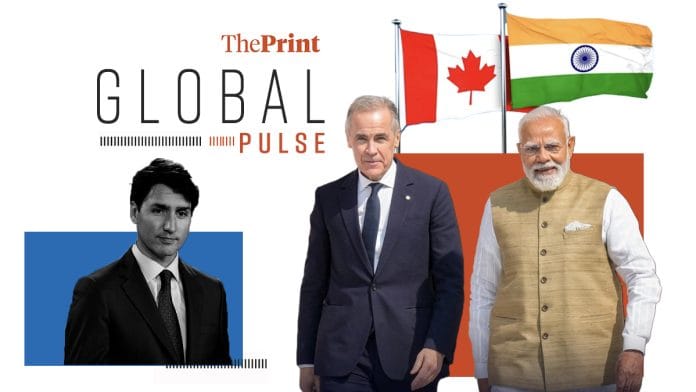



New Delhi: Canadian Prime Minister Mark Carney’s visit to India drew significant global media attention, especially in the backdrop of frosty ties between the two nations since 2023, when Carney’s predecessor Justin Trudeau accused New Delhi of “interfering” in Ottawa’s internal affairs and linked it with the assassination of Sikh terrorist Hardeep Singh Nijjar on Canadian soil.
Since Carney took office in March 2025, Canada’s agenda has been to restore strained relations with India. Cherylann Mollan and Nadine Yousif of the BBC report on the visit.
“India and Canada have announced a host of agreements, including a 10-year nuclear energy deal, after their prime ministers met in Delhi to reset ties that plummeted due to diplomatic tensions,” they write.
Speaking to reporters after the meeting with Carney at Hyderabad House in Delhi, Modi described the two countries as “natural partners in technology and innovation” and said they would enhance co-operation in AI, supercomputing and semiconductors, as well as jointly host a renewable energy summit.
According to the BBC report, last year, Canada’s spy agency listed India as one of the countries, along with Russia, China and Iran, “interfering” in Canada’s affairs.
And while Canada’s intelligence agency remains firm on its assessment, the country’s foreign minister, Anita Anand, saved the day on Monday by differing from the agency’s line during a press conference in Delhi.
“The words of the senior official are not words that I personally would use,” she said, defending Canada’s decision to reset ties with India.
However, Carney has yet to speak with Canadian mediapersons since his trip began. “Because his meeting with Indian Prime Minister Narendra Modi ran long and his flight to Australia couldn’t be delayed and well, there was no time,” Campbell Clark writes in The Globe and Mail, a Canadian English daily.
The author highlights that a shift is visible in Canada’s approach towards India, moving from uncomfortable diplomatic questions to trade deals.
“It’s reasonable for Mr. Carney to try to reset relations with India and launch trade talks. It’s a tumultuous world. And Mr. Carney didn’t say much about foreign interference when he visited the People’s Republic of China, either,” Clark writes.
But, he says that “a whack of accountability” is still due.
India is delighted to welcome Prime Minister Carney on his first visit to our nation. This is an important milestone in India-Canada relations. PM Carney's accomplishments, including those before he became Prime Minister, are very inspiring. I can say with confidence that from… pic.twitter.com/uYnBRcNrKP
— Narendra Modi (@narendramodi) March 2, 2026
After Trudeau’s accusations, the Indian government took offence and denied all allegations of interference. However, some people in Carney’s own party have remained suspicious and claim that they continue to be targeted by India.
Clark asks, “Has India really stopped all its foreign-interference activities?”
It is difficult for Carney to answer this on the diplomatic stage for two reasons, Clark writes. “(A) security services probably won’t guarantee all interference has stopped and (b) asserting that it has stopped suggests that it happened in the first place. And India insists it never happened.”
The Canadian daily also highlights why clarity on the question of foreign interference is especially important. “The allegations of transnational repression aren’t just spy-versus-spy stuff in a foreign land. They are concerns that affect the safety of Canadian citizens, and not just activists for a separate Sikh state of Khalistan to be carved out of India.”
Ian Austen of The New York Times accompanied Carney to India and reported on the visit from the ground.
“There was no mention of that charge or of the diplomatic rupture that ensued. Instead, the emphasis was on renewing the relationship, with a focus on business — including a resumption of uranium shipments to India,” writes Austen.
Following the killing of Nijjar, designated a terrorist by the Indian government, and Trudeau’s accusations, “both countries expelled diplomats and relations were largely frozen”.
“But after a meeting between Mr. Carney and Mr. Modi at the Group of 7 summit in Alberta last June, relations began to thaw as Canada looks for new markets beyond a suddenly unreliable United States,” Austen reports.
Carney’s strategic and diplomatic choices come in the aftermath of his Davos speech, NYT reports.
In his address to the World Economic Forum at Davos, Switzerland, in January, Carney had said that the “changes to the world order” required a “pragmatic approach”.
“We’re engaging broadly, strategically, with open eyes,” Carney said in Davos. “We actively take on the world as it is, not wait around for a world we wish to be,”
Kimberley Kao of the Wall Street Journal reports on the 1.9 billion US dollar Uranium supply agreement signed by the two countries during the visit. Canadian firm Cameco will supply uranium to India for nuclear energy from 2027 to 2035, the office of the Prime Minister of Canada said Monday, WSJ reports.
“A new Comprehensive Economic Partnership Agreement between the two countries will be concluded this year, which aims to double two-way trade to C$70 billion by 2030.”
HCL Technologies, India’s third-largest IT services company, will expand its operations in Canada, increasing its workforce by 75 percent by 2030, the report says.
According to the joint statement between India and Canada, as reported by the WSJ, Carney and his delegation met business leaders from multiple sectors, and agreements worth more than 5.5 billion Canadian dollars were signed during the visit, a move expected to generate thousands of jobs in Canada.
(Edited by Ajeet Tiwari)
Also Read: India, Canada agree to cooperate in fight against ‘terrorism, extremism’ as Modi, Carney reset ties
India blundered. Canadians cooled down on their allegations and accusations only because President Trump kicked them hard on their shins. But Trump will not remain the President forever – after three years, someone else will be in that chair. US-Canada relations will be reset and the Canadians will go back to being parasites – profiting disproportionately from the US under favourable and pretty much one-sided trade deals and also enjoying the protection of the US military umbrella for free. They will have no need for India or China and, therefore, show their true colours once again. They will pick up from where they have left off and again start supporting the Khalistani secessionists and glorify these terrorists as ‘activists’.