





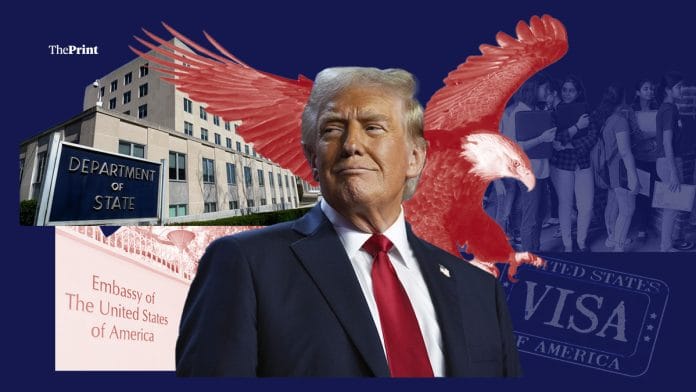



New Delhi: Priests, spouses, trainees, human trafficking victims and informants will now be subject to social media vetting as part of their visa applications as the United States tightens its border regulations.
The US Department of State, in a fresh notice released on 26 March, said that it will be expanding social media vetting to more non-immigrant visa categories. All applicants for the A-3, C-3 (if a domestic worker), G-5, H-3, H-4 dependents of H-3, K-1, K-2, K-3, Q, R-1, R-2, S, T, and U will now undergo social media screening.
The notice further instructed the applicants to adjust the “privacy settings” for their social media profiles to “public” or “open”.
Who all are affected
Social media vetting was first introduced in June 2025 to the H1-B applicants and their dependents. F, M, and J category students and exchange visitors were also included in the list.
The newest amendment, however, extends this to those who enter the US for specific purposes such as short-term work, training and special immigration programs.
Even lesser-known categories will be subjected to this scrutiny, such as A-3 visas, which are issued to cooks, chauffeurs and attendants of foreign diplomats, and C-3 for government officials and their staff transiting through the US.
These come under the non-immigrant applicants who are seeking temporary stays in the country.
Earlier, Indians entering the country to receive training under an H-3, trainee visa, were exempted from social media vetting. However, individuals getting trained by American companies in fields like business, agriculture and technology now have to show their social media.
The regulation also brings spouses under the radar. Whether seeking non-immigrant or immigrant visas under the K visa, spouses of a US citizen have to reveal their social media activities.
“The Department uses all available information in visa screening and vetting to identify visa applicants who are inadmissible to the United States, including those who pose a threat to US national security or public safety. We conduct thorough vetting of all visa applicants,” the notice read.
Q visa applicants — people travelling to the US as a part of cultural exchange programs, and R visa applicants, majorly priests, ministers and missionaries, too, are compelled to open their profiles.
The new regulations include S, T, and U visa granted to informants, human trafficking victims and assault survivors, respectively, to the vetting process.
What are authorities looking at on socials?
The notice further stated that this measure is taken to protect Americans and the country’s national interests: “Every visa adjudication is a national security decision.”
Authorities review applicants’ social media for signs of “hostile attitudes” towards the country, including antisemitic, racist or otherwise hateful language, as well as any links to groups designated by the US as terrorist organisations. They also assess whether there are inconsistencies between an applicant’s online presence and the information provided in their visa application.
“All applicants credibly establish their eligibility for the visa sought, including that they intend to engage in activities consistent with the terms for their admission. A US visa is a privilege, not a right”, the notice emphasised.
These are a niche category of visa, and most Indians travel to the US on H-1B, F-1, L-1, B-1/B-2 or family-based immigrant visas, not the newly added categories.
(Edited by Insha Jalil Waziri)