





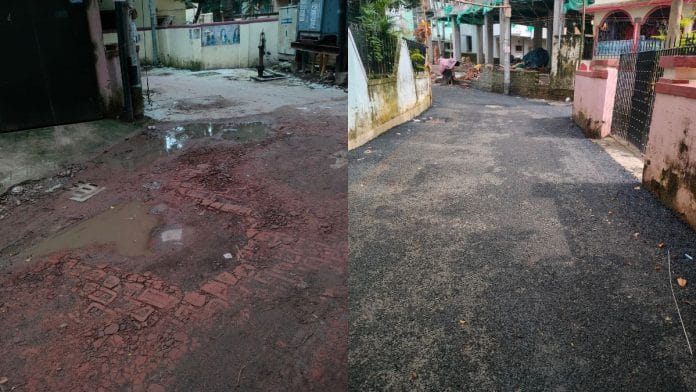



New Delhi: Aishwarya Roy’s heart skipped a beat when she saw an email from CPGRAMS, India’s 24×7 Grievance Portal in September, two weeks after she had mailed them about potholes in her Kolkata neighbourhood. As she read the notification, she could hear central government workers at her locality in Kolkata, fixing the roads. She simply couldn’t believe that a government portal actually worked.
For years, Roy, a Kolkata-based marketing manager, had been driving back home on bumpy roads. The potholes made two-wheelers wobble dangerously and caused searing lower back pain. She had earlier raised complaints with local officials and the municipality, but to no avail. The complaint that ignited action almost became a defining hour for an Indian citizen.
Roy shared her experience on Instagram, which truly captured the zeitgeist. Her post, ‘How I got the govt to fix our roads,’ has over 7,000 likes on Instagram. “Like the moral compass of the world, the road outside my house had been broken for YEARS,” her post read.
India’s infrastructure collapses have been a daily fixture in newspaper headlines and memes on X. So, a functional government portal leading to actual change on the roads surprised many—Roy’s small victory became aspirational.
The Centralised Public Grievance Redress and Monitoring System (CPGRAMS is the government’s online platform for citizens to lodge complaints. Launched across all ministries and departments in June 2007, it is currently active across all 36 States and Union Territories. The platform resolved over 70 lakh grievances between 2022 and 2024 alone, according to public reports from the Department of Administrative Reforms and Public Grievances (DARPG). Data on the number of complaints received and action taken is regularly published. In the monthly data for November 2025, the system recorded significant activity, with Central Ministries redressing 1,42,856 grievances and States/UTs disposing of an additional 70,598 cases, bringing the total number of actions taken for the month to 2,13,454.
Also read: Bengaluru to Palghar, potholes are a death trap. AI startups racing to solve it
A complaint taken seriously
In August, Roy saw the same monsoon template play out outside her house: Broken roads and potholes filled with dirty water up to the brim.
“Everyone has been talking about the infrastructure of this country, and rightfully so. We have a lot to say, but we don’t know how to make the politicians or officials feel responsible. We pay so much tax for having an efficient, workable life, and yet we have nowhere to go,” Roy told ThePrint.
She had been thinking about bringing about a change and researching the best way to lodge a formal complaint. She considered approaching the centre, since verbal complaints to state and municipal officials had gone unheard.
That’s when she came across CPGRAMS, launched in 2007. It provides citizens with a single, 24×7 portal for lodging grievances related to service delivery by all Central Ministries/Departments and State Governments/Union Territories. Complaints have to be resolved within 21 days.
“I had very little hope,” Roy said about lodging the complaint. “There was a banking solution, a tax solution, fixing highways… I could see all these options… but I was a little confused, how to find a road that is not a state highway but a small neighbourhood road, there was no option for it.”
She finally decided to lodge a complaint under the Ministry of Housing and Urban Affairs and the Housing and Urban Development Corporation.
“I thought I was looking for urban development. I wrote a huge letter detailing the poor condition of roads and how it affects communities here. Like children tripping, the elderly refusing to walk. I gave the address of my house and the adjacent roads, and mentioned that for two years, no action has happened. Then I added pictures,” Roy said.
Roy clicked close-up pictures of the road in front of her house. She recalled the confusion and surprise of passersby.
“I was pretty sure nothing would happen,” Roy said, even after she sent in the detailed complaint.
Two weeks later, Roy woke up to the sound of drills and bulldozers. At first, she was puzzled—mistaking the sound to emanate from a building under construction.
“I thought I was dreaming,” Roy said. When she went out, she saw that the construction sound was actually of road repair.
“I ran to my laptop and saw the portal, and saw that my complaint was under process. Next day, an officer in an ambassador with a red siren —still a regular thing in Kolkata—actually visited the spot and oversaw the work.”
Roy, her family, and the entire neighbourhood were puzzled and in shock for days—could a small complaint actually lead to change? The answer was a resounding yes, a reality they’re still trying to come to terms with.
(Edited by Theres Sudeep)
That’s great. I have a bigger issue to address after reading this : why is everyone so dependent on central government ? I mean this country literally functions because of the PMO and HMO. I am glad something else also works in the centre but there is a demand for municipal reforms and there is already murmurs about it but we need it.