





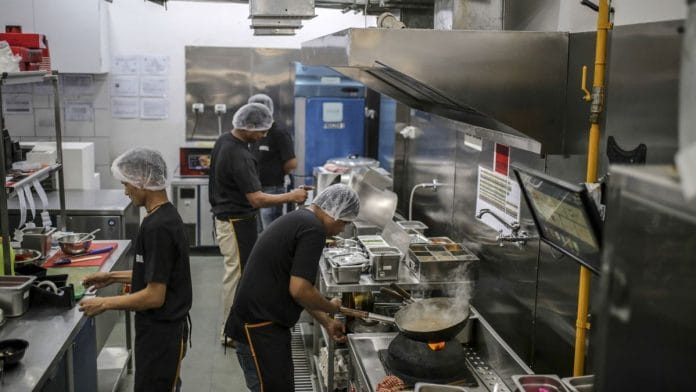



New Delhi: The Department of Food Safety in the national capital is set to begin an inspection drive on food vending establishments, including cloud kitchens and dark stores run by Swiggy, Zomato, Blinkit, and others, starting 1 April.
“We don’t want to create fear. But our priority is the health of Delhi residents. The objective of this drive is to have a ground impact. If any cloud kitchen or dark store is found to be flouting health norms, strict actions will be taken. Our department will seal them,” Food Safety Commissioner Jitendra Jain told ThePrint.
Jain, who took charge in October, said that the department had been busy managing food safety during the festive season, including Diwali, Navratri and Holi, along with routine checks. With that period now over, the department is ramping up sample collection and inspections.
In March alone, nearly 400 samples have been collected by the department’s officials. Every day, more than one establishment in Delhi is being penalised, with fines ranging from Rs 3 lakh to Rs 10 lakh. And, the focus is now shifting to cloud kitchens and dark stores, with approximately 2,194 such establishments operating in Delhi.
Over the past year, the Food Safety Department has received 46 complaints related to cloud kitchens. A majority of these complaints have come from the Kamla Nagar area. However, none of these were about hygiene issues. Most complaints were about concerns like inadequate food quantity, orders getting mixed up during delivery, and the same food being served repeatedly over multiple days.
“We work quietly and don’t publicise, because we don’t want to create fear among the public. Around 40 lakh people eat out. If we put out our findings, small and big both, it will create havoc in the national capital. Hence, we work behind the scenes to ensure the food served to the Delhi people isn’t unsafe,” he said.
Jain added that the department does not rush to take legal action.
“We believe in corrective measures rather than punishment. Unless there is a serious violation, we avoid criminal charges. If establishments fail to meet hygiene and safety standards, we impose financial penalties upto Rs 10 lakh,” he said.
Fear of regular inspections
Regular inspections have created a sense of caution among restaurants and hotels. The commissioner noted that over the past year, around 4,000 samples were collected across Delhi, of which only 6 per cent failed.
Of these failed samples, nearly 70 per cent were found to be substandard, 20 per cent were classified as unsafe, and 10 per cent were misbranded, meaning the product claims did not match the actual findings. For example, a product might claim to contain 200 calories but actually have only 120.
“On an average, the Food Safety Department is penalising one person a day, be it financial or criminal,” he said. “And the department has collected penalties of Rs 5.5 crore in a year (2025).”
Jain explained that not all violations are severe. In cases where the issue is minor, the department focuses on imposing a penalty and educating the business rather than taking strict action.
He cited an example where a well-known ice cream chain was pairing alkaline fruits with citrus fruits. While this is not unsafe or harmful, it does not align with food regulations.
“Our guidelines are very detailed,” he said. “So, we penalised them and explained why this combination isn’t correct. We can’t publicise every such case, as it could unnecessarily affect their business.”
However, he noted that stricter action is taken against kitchens that are not consumer-facing. In consumer-facing kitchens, consumers can raise concerns directly, but there is always a fear.
“But for kitchens that operate behind the scenes, there is zero tolerance, such units can be sealed without leniency,” he said.
At the same time, the department considers the human aspect.
“If someone is new, for instance, we give them a chance. We guide them, explain the rules, and help them understand how to operate properly,” he added.
Also read: A meat crisis is turning Kashmiris into vegetarians for now
Parameters for cloud kitchens
The Food Safety Department evaluates cloud kitchens and dark stores based on three key aspects. The first is registration. If an outlet is found operating without proper registration, it is initially issued a show-cause notice, and if non-compliance continues, the establishment is sealed.
The second aspect is misbranding, which includes three types of violations: when product claims do not match actual findings, when false health claims are made, and when food is presented as fresh despite not being so.
The third is hygiene-related violations, which are dealt with under two categories, adjudication and prosecution. Under adjudication, financial penalties ranging from Rs 5,000 to Rs 10 lakh are imposed, depending on the severity of the offence.
In more serious cases, prosecution is initiated. If someone falls seriously ill after consuming unsafe food, the offender can face up to three months of imprisonment. In cases where contaminated food leads to death, the punishment can extend up to seven years in jail, along with cancellation of the licence.
“When our officers collect samples, an identical sample is also handed over to the owner. If the sample fails in our testing, the food business operator has the right to get their sample tested at another lab and challenge our findings,” Jain said.
He added that the department’s testing process is highly reliable and precise.
“In cases where the department has initiated jail action, even the Supreme Court has not granted bail so far,” he said.
A former FSSAI officer, who retired in 2020, told ThePrint that the system has a significant regulatory gap regarding cloud kitchens.
“I don’t think anyone is maintaining a proper record of complaints against cloud kitchens or even a comprehensive list of how many are operating. Typically, a cloud kitchen is inspected only if a complaint is filed,” he said.
The retired officer added that cloud kitchens weren’t prevalent during his tenure. They began to grow rapidly only after the COVID-19 pandemic. According to him, there is no distinct regulatory category for cloud kitchens, and they can operate from almost anywhere, including unhygienic or unsanitary locations.
He said obtaining an FSSAI license is relatively easy and streamlined, with pre-inspections rarely required. Usually, inspections happen over time as the kitchen operates, and improvement notices are issued if violations are found.
When asked about the FSSAI’s role in monitoring cloud kitchens, the former officer said it’s “minimal.” Most of these kitchens fall under the jurisdiction of state-level authorities, like Delhi Food Safety.
“That too with the lower rank officers because cloud kitchens are not considered high-value or large-scale food businesses,” he said.
(Edited by Ratan Priya)