





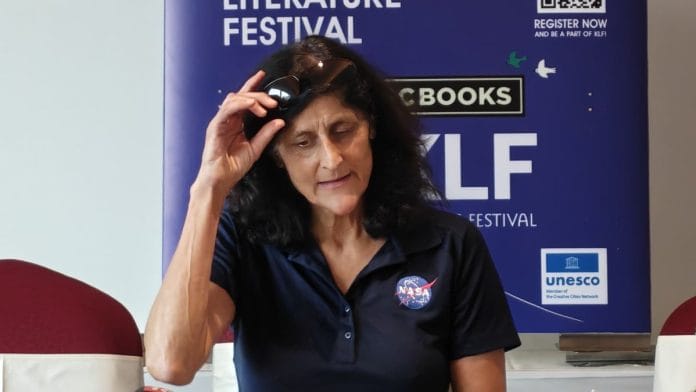



Kozhikode: Sunita Williams was one of two astronauts who were marooned on the International Space Station in June 2024. But she is not complaining about the experience. She feels lucky to have gotten extra time in space, the astronaut said during a press interaction ahead of her sessions at the Kerala Literature Festival in Kozhikode.
“You know, the part that everyone doesn’t understand is how much time we spend on the ground. I got extra time in space; I’m pretty lucky,” she said.
As she prepared to address four sessions at the ninth edition of the Kerala Literature Festival, Williams reminisced about the nine months she spent aboard the International Space Station (ISS) with fellow astronaut Butch Wilmore. The mission was initially supposed to be an eight-day test flight.
Initially, the astronaut duo tried to be patient after docking indicated that some work needed to be done before they could return to Earth. Williams tried to keep herself occupied through chores, including stocking food and maintaining bathrooms. Williams and Wilmore returned to Earth in March 2025 on SpaceX’s Dragon capsule.
During her time at the ISS, Williams did her best to help the seven-member team already aboard the space station.
“In the beginning, as well as the test points that we did, I tried to help the team. You know, make sure that when they get done with the experiments that they’re assigned to, they can come back and have a hot meal we’ve fixed it for them or done whatever we need to do to make it a team event,” she said.
However, as it became clear that the pair was going to be at the ISS for much longer, Williams wanted to do more. She filled in for two other astronauts who had trained for years to fly but had to give up their seats on the Dragon capsule so Williams and Wilmore could come back safely. Williams informally asked the astronauts and mission specialists who were assigned those experiments if she could observe and learn, and do the best she could.
“And that’s what our job is,” she said.
Also read: Space insurance is gaining traction among Indian startups. PSLV failure highlights the need
Excited about LEO commercialisation
Williams’ visit to Kerala comes a day after NASA announced her retirement after 27 years of service, including 608 days in space over three missions. The astronaut said she’d like to unwind and spend time with her family, without any major objectives other than talking about her story in space exploration.
However, she will miss space, space programmes, and the people she worked with.
“The view from space is incredible, of our planet and then out to the solar system. So not having that potential opportunity out there is, of course, a little heartbreaking. But you have to pass it on, and the next generation has to see that and do that and become famous. So I’m looking forward to them doing big things,” she said.
The Indian-origin astronaut, who has roots in Gujarat’s Mehsana, said she never expected to become an astronaut. But being a tester and understanding how to ask questions while developing new spacecraft went hand in hand with the job, she said.
“I was surprised. I think the biggest emotion would have been like, ‘Oh wow! Maybe it was a clerical error and they let me in.’ But when I got there, I felt like it was the right place, and just tried to do my best while I was there and was provided some really amazing opportunities to work on the [International] Space Station,” she added.
Williams is excited about the commercialisation of the low Earth orbit. She said the ISS laid the foundation and other projects can take it forward.
The ISS helped scientists understand how different processes work in microgravity, including 3D-printing heart cells and metal. According to Williams, private companies and research institutions can improve upon the work and use the findings on Earth.
“The space sector is wonderful, space business is awesome, but there are even more creative people who can come up with amazing ideas,” she said.
(Edited by Prasanna Bachchhav)