





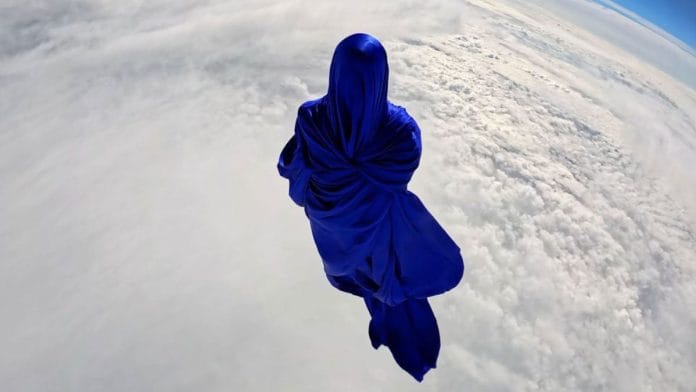



New Delhi: A sculpture wrapped in electric-blue silk, drifting against the blackness of space—it looks like CGI but is, in fact, the result of a collaboration between artists and engineers.
The project, Mission Taroni, sent a silk-draped sculpture to the edge of space, roughly 33 kilometres above Earth, high enough for the sky to turn pitch black and the planet’s curvature to come into view.
The effort was led by The Dorothy Project, a Montreal-based collective co-founded by artist and filmmaker Dorothy Leith, in collaboration with Taroni, the historic silk weaver from Como in Italy.
In a statement, the company said it partnered with The Dorothy Project “to be the first to send its silk fabric into the stratosphere,” testing how its ultra-light double satin behaves, where the direct rays of the sun illuminate it without the interference of atmospheric pollution.” The team added that the goal was to explore our relationship with the planet, inspired by the “overview effect” astronauts experience while looking back at Earth—marking the first time a haute couture fabric has reached such heights.
The team created an ultra-light human cast, designed a custom silk covering, and mounted it on a carbon fibre rig before launching it by balloon from the Canadian countryside into the stratosphere.
In September 2024, the sculpture was launched on a balloon flight that lasted approximately two and a half hours. During ascent, it stayed almost completely still, suspended beneath the balloon as it climbed into a thinner atmosphere. The dramatic movement began only after the balloon burst, when the system entered free fall, and the silk started to move.
The team said that the dynamic footage was captured during the descent, and the balloon and payload were later recovered. Nothing was left in space: the module, mannequin, cameras, and silk all returned to Earth, and the silk was reused in later works.
Watch the video here.
Also read: Is the American middle class really shrinking? What a 45-year study says
Not altered by AI
Weighing around 700 grams, the sculpture was light enough to be carried by a hydrogen balloon. It remained largely still during ascent, with the most striking visuals emerging after the balloon burst, sending the figure into free fall.
The sequence was captured using Insta360 cameras mounted on the structure, which withstood extreme temperature swings. The footage was slowed but not digitally altered—part of the team’s effort to preserve authenticity in an era increasingly shaped by AI.
It echoes the “overview effect”, the cognitive shift reported by astronauts when viewing Earth from space, where borders dissolve and the planet appears fragile and unified.