





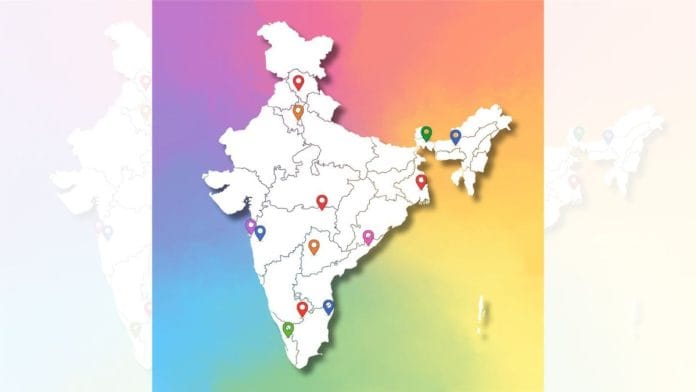



New Delhi: For queer people, accessing STI care remains riddled with shame, stigma, and institutional barriers. Even in urban centres, it’s not easy to find a queer-friendly sexual health clinic near you. When it comes to PrEP and PEP—medicines that are key to limiting the spread of HIV—the search becomes even more difficult. Now, a Delhi-based nonprofit, Safe Access, is changing that. It has curated India’s first directory of health centres that offer PrEP and PEP.
PrEP (pre-exposure prophylaxis), commonly taken as an oral pill once a day, can prevent HIV infection from sex or injection drug use. PEP (post-exposure prophylaxis) is a 28-day course of medicines taken after a possible exposure to prevent HIV infection. The average cost of PrEP is about Rs 700-1,200 per month, while that of PEP is Rs 3,000-4,500. NGOs offer the medicines at subsidised rates.
Getting quick access to PEP is especially important because the course must be started within 72 hours of a potential exposure to be effective.
“Often, when people approach Safe Access, they are in panic mode,” said Shubham Choudhary, founder of Safe Access. “They’ve perhaps engaged in sex with someone, which was unprotected. And now they are really worried about what will happen to them. So, there is a very short window to help them locate a service provider who can provide PEP.”
A person Choudhary knows was charged Rs 40,000 for PEP in 2017 by a “sexologist” in South Delhi. “Some health service providers know that the other person is vulnerable at that moment. And so they use that vulnerability and ask 10 times the actual amount,” he said.
The new online directory will help ensure that more queer people aren’t exploited, and could take away some of the stress of an otherwise overwhelming moment.
Launched in September, the online PrEP and PEP locator lists 21 queer and trans-friendly sexual health centres that offer the medicines. Some are run by community-based organisations, while others are for-profit clinics. A person can select the medication they’re looking for, and the list shows relevant centres and the probable cost.
The platform also has a review feature, so people can offer feedback based on their experience with a clinic.
Sumi, advocacy officer at a health clinic of Humsafar Trust, Mumbai, welcomed the platform.
“A directory will help people find clinics more easily. No matter what information we want, we first google it. So if people can easily find us online, they will be able to access these services, and it will eventually help us bring down the number of people who are HIV positive,” she said.
Also read: There is more to queer life than young couple falling in love, facing challenges, then uniting
Easy, affordable access
Founded in 2019, Safe Access works to enable equitable healthcare access for the LGBTQ+ community. The Delhi-based organisation went digital during Covid-19 and has remained so since.
When Choudhary’s team posted an article about PrEP and PEP on the Safe Access website in 2024, they didn’t expect the number of responses they would receive. People wanted to know where they could get the medicines and which were the closest, most affordable options for them. That’s where the idea for the PrEP/PEP locator was born.
Over a year later, the online directory lists health centres from all major Indian cities. And people who can’t travel to these urban centres have the option of contacting an online service provider who can ship them the medicine.
“In the directory, we have also listed whether health centres offer medicine at the sliding scale. There are certain not-for-profit clinics that offer a ‘pay whatever you can’ model, and some heavily subsidise the cost. So we want to actually make PrEP and PEP accessible by giving people a tool to find a provider that works for them,” Choudhary said.
The platform is relatively new, and there are still some issues that need streamlining. When ThePrint attempted to contact health centres listed on the directory, more than one had outdated or nonfunctional contact numbers. Choudhary was surprised to learn this.
“We kept a six-month time frame to go back, call everyone, and check, because we want to be on top of things. But looks like we have to get started right away,” he said.
Bhavapriya, programme officer at Safe Access, is already on it.
“Currently, I handle maintenance, which involves making sure that more and more organisations are willing to come on board, and also that the existing information is up to date,” she said.
(Edited by Theres Sudeep)