





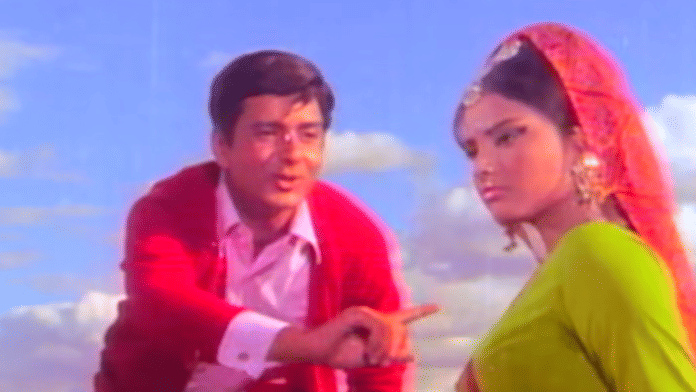



A young foreign-returned heir and his driver are attacked by robbers. While they are slowly losing the fight against the gang, a village belle and her entourage step in and save the young man. This marked the spunky debut of Rekha in Hindi cinema with Mohan Segal’s 1970 film Sawan Bhadon.
Rekha plays the village belle Chanda, who never backs down in the face of a fight. Sawan Bhadon also marked the debut of Navin Nischol, who plays the foreign-returned Vikram. Ranjeet plays Chanda’s brother Damu.
Vikram’s stepmother, Sulochana (Shyama), and stepsister, Dolly (Jayshree T), have been fleecing the family wealth for their extravagant life, while he has been working in Europe. When he returns, Vikram discovers that his stepmother has fraudulently grabbed the lands of the villagers and has been levying high taxes for working on them. Vikram’s actions of trying to return the land to the rightful owners, falling for Chanda and trying to stop Dolly from marrying a crook Madan (Narendranath) anger Sulochana, who soon schemes to kill him.
The ideal woman
Sawan Bhadon uses elements of the feudal system to show the class tension between Damu and Vikram’s family. But director Mohan Sehgal does not explore it beyond how Chanda is seen as a “cunning” woman who is trying to ensnare Vikram with her looks.
The film is also regressive in its depiction of women. While Sulochana and Dolly are shown as villains, most of their initial villainy is shown to be because of their lifestyle. When Dolly throws an extravagant party to celebrate the return of Vikram, he chastises her and lectures her on morality, with the familiar phrase “girls from respectable homes do not dance in parties”.
He even tries to emotionally blackmail her by mentioning how their father hated parties and women wearing Western clothes. While Dolly refuses to listen, Vikram continues to assert his authority over her lifestyle, in the guise of being a “well-meaning” guardian.
He also falls for the desi Chanda, who is spunky but also more traditional in her attire and outlook. A textbook depiction of how women in Western clothes are vamps and those in Indian clothes are the ideal woman.
Also Read: Indo-Soviet film Ali Baba Aur 40 Chor wasn’t a diplomatic feat but a commercial success
Why it deserves a rewatch
In their debut film, both Nischol and Rekha have commanding screen presences. Nischol aces the role of the polished young man who has just returned from lands far away, but has also not forgotten his roots. This is a role that will also evolve over the years in Hindi cinema and have standout performances such as that of Shah Rukh Khan in Dilwale Dulhania Le Jayenge (1995).
Nischol’s smile and his wardrobe — a collection of suits and cashmere sweaters — help one fall for his charm. A gold medallist from the Film and Television Institute of India, Nischol was the perfect package with good looks and talent.
He even dances to ‘Aankhiyan Na Maar Mundiya‘, dressed in the traditional attire of a Kathak dancer, and manages to exude grace, while trying to show Dolly how Madan is a crook.
He is complemented by Rekha, who plays the fiery female lead with absolute ease. Rekha by then had already started acting in Telugu and Kannada films was a natural. She is easily able to manoeuvre the shift in her demeanour from playing practical jokes on Vikram to being coy while romancing him in songs like ‘Mera Maan Ghabraye’.
In ‘Ik Dard Utha’, she plays the seductress of sorts, with the suggestive lyrics describing the feeling of engaging in intimacy with her lover. But in the film, the actor who stands out for dancing is Jayshree T, who performs the cabaret number ‘Aaankhein Meri Maikhana’ and also the more classical song ‘Hai Nazar Baaz Saiyan’.
The songs of Somik-Omi add to the plot of the film, which goes through quite a few twists and turns.
It is, however, the villains who make the film more enjoyable, especially Shyama, who plays the role of the scheming stepmother with aplomb, shifting from the aarti-thali (puja tray) holding woman to a cold-blooded conspirator. Ranjeet’s role is more of the disillusioned villager who turns to plotting and gambling due to unemployment. The role shows the range of the actor, who would get typecast as an unscrupulous, evil villain in his later movies.
The film, which was also a commercial success, gave Bollywood three distinct performers, and for that reason alone, it deserves a rewatch.
(Edited by Insha Jalil Waziri)