





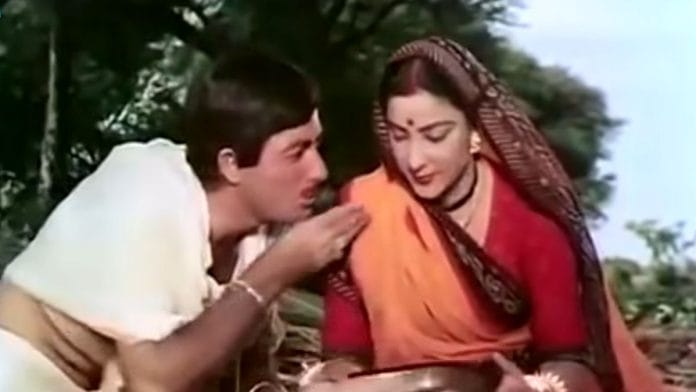



As Neeraj Ghaywan’s Homebound exited the Oscars 2026 race, it also reopened an older cinematic memory. Long before India began counting Oscar misses, Mehboob Khan’s Mother India had already made history by becoming the country’s first Academy Award nominee in the Best Foreign Language Film category in 1958, with actor Nargis’ Radha at its moral and emotional core.
Mother India was a cinematic milestone for Hindi cinema. At its heart stands Nargis, whose portrayal of Radha moved past performance. She, somewhere in the narrative, embodied the character. So, nearly seven decades later, if Mother India is remembered today, it is because of her.
Radha was a living representation of resilience, virtue, and sacrifice. She is introduced in the film as a young bride, and what follows is decades of struggle. She transitions from an optimistic newlywed into a tired and tested mother.
Her character arc is defined by extreme poverty, abandonment by her disabled husband Shamu (played by Raaj Kumar), and the responsibility of raising her children alone while fighting a corrupt moneylender.
Mother India gets its drama quotient from the good son-bad son trope. Radha’s sons, Birju (Sunil Dutt) and Ramu (Rajendra Kumar) grow up amid poverty and injustice. Ramu accepts hardship, works honestly, and follows his mother’s moral code. Birju rebels and becomes violent and lawless.
The film’s most heartbreaking moment, which has over the years been debated and analysed extensively, is when Radha shoots her own son, Birju.
Her face in that moment, torn between motherly love and morality, captures the tension of Mother India. It captures the cost of righteousness in an unjust world.
Nargis’ acting chops need no proof. Her performance in Mother India is often described as iconic and is compared to that of Meena Kumari as Chhoti Bahu in Sahib Bibi Aur Ghulam (1962), Madhubala as Anarkali in Mughal-e-Azam (1960), and Nutan as Kalyani in Bandini (1963). Whether it is her posture bending under labour, her gaze in moments of confrontation, or the quiet grief that is communicated through her expressions, Nargis exposes Radha’s inner world without melodrama.
At the time, Hindi cinema often leaned heavily on melodrama and theatrics.
Her restrained and rooted performance became a tutorial for generations of actors to come.
First Oscar nomination
Internationally, Mother India marked a watershed moment.
At a time when few non-Western films broke into the international awards circuit, the Oscar nomination for Mother India mattered a lot. It stood out for its clarity, emotional universality, and thematic ambition.
The nomination also highlighted how deeply local stories can resonate globally when told with honesty and conviction.
Though the film ultimately lost to Federico Fellini’s Le Notti di Cabiria, the nomination paved the way for future Indian entries and brought Indian cinema into the global conversation.
But, above all, it told Indian filmmakers that stories rooted in rural India also have the potential to carry universal meaning.
Also read: Before Sholay, there was Mera Gaon Mera Desh. Its Gabbar was more ruthless
Impact on national consciousness
Beyond Nargis’ performance, Mother India had a profound impact on Indian cinema and national consciousness.
Released just ten years after Independence, the film projected an image of India that was resilient, stoic, and ethically upright, offering the world a vision of a young nation defined by suffering borne with dignity.
Not many know but Mother India was also a direct cinematic rebuttal to Katherine Mayo’s 1927 book of the same name, which looked down upon Indian culture and women.
It focused on backwardness, child marriage, and caste issues, among other things. Through her narrative in the book, Mayo justified the need for British rule in India.
Nargis had not even turned 30 when she took on the role of Radha, a mother of two grown men. She was bold enough to step into a role that few leading actresses of her time would have risked. In Mother India, Sunil Dutt, her on-screen son, was the same age as her, and Rajendra Kumar, also playing her son, was actually a couple years older than her. This casting choice pushed her decisively out of the conventional heroine bracket. At a time when female stardom was tightly bound to youth and romantic desirability, Nargis chose to age on screen, to inhabit labour, loss, and moral authority rather than glamour.
Radha’s strength is carefully framed within a Nehruvian ideal — disciplined, restrained, and deeply internalised. Her virtue lies not in resistance but endurance; she absorbs injustice rather than overturning it. Male rebellion, embodied by Birju, is punished as dangerous and destabilising, while female sacrifice is sanctified as moral necessity.
Radha’s life in an agrarian setting, the cycles of drought and harvest, and the struggle against predatory moneylenders reflected the lived realities of rural India.
Mehboob Khan’s direction is phenomenal. The film is visually expansive, almost epic, but still Khan managed to make it emotionally intimate. There are shots of fields and floods along with close-ups that capture private anguish.
His direction transformed a rural family’s personal tragedy into a national narrative, using cinema as a tool.
Today, revisiting Mother India can be an emotionally demanding experience. To some, it might even feel dated. But the film’s emotional core remains unshaken, and a huge credit goes to Nargis.
(Edited by Aamaan Alam Khan)
Hope ‘Mother India part 2’ celebrates free-market capitalism, prosperity, development, world-class police and judicial services, etc., along with death to socialism.