








Bollywood has paid homage to William Shakespeare over the decades, be it in 1935 with Khoon Ka Khoon, Angoor in 1982, or Vishal Bhardwaj’s films like Maqbool, Omkara, and Haider in contemporary times. But often, movies in the earlier decades were blended with the ‘masala’ Bollywood elements, creating entertainers like the 1973 film Manchali. The film, based on a novel by Satyendra Sharat, also borrows elements from Taming of the Shrew, a play written by Shakespeare in the 1500s.
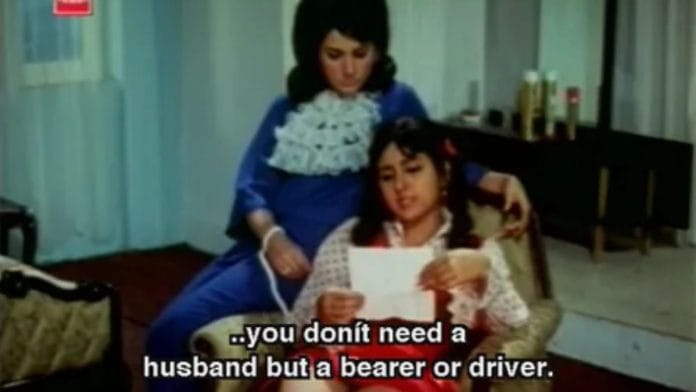
Directed by Raja Nawathe, Manchali is about a rich, spoilt girl, Leena (played by Leena Chandavarkar) whose inheritance is taken care of by her uncle and aunt. The only condition under which Leena will receive access to the money is if she gets married. While her uncle and aunt look for a groom of their choice, Leena decides to run her own scam—get a husband for hire.
Leena’s plan is simple—get a husband whom she marries for as long as it takes to get her inheritance and then divorce him. But in true Bollywood fashion, her best laid plans go awry, and she ends up with a street-smart man, Sushil Kumar (Sanjeev Kumar), who offers to be her pretend husband.
Kumar’s charms win over Leena’s family and friends; a mandatory lovers’ fallout follows and a dramatic climax eventually leads to a happy ending. Manchali did not complicate matters—it’s a feel-good romance with just the right amount of intrigue.
Flirting and fighting
The early 70s was the era of Sanjeev Kumar. Beginning with his National Award-winning performance in Khilona (1970), he went on to do more serious films like Koshish (1972) and Aandhi (1975). However, in between, he acted in the box office hits Seeta Aur Geeta (1972) and Manchali (1973), which demonstrated that he could also play the quintessential, charming hero with ease.
Kumar’s breezy performance holds the film together as much as Leena’s spoiled-girl-with-good-heart act. With an impish grin, Kumar as Sushil not only manages to impress the hard-to-please Leena but her friends as well. As the street-smart man, Kumar blends mischief, disarming charm and humour to slowly ease into Leena’s circle of friends, so much so that Leena gets jealous.
Chandavarkar keeps up with Kumar in every scene, and when the two flirt or fight, one is invested in the outcome of their love story. She manages to balance the act between being snooty and a girl just trying not to give in to the pressures of arranged marriage. Her desire to get her inheritance at any cost is also indicative of the way property laws in India have never aligned with the ambitions and desires of modern women.
While the film eventually veers toward a conventional take on ‘love over money’ and the importance of love, for a brief instance, it lets its female lead dream beyond the proscribed ways of the world.
Nazima plays Leena’s friend Pushpa, who is her biggest supporter in all the hare-brained schemes, but will also look out for her friend. Manchali also established Nazima as one of the popular supporting actors of the time.
Also read: Raaj Kumar & Meena Kumari’s chemistry saves ‘Kaajal’
Kishore Kumar’s fourth marriage
The film’s romance is buoyed by its music. The music of the film was composed by Laxmikant-Pyarelal. One of the biggest hits was ‘O Manchali Kahan Chali’, a peppy number by Kishore Kumar, where Sushil tries to woo Leena.
‘Gham ka Fasana’, again by Kumar, has a few words spoken by Chandavarkar. It is a romantic number played when the newly married couple flirt with each other. The song would foreshadow Chandavarkar’s personal life later, as she eventually married Kishore Kumar.
A widow, Chandavarkar, was initially not keen on Kishore Kumar, who was 21 years older than her. But eventually, love blossomed, despite stiff resistance from her father. The singer and actor had already married thrice before and Chandavarkar’s father was not convinced if he was a fit groom for her daughter. However, just like in Manchali, he would later welcome the singer as his son-in-law.
Chandavarkar appeared only in two films later, Sarfarosh (1985) and Mamta ki Chhaon Mein (1989).
But Manchali remains a glowing testimony to the actor’s talent and her short but illustrious career, which lasted just over a decade.
(Edited by Ratan Priya)