





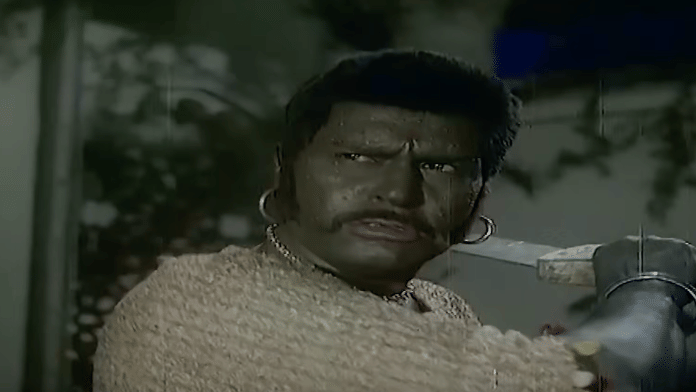



Rajendra Kumar’s 1972 hit film Gora Aur Kala is a prime example of Bollywood’s problematic relationship with blackface and brownface. The film lacks both nuance and subtlety in its tone-deaf depiction of two brothers.
A pair of Siamese twins is born to a Maharajah (Dev Kumar) and his queen (Sulochana Latkar). Doctor Randhir (Rajan Haksar) warns the royal parents that the twins, in all probability, will not survive the surgery. Meanwhile, the king’s friend Raja Zohrawar Singh, played by veteran actor Madan Puri, plots to kill him and his heirs.
The surgery is successful, but one twin, Kali, has a darker skin colour because of a blood disorder and a paralysed arm from the surgery. But before the parents can heave a sigh of relief, Zohrawar’s men attack, and there is a race to save the heirs. They get separated, with the king’s right-hand man saving the fairer one, Karan; whereas Kali is taken in by a band of dacoits.
The remainder of the two hours and 8 minute long film is spent chronicling the twins life, their eventual reconnection and take over of their father’s kingdom.
Racism runs deep
For a film that tries to show that “beauty is skin deep”, director Naresh Kumar and the scriptwriters seem wholly oblivious to its problematic depictions. Kali, who has grown up to be a Robin Hood-style dacoit, attacks the convoy of Rajkumari Anuradha (Hema Malini) and takes her back to his home with the intention to rape her.
The film essentially sends the message that a lighter skin tone equals noble and good, as represented by Karan, the swashbuckling do-gooder guy; and dark skin means a person will be cruel, and even eat in a manner that evokes disgust. Kumar effectively portrays the difference in characters, contrasting Kali’s savage nature with Karan’s polished charm. But therein lies the issue of colourism. Colourism has been rampant through the decades in Hindi films, with villains and goons often depicted with a darker skin colour compared to the hero.
Bollywood is no stranger to colourism. As recent as the 2019 films, Bala and Super 30, featuring AI-listers Bhumi Pednekar and Hrithik Roshan, respectively, have featured brown-faced characters. In fact, the trailer for Dhadak 2 (2025) reportedly sparked a controversy about the lead actor Siddhant Chaturvedi’s darker-than-usual appearance as a Dalit character.
And then, of course, we have the infamous song “Hum kale hai toh kya hua” by Mohammed Rafi that tries but still falls in the pit of problematic depictions.
Even the dialogues in the 1972 film are cringeworthy.
When the village belle Phulwa (Rekha) tries to flirt with Kali, he tells her, “My hands are made to remove jewellery, not make someone wear it.”
In a sea of stereotypes, Phulwa is a breath of fresh air. She expresses her sexuality without shame and even tries to seduce Kali in the song “Ek toh mera mastana shabab”. In one scene, when an angry Kali tries to beat her, she tells him, “Beat me more, I swear I am enjoying it”, to the pure shock of the dacoit.
Throughout her career, Rekha was considered “dark” for a heroine, and that creates the inherent issue of how she is cast. Between Phulwa and Anuradha, there is a clear distinction where the former is shown to be “forward” and the princess being coy and traditional. If not colourism, there is a clear demarcation of class between the female characters.
Also Read: Asha Parekh set the tone for 1970s glamour in Aan Milo Sajna
Too little too late
The film’s soundtrack may not be the best work of composer duo Laximkant Pyarelal, but its song “Dheere dheere bol, koi sun na le” remains evergreen. Sung by Lata Mangeshkar and Mukesh, the song and its remixed version became a trending audio on social media recently, with several reels featuring the hit.
The film ends on the typical “all is well that ends well” note — the romances are sealed, the throne secured and the villain punished, but it leaves a bad aftertaste.
Until the last-minute message that “fair and dark are equal” is way too late and flimsy to make up for the underlying racism and colourism rampant throughout the movie. While the long-lost twins trope has been in popular Bollywood, the film took it one step further to create the dark and fair dichotomy.
Even the fact that the plot adds a mental health issue to Kali’s character does not help the cause at all. If anything, it further demonises the character and the associations Indians have with darker skin colour. But since Gora Aur Kala was a big hit, it shows that the makers were just catering to the market.
(Edited by Insha Jalil Waziri)