





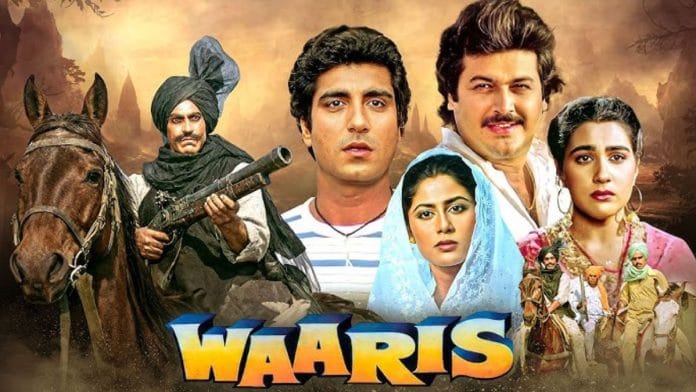



The Raj Babbar-Smita Patil starrer 1988 film Waaris is a story of inheritance, identity, and familial conflict. A familiar plot used in many Bollywood films. What elevates the film is how deeply it is rooted in its cultural milieu of rural India.
Rural Punjab isn’t just a backdrop here. The film breathes through its fields, its customs, and its social hierarchies. Waaris captured a realistic side of Punjab villages, contrary to the glossy, almost postcard-like portrayals that Bollywood later popularised.
The film lingers on textures, mustard fields, mud homes, livestock, and community gatherings, without romanticising them excessively.
In Waaris, greed triggers a violent land dispute between two brothers, Dulla (Amrish Puri) and Gajjan (Kulbhushan Kharbanda). Their father writes a will that favors Gajjan’s bloodline, and that doesn’t sit well with Dulla, who not only murders his father but also hires a goon to murder Gajjan’s son, Shravan (played by Raj Kiran). After which, Shravan’s newlywed wife Paro (played by Patil) navigates a vengeful plot to protect her husband’s land, heir, and honor.
Director Ravindra Peepat, who adapted the film from a novel by Sohan Singh Hans, portrays the village’s social fabric with nuance. Patriarchy is embedded in everyday interactions. First glimpse is shown at the beginning when Ramesh Tiwari’s Thekedaar tries to force himself on Paramjit or Paro, played by Patil. And, her rejection doesn’t sit well with him.
Power structures are clear. Honour, lineage, and reputation dictate choices.
Cultural relevance of Waaris
To understand the significance of Waaris, it is very important to place it within the socio-political and cinematic landscape of 1988. This was a time when Hindi cinema was dabbling between two worlds, mainstream commercial films and parallel cinema that brought realism and social commentary.
Waaris sits interestingly between these spaces. It carries the emotional weight and cultural depth of parallel cinema, while also featuring a character like Shibo (played by Amrita Singh), whose bizarre fashion choices lighten the mood.
Shibo reflects the era’s preoccupation with the tradition versus modernity debate. She wears skirts and jeans in the village. As India stood on the brink of economic and social change, Waaris captures a world that is both resistant to and inevitably shaped by these shifts.
In the late 1980s, Punjab itself was undergoing a turbulent phase. There was political unrest and identity struggles due to the Khalistani movement.
While Waaris does not directly address these issues, its focus on land, identity, and community resonates strongly with the larger context of the time.
Peepat’s storytelling is unhurried and can feel slow by contemporary standards, but it serves a purpose. The pacing mirrors the life in a village. Scenes are often built around interactions rather than events, and conflicts emerge organically. And, this approach makes the emotional beats more impactful, even if they arrive quietly.
When Waaris was released in 1988, Smita Patil had already cemented her legacy as one of Indian cinema’s most powerful performers. This film adds another layer to that legacy. But Peepat neither idealises nor victimises the female protagonist in the film.
The beauty of Patil’s character is how aptly she represents the contradictions of rural womanhood. In them, strength coexists with vulnerability, submission that masks defiance.
Along with Patil, the one actor who shoulders the film’s narrative is her real-life husband Raj Babbar, who is cast opposite Amrita Singh. He plays Bhinder in the film.
Babbar’s performance reflects the internal conflict of a man caught between tradition and change. In many ways, his character embodies the central tension of Waaris: the pull of legacy versus the need for evolution.
And, fortunately, he avoids the trap of turning masculinity into a monolith. Instead, it shows its fragility.
His interactions with Patil’s character are particularly compelling. There’s an unspoken dialogue between them that speaks volumes about gender dynamics, power, and the limitations imposed by their environment.
Also read: Jab Jab Phool Khile cemented Shashi Kapoor as a star. Nanda played a rebellious, flawed heiress
Legacy and relevance today
Looking back, Waaris feels like a film that belongs to a different cinematic sensibility. In today’s world, where rural settings are often glossed over or reduced to tropes, its grounded portrayal stands out even more.
The questions it raises, about the inheritance of not just property but values, about the cost of tradition, and about the space for individual agency, are still being grappled with in contemporary society.
Waaris may not be the most widely remembered film of its decade, but it is undoubtedly one of its more culturally resonant ones.
(Edited by Ratan Priya)
Title says 1998 film, Ms Patil died in 1988.