





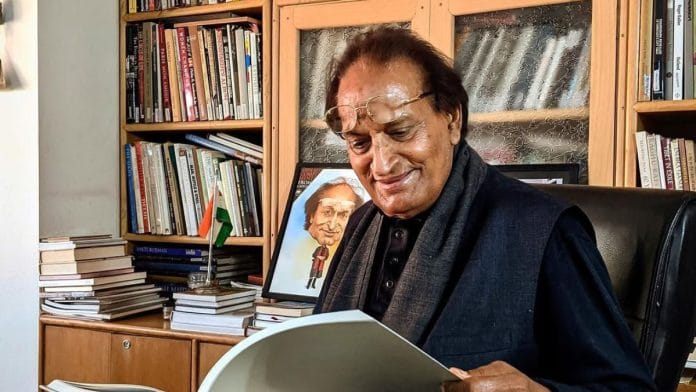


New Delhi: A young Raghu Rai was in a village in Haryana, where he saw a donkey. He found it funny, clicked a photo, and soon after, found it published in The Times. It was the beginning of his lifelong pursuit—not of photos but of the “heartbeat” within them.
Widely regarded as the most influential photographer of modern Indian history, Rai passed away Sunday at the age of 83. He had been diagnosed with prostate cancer two years ago, which recently spread to his brain. His last rites will be performed at Lodhi Crematorium at 4 pm on Sunday.
Rai’s journey as a photographer spanned more than six decades, during which he closely documented the lives of the Dalai Lama, Mother Teresa, and former Prime Minister Indira Gandhi. He believed each photograph had to be different—an act of discovery, and an attempt to create “something new”. In his practice, he made himself fully available to the moment—physically, mentally and spiritually—allowing life to unfold before his lens.
“Your photograph must carry your energy—only then does it become yours,” said Rai in an interview with Saeed Naqvi in November 2022.
Becoming Raghu Rai
Rai’s evolution as a photojournalist unfolded in parallel with India’s political upheavals. From the Bangladesh Liberation War to the rise of Indira Gandhi, Rai was documenting history even as he was building his own career. His images grew in depth and urgency alongside the nation’s defining moments.
In his interview with Conde Nast Traveller in 2024, Rai candidly spoke about the first gig he got with his brother, Sharampal Chowdhury aka S Paul, a veteran often regarded as photographer’s photographer. In 1965, Paul took him along on his assignment in a small village near Rohtak, Haryana. He lent him a small camera, an AGFA Super Silette.
During the assignment, as Rai went looking for his brother, clicking photos of the village kids who followed him around, he saw an old woman using sugarcane as a walking stick. It gave him an idea.
“So I told these kids, I will also take your pictures if you stand next to this lady. They made two lines around her, right before I clicked the photo,” he told the magazine. The photo remained a striking memory.
Rai was born in 1942 in Jhang, a small village in present-day Pakistan. He was familiar with village life. So when he clicked a photo of a donkey looking “very cute”, it was admired by Paul, who got it printed in The Times. That was the moment Rai realised that the world of photography was fascinating.
Starting his career in the early 1960s, Rai joined The Statesman in 1966. During his time at the newspaper, he was introduced to Mother Teresa. In 1970, he clicked one of her first photos, which pictured her walking down a staircase in a white saree. It was the starting point of Rai’s lifelong association with her, which had a profound influence on him.
“She did not just look at you—she held your hands and looked into your soul. In that moment, something inside you would awaken,” Rai told Naqvi.
A year later, as the Bangladesh Liberation War unfolded, thousands of refugees were crossing the border to reach India. In Kolkata, the refugees had to fend for themselves, living inside empty sewage pipes, makeshift tents, or out in the open. Rai’s photos of the plight of refugees became the testament of the times. They were published in the New York Times, Sunday Times, and Guardian. He was interviewed by TV channels. The world saw the tragedy through his eyes.
Rai covered politics, human interest stories, and more. He was one of the few photographers who clicked Indira Gandhi from close proximity. Her last portraits before the assassination were taken by Rai.
“I was photographing Indira Gandhi almost every other day from 1967 onwards when she became the prime minister. Indira Gandhi was at the peak of her career and in a certain way her growth coincided with my own,” Rai wrote in his book, Picturing Time.
Rai’s work had become globally known. He left the newspaper in 1976 and joined India Today four years later. He also met the father of candid photography, Henri Cartier-Bresson, who deeply admired his work. On his offer, he joined the Magnum Photos collective in 1977.
Rai photographed the Dalai Lama in 1975 in Ladakh, finding him “gentle, wonderful and at ease”. The images capture the spiritual leader at work, stretching, seated facing mountainscapes, and smiling quizzically.
In 1984, Rai’s photo, ‘Burial of an Unknown Child’, captured the horrors of the Bhopal Gas Tragedy. He was covering it on behalf of Greenpeace. Nearly two decades later, Rai returned to Bhopal to photograph the survivors, revisiting a story that had never truly ended.
Rai has produced over 18 books in his lifetime.
Also read: History can be written & rewritten. Photos can’t be taken again – Raghu Rai
Digital rebirth
Rai never followed the set patterns of photography. “A photograph must carry a pulse,” was his mantra.
Rai worked with grainy, textured cameras, which added a living quality to his photos. But when he started using digital, he felt “reborn”.
“The control, the immediacy—it is like a painter seeing every stroke as it happens,” said Rai in an interview.
Instead of relying wholly on cameras, Rai trusted his eyes with framing. Later, he moved toward panoramic formats. Differing from the Western idea of India, he captured a country where many moments unfold at once.
Rai’s legacy has been taken forward by his daughter Avani Rai, who is also a filmmaker. She opened the Raghu Rai Foundation in 2010, which has over 50,000 photos taken by Rai.
The legendary photographer never left his house without his camera. In one of his interviews last year, Rai offered advice to emerging photographers: Don’t shoot endlessly. He urged young photographers to attach meaning to their frames and not chase Instagram followers.
(Edited by Prasanna Bachchhav)