





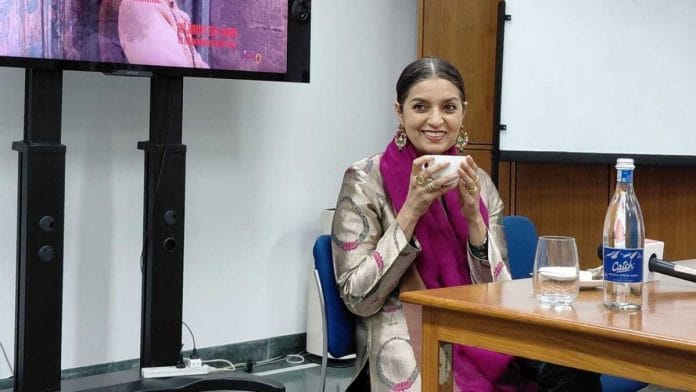



New Delhi: In author Jhumpa Lahiri’s world, migration does not begin at the airport and does not end at citizenship. It begins much earlier in the body, in language, and in the knowledge of being legible in one place and tentative in another.
Speaking about the many immigration issues today at a press conference at the Italian Embassy Cultural Centre in Delhi, Lahiri, 58, placed that private unease inside a sharply altered public world, one where movement, language, and belonging are being reorganised by fear and politics.
While “connectivity and communication is better now”, she said the world feels darker, more hostile to migrants and minorities, and disturbingly familiar in its rhetoric and exclusions. In this climate, language itself has become a frontline: a tool of power, a marker of loyalty, and often the first place where belonging begins to fracture.
“This is a concerning moment globally. It feels like the shadows of 1930s Europe. It is very scary,” she said.
For Lahiri, whose life and writing have been shaped by migration between continents and languages, the immigrant condition is now inseparable from a deeply divided political world — one where who belongs, who speaks which language, and who gets to feel safe have become increasingly contested questions.
“Part of the immigrant community was my main reality. I was, politely or not so politely, welcomed and not welcomed, accepted and not accepted,” she said, describing how migration shaped her earliest sense of self, growing up in the US.
Speaking about the United States, where she lived and worked for decades, Lahiri said the country itself has undergone unsettling political shifts.
“Different iterations of the US for me are alarming, terrible, frightening, and going backward,” she said.
The anxiety, she added, is not limited to one geography.
‘Language is foreign’
For Lahiri, immigration cannot be separated from language — from who controls it and who is excluded by it.
“The danger of certain powerful languages is that they threaten minor languages and even what language gets to be taught,” she said.
She described the global spread of English as overwhelming and politically consequential.
“There is an English tsunami across the world,” she said.
Lahiri warned that when language is absorbed into nationalist projects, it begins to work as a gatekeeping device rather than a bridge.
“Language as a nationalistic project is dangerous. We must actively resist it, this intertwining of language and the nation-state,” she said.
She added that the erosion of linguistic diversity is not a cultural problem alone.
“Diminishing linguistics is dangerous,” she said.
Yet the Pulitzer-winning author framed learning and inhabiting multiple languages as a form of quiet resistance in an increasingly monolingual world.
“Anyone who wishes to can learn another language. It is a radical boundary to cross. It resists the monolingual centre of gravity,” she said.
Moving across languages, she said, always carries emotional and political weight.
“Switching languages, like I’m a foreigner coming into your language, strikes a chord,” she said.
But for Lahiri, the most difficult part of multilingual life is living with the feeling that no language entirely belongs to you.
“For me, language is foreign. I don’t have a language. Everything I feel is fully felt outside of all languages,” she said.
At the same time, she insisted, language can never offer perfect shelter.
“All languages are imperfect,” she said.
Reflecting on her own linguistic inheritance, Lahiri spoke of a deep emotional closeness to Bengali.
“My relationship with Bengali was especially imperfect. I was exposed to the language familially. It was my parents’ language, not mine,” she said, adding she doesn’t really have a mother tongue.
English, she added, arrived differently in her life tied to family, migration and pressure.
“I was nervous about English — the other language — and also speaking my parents’ language (Bengali) around my friends,” she said.
For a long time, Lahiri said, she couldn’t talk about the differential treatment and subtle discrimination she faced in the US while growing up.
“I did not have the words for what was happening to me at the time. We never talked about discrimination,” she said.
Only later, she added, did public language around migration and identity begin to catch up with lived experience.
“The vocabulary is there now. People can talk about it,” she said.
Also read: Delhi-NCR people love urban rom-com movies. And it’s showing in the box office, report says
‘A place to belong’
On belonging in this world, Lahiri said it is shaped not only by language but also by urban life, by where diversity is visible and where it is policed.
“I am strangely drawn to places like New York and Rome, because in that urban mix there is relative safety. But not always, not for everybody,” she said.
Large cities, she suggested, offer a fragile buffer for difference.
“Cities can contain diversity. In small cities, who you are gets more diluted,” she said.
But intolerance, she cautioned, does not always announce itself openly.
“Questions of intolerance can be blatant and violent, and can also be insidious and subtle,” she said.
Her own movements across countries began early, and even travel to India once felt remote and unreal.
“Going to India felt like going to the moon. It was very different,” she said.
She didn’t belong there either.
Despite decades of global mobility (she now lives in Rome, Italy), Lahiri said safety has remained elusive.
“But I have never felt safe anywhere in the world. Everyone noticed my family’s differences. They asked the usual, where are you from, what are you doing here,” she said.
Instead, she said, her idea of home and of belonging has gradually detached itself from geography and questioned why should there be a place to belong to anyway.
“I find home, a sense of belonging, in libraries around books, and sitting by the sea, and when I spend time with my family, with friends,” she said. “Home comes to me.”
Writing across languages, she said, has become one of the few stable ways of inhabiting the world.
“Borrowing books and language is a privilege,” Lahiri said. “To write in Italian, I can express a lot more playfully and profoundly.”
Lahiri is currently translating Ovid’s Metamorphoses from Latin to Italian. Her latest short story collection is called Roman Stories that she wrote in Italian.
(Edited by Aamaan Alam Khan)
For someone of tremendous privilege, it seems quite odd to harp on “safety” … she doesn’t quite explain what safety she is referring … I can guess, but judgment on that. However, if she could learn Latin and Italian later in life to be able to translate classic works, I am sure she could have learnt Bengali if she wanted to. Disowning her “parent’s language” so sadly disingenuous.