








New Delhi: The recent crackdown on Nepal’s fake rescue racket has shattered the country’s tourism ecosystem, with many climbers cancelling their bookings and tour operators and sherpas facing increased scrutiny by the travelers and the authorities.
A massive insurance fraud was uncovered where trekking guides and agencies in Nepal intentionally made foreign tourists sick to trigger unnecessary helicopter rescues and generate fraudulent insurance payouts.
Tamang Sherpa, who runs Sherpa Private Limited in Kathmandu, is feeling the impact of the insurance scam. “When I heard this news a few days ago, this shocked me. For generations, we built a reputation in the field of tourism and few people are destroying it,” said Sherpa.
“For the last one week, tourists are enquiring us about this fraud and asking for their safety while climbing,” said Reyang Sherpa, adding that three tourists cancelled the climbing due to the case. He said all the cancelled ones are foreign climbers.
Agencies in Nepal have been hearing of such incidents for years, but on a small scale. “This time, the scale of fraud is too large. It will impact our trekking industry and business,” he said.
Nepal’s fake rescue scam was exposed in 2018, resulting in the government intervening through a fact-finding committee, which produced a 700-page report with reform recommendations.
“The implementation (of the reforms) was not done properly on the ground, and the rescue racket was ongoing over the years,” said an official of Nepal Police’s Central Investigation Bureau (CIB).
In March, Nepal Police arrested people working at the mountain rescue companies. A total of 32 people have been charged, and 11 arrests have been made so far. Among those charged are operators and staff from three helicopter companies, namely Mountain Helicopters, Manang Air and Altitude Air.
The Kathmandu Post, in its report, cited the CIB data. According to it, between 2022 and 2025, investigators identified 4782 foreign patients treated across the implicated hospitals. Of these, 171 cases were confirmed as fake rescues.
The report cites an example where police documented a case in which four tourists were rescued on a single helicopter flight, on the same date, using the same helicopter. But insurance claims were submitted as multiple separate rescues, with the bill reaching $ 31,100 plus a separate hospital bill of $ 11, 890.
Before the March operation, the Nepal police arrested six operators and managers from rescue companies for claiming insurance money by faking the rescue of foreign tourists.
The news is all over social media now. “It harms Nepal’s prestige and pride,” said Madhav Thapa, a resident of Kathmandu.
The recent probe was triggered on 26 September 2025, when a citizen group called Deshbhakta Gen Z filed a complaint with the CIB, prompting the bureau to reopen files that had gone cold for several years.
Also read: Mount Everest now a bucket list item. There are no George Mallories, Andrew Irvines anymore
How fraud is happening
The trekking guides used a range of methods to force helicopter evacuations.
In emergencies, helicopter rescues play a critical role. This system is being misused through a large insurance fraud network.
According to Nepal investigators, guides secretly fed baking soda to induce severe illness among travellers, which can cause gastrointestinal distress mimicking altitude sickness.
When trekkers reported nausea or body aches, they were advised to descend with costly emergency helicopter evacuations. Operators used forged medical and flight documents to claim costs from international travel insurers.
The profit is divided among the guides, the helicopter companies, the trekking agencies, and the cooperating hospitals.
“A charge sheet has been filed at the court. The court is recording statements of the accused, giving high priority to this high-profile corruption case,” said Dipak Kumar Shrestha, a spokesperson for the Kathmandu District Court, cited by Organised Crime and Corruption Reporting Project (OCCRP).
The chief of CIB, Manoj Kumar KC, said the scam continued due to lax punitive action. “When there is no action against crime, it flourishes. The insurance scam too flourished as a result,” he said in an interview to The Kathmandu Post.
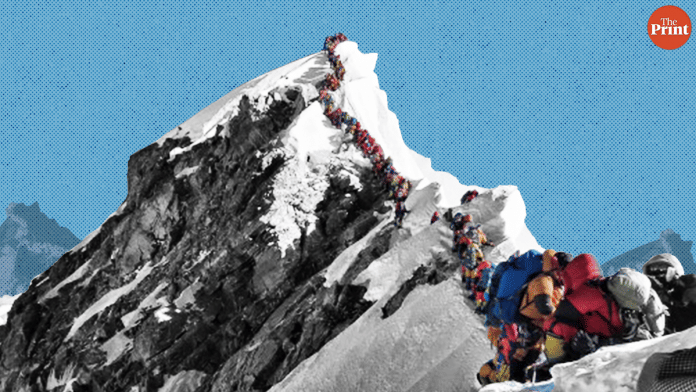
Every year, hundreds of people try to climb Mount Everest—it is a multi-million dollar, high-risk industry.
With the reveal of recent fraud, tourists and Sherpas are in panic. “We are helping a number of tourists to climb Everest. As an indigenous Himalayan ethnic group, we have mountaineering skills, but it will not work if tourists do not come. These incidents will surely impact the footfall,” said Riyang Sherpa, helping tourists in climbing based in Kathmandu.
(Edited by Ratan Priya)