








Kolkata: Fifty-four years after the arrest of the founder of Naxalism, Charu Majumdar, punctured the romance of armed revolution in West Bengal, a new indie film captures the life of a revolutionary Red cadre—who defies establishment—just before the upcoming high-stakes elections in the state.
The low-budget movie, Adamya (The Unbroken), captures the life of a young Communist who chooses the barrel of the gun over the ballot box. Released on 13 February in limited theatres, the movie, directed by Ranjan Ghosh and presented by veteran director Aparna Sen, has become a regular favourite for the audience. Reviewers have critically acclaimed the movie, and a raging debate has started in West Bengal.
‘Adamya’ is not a straightforward glorification of violence; instead, the film focuses on the psychological journey of the protagonist.
“In the end, ‘Adamya’ tells the audience the battle against oppression must continue,” Ghosh told ThePrint over the phone. “Maybe that is one of the reasons why it has touched a chord among the audience, and not so much for the violent means adopted by the hero.”
Rage against the system
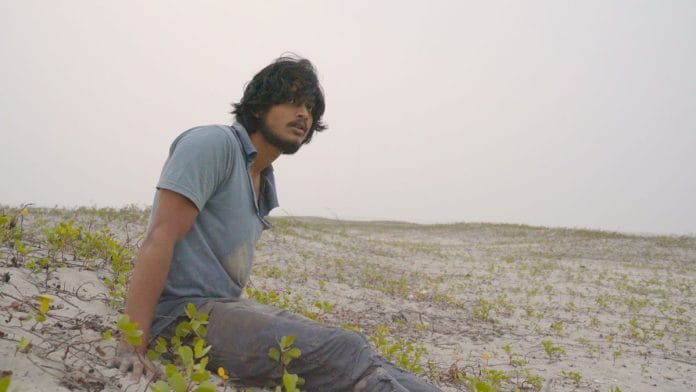
‘Adamya’ tells the story of the young Palash, played by Aryuun Ghosh, a revolutionary student who attempts to kill a sitting MP in West Bengal, who, interestingly, talks about development in his poll speeches and speaks in Hindi. Palash miserably fails—like most of the Naxalites did in real life—in his mission, and ends up killing a young policeman instead. He then escapes to the breathtaking wilderness of the Sundarbans even as a massive manhunt is launched to nab him.
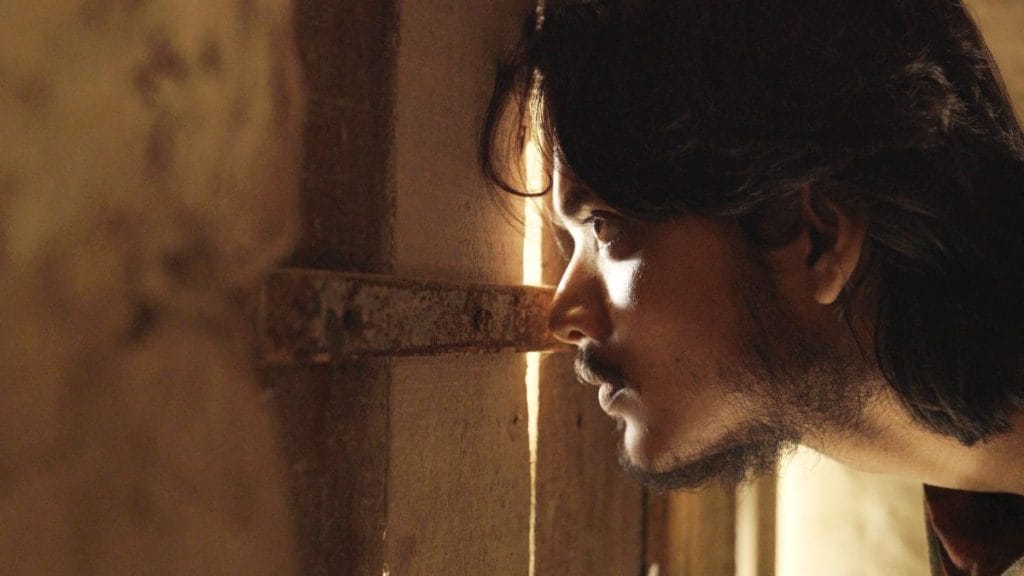
In a desolate hut by a weedy pond, with only himself and an occasional voice on the phone giving him curt instructions for company, Palash confronts past demons and present peeves as electioneering reaches fever pitch in Bengal and talks of displacement of tribals for much-touted development projects become news bytes.
Alone in the hut, Palash talks inside his head with a dead comrade, whom he might have failed, thinks of his aged mother, whose only lifeline would be lost if the police get to him.
Also read: Free after 6 months, Sonam Wangchuk says, ‘Everyone should go to jail at least once’
‘Not a celebratory depiction of violence’
With severe financial strains, minimal resources, still photographer Arko Prabha Das debuting as cinematographer, a single Sony A7R III camera turning into the principal visual tool, Ghosh has pulled off a film that has spoken to an audience hungry for original storytelling, even though ‘Adamya’ harks back to the angry 1970s when the best and brightest of Kolkata’s college and university students romanticised armed insurrection.
The shooting of the film posed a big challenge for Ghosh and his team. “We didn’t even have a tripod. We borrowed a wooden tool from our hosts in the Sundarbans and used it as a tripod,” the director said, adding that at night, scenes were illuminated by torch beams, household bulbs, or a tubelight from a temple.
“This helped preserve a raw, lived-in texture that felt true to the film’s world,” he added.
The shooting was done in a span of four months in the Sundarbans, with the team members living together in a modest village home during the process. “Instead of following rigid shooting schedules, we allowed the environment—the tides, the winds, the shifting light—to dictate our rhythm. Many unscripted moments eventually became part of the film,” Ghosh said.
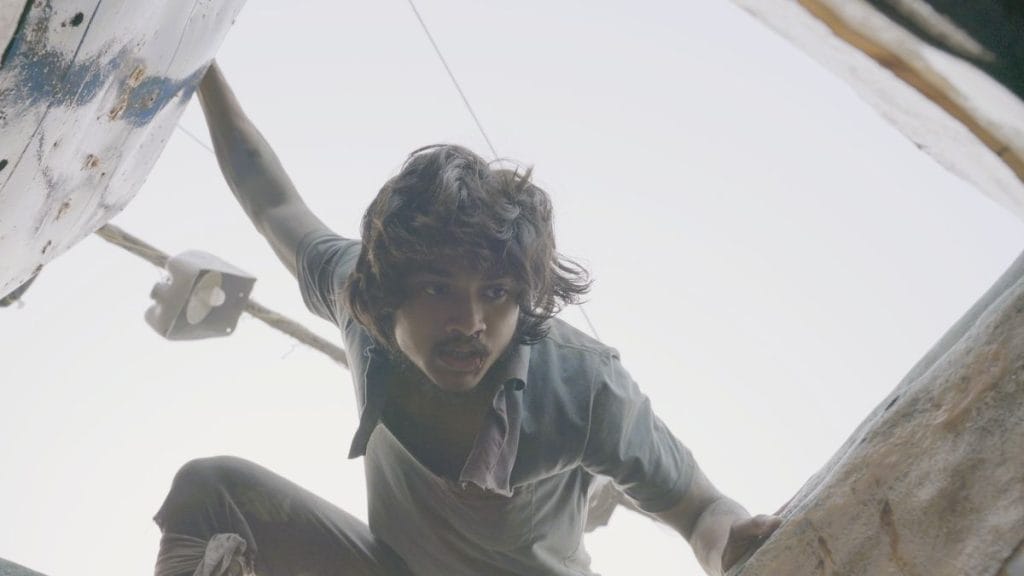
The reviews have been encouraging, ranging from ‘Adamya arrives like a breath of fresh air’ to ‘rigorous craft behind film not debatable’.
“The Bengali film industry is often accused of playing safe, sticking to the formulae of family drama and detective thrillers. Even filmmakers who once made a mark by walking against the tide have retreated into safe shells. In such a scenario, Ranjan Ghosh’s Adamya arrives like a breath of fresh air,” The Telegraph wrote.
For National-award-winning filmmaker Srijit Mukerji to achieve the cinematic heights ‘Adamya’ does with a crew of six is nothing short of a miracle. “The politics of the film might be debatable, the indomitable heart and rigorous craft behind it is not,” Mukerji wrote on Facebook.
The reason why Mukherji found the politics of the film debatable is that it takes the audience back to 1970s Calcutta (now Kolkata), when young women and men, many of them college and university students, joined a radical, Mao-inspired uprising targeting landlords “class enemies” and state authorities, led by Charu Majumdar. Arrests of top leaders and intense state repression had brought the movement to a halt in Bengal, but it soon spread to other states.
Ghosh told ThePrint that ‘Adamya’ captures Palash’s journey—“his reckoning and moral confrontation as a radical rebel hiding after a failed attack”.
“My film explicitly examines the thin line between legitimate protest (rebellion) and violent anti-state action (extremism). I would like to leave it to the audience to decide if Palash is an extremist or a patriot. The film is inspired by Sukanta Bhattacharya’s revolutionary poem Deshlai Kathi (The Matchstick) and hence focuses on the revolutionary spirit, eroding democratic values, and resistance against corporate interests,” Ghosh said.
Ghosh admitted that the film deals with the themes of Naxalism and extreme left ideology by exploring the desperate circumstances that fuel them, but said that it also leans more toward a psychological exploration of the rebel rather than a simple, celebratory depiction of violence.
Also read: Galwan to Maatrubhumi — Salman Khan renames film about India-China clash
‘A metaphor for the whole world’
‘Adamya’ has come at a time when the ‘politically violent state’ has been gearing up for the next Assembly polls, which are scheduled on 23 and 29 April. While the fight remains between the ruling Trinamool Congress led by the party’s formidable supremo and state Chief Minister Mamata Banerjee versus the opposition BJP, which won as many as 77 seats in the last Assembly polls in 2021, the Left Front, which had ruled the state for 34 years, remains in a pitiable state.
Bengal’s Left parties had landed zero seats in the 2019 and the 2024 Lok Sabha polls as well as the 2021 assembly elections. After his party’s 2024 Lok Sabha no-show, Srijan Bhattacharyya, state secretary of the Students’ Federation of India and the CPI(M) candidate for the Jadavpur Lok Sabha constituency, had told ThePrint that the Left desperately needs to step beyond echo chambers.
“There was huge support for some of us from the CPI(M) on social media and on the streets. But it was a bubble,” Bhattacharyya said.
The young Communist leader had rued that while the Left focuses on people’s issues like ‘roti, kapda and makaan’, Banerjee has made every Bengali voter acutely aware of their religious and caste identity.
“It is not just Hindu-Muslim. Even among Hindus, this entire controversy around Matuas came up during her reign. She has succeeded in creating binaries, which in turn create vote banks based on identity,” he said. “Because of her, the BJP-RSS has made deep inroads in the state. We have to create an alternative political narrative.”
For Sayantan Ghosh, academic and author of a new book on upcoming polls in West Bengal titled ‘Battleground Bengal’, the seeds of left-liberalism remain deeply rooted in Bengal’s soil.
“Yet, there is a striking dissonance between this enduring public ethos and the hollowed-out remains of the institutional Left. Decades of rigid dominance under the CPI(M) have left the movement ossified; the party’s historical ‘35-year shadow’ now serves as a barrier rather than a foundation,” Sayantan Ghosh told ThePrint.
The author said that due to an inflexible orthodoxy and a refusal to modernise its worldview, that has left the political Left unable to tap into the very ideological reservoir it helped create, “leaving a silent, yearning void at the heart of Bengali politics”.
For the director, though, ‘Adamya’ is a metaphor for the whole world, not just for West Bengal or India. “The film tries to hold a mirror to the corridors of power and reflects a deep disillusionment with the socio-political landscape across the globe. Look at whatever is happening around the world. Look at our neighbours. Everywhere, the key operating word is ‘Exploitation’, ‘Greed’, and ‘Oppression’,” he said.
Ghosh finds the overwhelming ambition of the political class to be responsible for this situation. “I had such a sense of clairvoyance when Trump was attacked twice in 2024! In the July attack, he escaped, but one person was killed and two more critically injured! Come to think of it, we filmed Adamya between January and April that year! So, yes, the story of Adamya is universally true for any regime anywhere across the globe. There is really no decent political choice anywhere,” he said.
(Edited by Saptak Datta)