





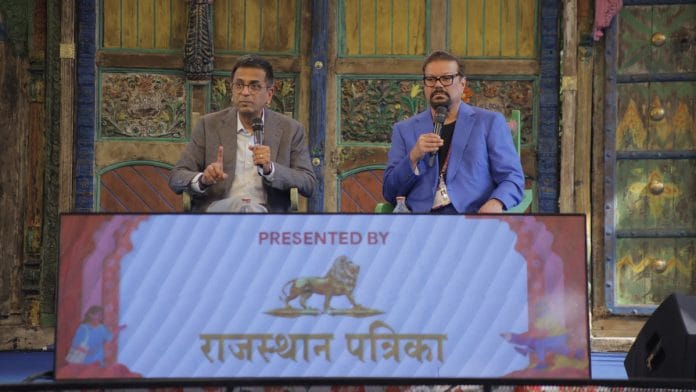



Jaipur: When former chief justice of India DY Chandrachud invoked the principle of ‘bail, not jail’ as the rule, journalist Vir Sanghvi shot back with two words: Umar Khalid.
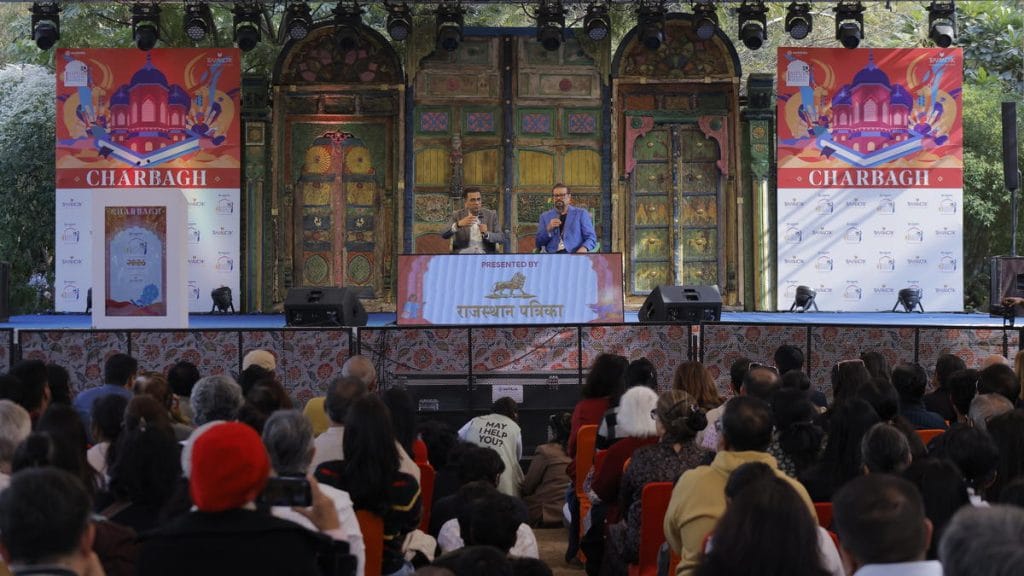
Under the shade on a sunny winter day at the Jaipur Literature Festival, with standing room only, Sanghvi and Chandrachud discussed law, jurisprudence, and the issues threatening the proper functioning of the Indian judiciary at a session titled ‘Ideas of Justice’ on Sunday.
At the mention of Umar Khalid, who has spent more than five years in Tihar Jail awaiting trial in the 2020 Delhi riots case, Chandrachud reinforced that even where bail is denied under specific legal conditions, an accused is entitled to an “expeditious trial”.
“If an expeditious trial is not possible under present conditions, then bail should be the rule and not the exception,” he said.
Sanghvi then posed the question of whether Chandrachud would give Khalid bail if the case were to appear before him today. However, the former CJI said he did not want to criticise the legal fraternity.
“Judges have to look at the record of a particular case and then see what kind of evidence there is, what kind of material there is before the court. So therefore, I think [as a] judge who has sat in the hot seat for 25 years, [I’d be] slow to criticise merely because I have a difference of opinion on this one,” he said.
But Sanghvi seized on the phrase “difference of opinion” and said the judge had given himself away.
To this, Chandrachud pointed out that the public often overlooks special cases where bail has in fact been granted. He cited the examples of Congress spokesperson Pawan Khera, civil rights activist Teesta Setalvad, and an electrician named Ikram from Uttar Pradesh, to underline that the court is “agnostic to faith, to caste, to gender”.
He did, however, acknowledge Sanghvi’s contention that the district courts are becoming increasingly hesitant to grant bail, noting that it was likely due to a “culture of distrust in our country and of authority”.
Also Read: ‘I like trespassing into people’s lives,’ says photographer Rohit Chawla at his book launch
‘All-pervading fear’ among judges
Chandrachud suggested that a fear of scrutiny and accusations of corruption has made many judges more hesitant to grant bail.
“Judges, particularly at the lowest levels, have a sense of all-pervading fear that, ‘If I grant bail, would my motives for the grant of bail be questioned?’ Sometimes you may have an offender who is alleged to have committed a serious financial fraud of, say, Rs 20,000 crores. And the judge feels that, well, if I grant bail, will my integrity be called into question?” Chandrachud said. “Because all too often now, we are willing to cast aspersions on people in authority. This is one classical case where judges of the district judiciary feel that it’s better for me not to grant bail and allow for a higher court to grant bail.”
He added that the same dynamic was playing out in the High Courts, leaving the Supreme Court to deal with nearly 70,000 cases in a year.
“Don’t cast moral aspersions on the district judiciary, because by doing so you are creating a broader ecosystem where people are fearful of exercising their duties under the law courageously,” he said.
The reluctance to grant bail cannot be seen in isolation, according to Chandrachud, but must be understood in the context of how the entire judicial “ecosystem” is treated in India, especially in matters of promotion — “how we assess people whose performance comes up for consideration when a higher office beckons them by virtue of their seniority in the institution.”
The discussion then turned to corruption within the judiciary. Chandrachud said the institution is drawn from civil society itself.
“Can you say that Indian society is absolutely dyed in white? Now, that’s not a justification for corruption in the judiciary because people who assume higher office have to answer a higher calling, and there is an expectation from judges that you will not behave in manners which are inappropriate,” he said. “But yes, there is corruption in the judiciary.”
Chandrachud added a caveat, though, that allegations of corruption in the judiciary are “widely exaggerated”. This, he noted, has made it easier to target judges after adverse rulings by claiming that “this judgment was delivered for a corrupt motive”.
Also Read: A poet reimagines Sita as a woman caught in conflict. She refuses to school Ravan
‘Greater transparency needed in appointment process’
Sanghvi then raised questions about the collegium system of judicial appointments and if it merits a revision.
Chandrachud said the charge against the collegium was that it functioned as an incestuous system, with judges appointing judges and little transparency in how new names are considered. While he said he agreed with some of the criticism, he also argued that much of it is “misplaced”, as the process of appointing judges takes place at different levels.
He added that there was a need for “greater transparency”, giving the example of the proposed elevation of lawyer and LGBTQ activist Saurabh Kirpal as a judge in the Delhi High Court, which had been repeatedly reaffirmed by the Supreme Court collegium but delayed by the government.
“As Chief Justice, I put out the entire reasons for reaffirming the appointment on the website of the Supreme Court. And we said that, look, the fact that he is gay, that he has a gay partner, should make no difference to his ability or capacity to be a judge of the high court… The final word is not in our hands on judicial appointments, but our views must be placed before the public,” Chandrachud explained. “I think, therefore, greater transparency in the appointment process is perhaps key to generating a greater deal of public confidence.”
Chandrachud also reflected on his tenure as CJI, saying he was proud of having worked toward making the Supreme Court a “people’s court”. He said he pushed for the live-streaming of hearings so litigants across the country could follow proceedings. He added that before his tenure, judgments were only available in English, but he began the circulation of judgments in different languages with the use of AI translations.
The jam-packed session ended with over-eager audience members pressing in around the former Chief Justice as he left the venue, peppering him with questions.
(Edited by Asavari Singh)