





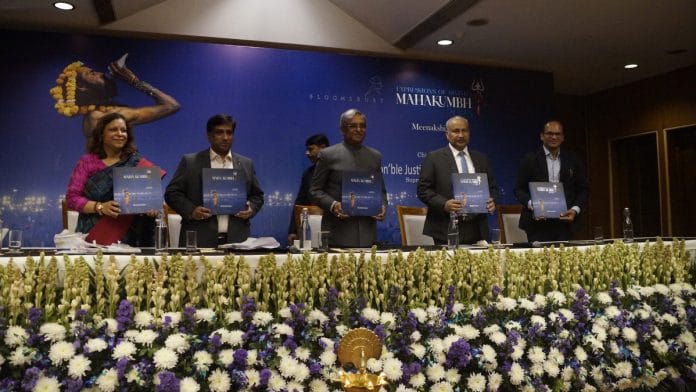



New Delhi: The humanity of the Kumbh Mela, not just its divinity, got the spotlight at a book launch attended by intellectuals, IPS officers and judges at the Habitat Centre last Friday. What unfolded in the room wasn’t talk of abstract faith but anecdotes, images and even poetry about the power of Kumbh, including a story about an Israeli woman who came all the way to India to pray for peace.
“What does divinity look like when it takes human form?” asked Meenakshi Singh, an Indian Revenue Service officer and the author of Expressions of Divinity – Mahakumbh 2025, a book of photographs that captures the sights and moments of a festival that comes to Prayagraj only once every 144 years and saw some 600 million people over 45 days in January and February.
Singh, currently serving as the principal commissioner of Income Tax in Lucknow, has been a passionate photographer for years, recounting that she visited Agra more than 100 times ahead of her first exhibition, Twilights of Time. She was also quick to share credit with her photography mentor Lalit Rajora and husband, IPS officer Rajeev Krishna, the DGP of Uttar Pradesh.
“I am ever so grateful to my husband. If I’ve got some privileged shots, he is behind my being there to take it,” she said in her opening speech at the event, which was attended by numerous members of the civil services’ firmament, with Supreme Court Justice Vikram Nath as the chief guest.
For Expressions of Divinity, she tapped into her realisation that the Kumbh is where the boundary between the physical and the spiritual grows razor thin.
“As I stood on the ghats amid millions of pilgrims, sadhus, seekers, children, ascetics and families, I realised that divinity expresses itself not only in temples and rituals. It is also in faces, gestures, silences, colours, stories, and gradually this book grew out of the dawns where I took the pictures,” she added. “This book attempts to hold that moment of liberation when the pious waters become your faith.”
The book, published by Bloomsbury, explores sacred sites such as Akshyavat, Patalpuri, Mankameshwar, Alopi Devi and Nag Vasuki. It also captures the swell of pilgrims at the Triveni Ghat, the meeting point of the Ganga, Yamuna and the mythical Saraswati.
“It transcends you back to the Mahakumbh,” said Bloomsbury MD Rahul Shrivastav.
Through the evening, other speakers, from Justice Nath to IPS officer Alok Sharma, went into their own memories of the Kumbh, including through Bhojpuri stanzas and a story about an unusual phone call to the police control room.
Also Read: Brahmins, Mughal yogis, British propaganda–How Kumbh Mela became world’s greatest gathering
The Israeli and the journalist
An unexpected display of faith unfolded during a Kumbh mela back in 2013, recounted Sharma, currently the DG of the Uttar Pradesh Special Protection Group and a veteran of four Kumbhs.
“I got a message from the control room that a foreign woman is standing in the water for four hours and crying. I also went there and four hours turned to five. Then she opened her eyes. I told her I’m the police chief of this place and to say if she had a problem,” he recalled. “She said, ‘I’m perfectly all right. I’ve come from Israel to pray for the peace of my country’.”
This, to Sharma, cemented the idea that all of the “shakti” of the world gathers at the Kumbh.
He also described a tense exchange with a Washington Post journalist who kept questioning the logic of the festival. When she complained about how dirty the Ganga was, he said he told her that children also dirty the “lap of their mother.”
“Either you’re a believer or a non-believer. If you don’t believe, you’ll miss the whole crux of this event,” he said.
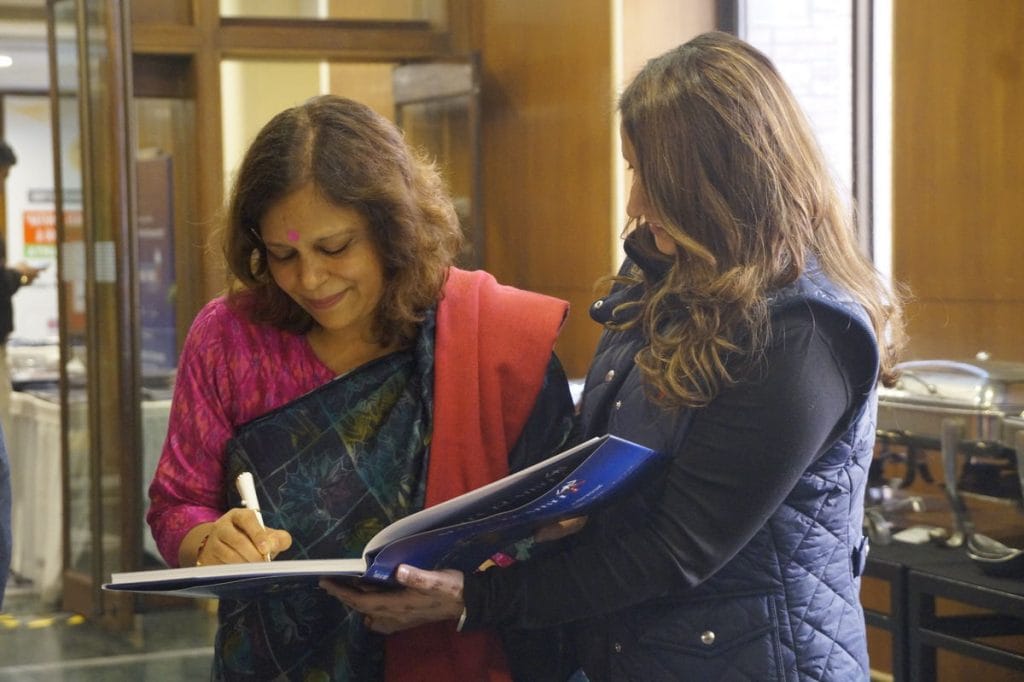
Believers seemed to comprise most of the guests at Habitat Centre, many of whom picked up copies of the book, signed by Singh with the line, “Let the pages carry you to Sangam.”
“I had the privilege of attending Kumbh this year, I feel every aspect of it, be it the people, be it the boatmen, be it the spirituality, this book by Meenakshi Singh conveys each and everything,” said activist and advocate Abha Singh.
Also Read: ‘Literature fosters compassion,’ says Tharoor at Kerala Lit Fest curtain-raiser
‘Amausa ka mela’
Another heartfelt tribute to the Kumbh came from Justice Nath, whose hometown is Allahabad and where he has also served as a judge.
“When I turn these pages and see the aerial view of the confluence, the snaking lines of pilgrims on the bridges and the tiny boats that look like moving lamps in the water, I do not feel that I am looking at someone else’s photographs. I feel that I am looking out of a familiar window,” he said.
He concluded his address with a few lines from Amausa Ka Mela by Kailash Gautam, a famous Bhojpuri poem that vividly captures the scenes and spirit of the Mauni Amavasya fair, often part of the larger Kumbh in Prayagraj.
The poem is its own ode to the humanity of faith, spanning village preparations to the chaos of train compartments to worrying about the cost of snacks to taking a dip in the Ganga. One stanza goes:
Chapayal ha kehu, dabayal ha kehu,
Ghantan se upar tangayal ha kehu.
Kehu hakka-bakka, kehu laal-piyar,
Kehu fanfanaat hauwe jeera ke niyar…
Amousa ke mela, Amousa ke mela.
(Someone is squeezed, someone is pressed,
Someone has been hanging from a handlebar for hours.
Someone is stunned, someone is red and yellow with rage,
Someone is sizzling with anger like cumin seeds in hot oil…
Amavasya’s mela, Amavasya’s mela.)
Disha Vashisth is a TPSJ alumnus currently interning with ThePrint.
(Edited by Asavari Singh)