





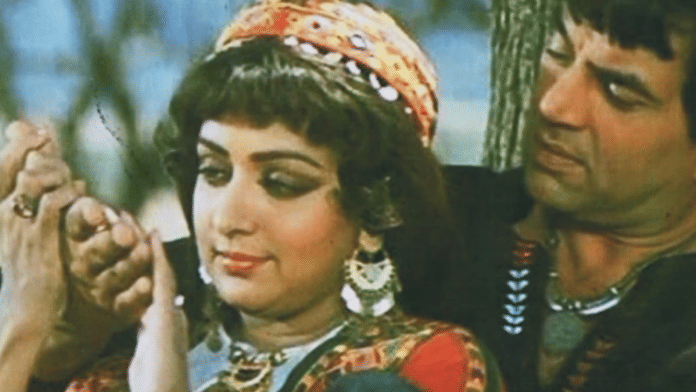



The Soviet Union and India shared diplomatic ties that were fuelled by a shared love for films. With movies like Awaara (1951) and Shree 420 (1955), Raj Kapoor became a sensation in the USSR. But it was Dharmendra’s 1980 blockbuster, Ali Baba Aur 40 Chor, that managed to bring together the two nations.
The fantasy film made by Indian director Umesh Mehra and Soviet director Latif Faiziev is based on the story of Ali Baba and the Forty Thieves from the Arabian Nights.
The film stars Ali Baba (Dharmendra), as a poor man who lives in the fictional Central Asian town of Gulabad, with his mother and elder brother Qasim, who owns a small shop.
The town is terrorised by 40 bandits, led by Abu Hassan (Rolan Bykov), who hide their spoils in a magical cave in the hills.
Ali discovers that his father has gone missing and sets out to bring him home. Away from home, Ali finds his father but also rescues Princess Marjeena (Hema Malini) from a usurper. The two soon fall in love, but before the lovers can get their happy ending, there are challenges to overcome, and justice to be delivered, which makes up the rest of the film.
It is the age-old story of “good over evil”, Ali’s goodness wins over Hassan’s evil and Qasim’s greed.
Also Read: Loafer is proof of Dharmendra’s unmatched versatility
A curious cast of characters
Dharmendra, who has also acted in other fantasy films like Dharam Veer (1977), is completely at ease in his role as Ali Baba. From a young carefree man who pranks his brother to save himself from his scoldings to being a saviour who saves his village from the dacoits, and also rescues a princess in the process, he delivers a seamless performance.
Dharmendra displays the perfect balance of charm, mischief and angst as the titular character and holds the ensemble film together.
Bykov is the perfect foil to Dharmendra. He is menacing, loud, and evokes the right amount of fear and revulsion, making the last few minutes of the climax even more thrilling.
The female characters are typical of how women were perceived in the 80s. Marjeena is the “pure” good girl; a docile damsel in distress, needing Ali’s protection. Towards the end of the film, however, she does develop some degree of agency fuelled by her interaction with young Fatima (Zeenat Aman), whose father is murdered by the thieves.
Fatima is a nomad and refuses to be the damsel in distress. While Malini plays the lead female character, Aman is by no means just a secondary supporting character. She is compelling as the woman who refuses to be subjected to societal norms and pushes on despite numerous setbacks, making Malini’s character pale in comparison. In fact, Aman’s Fatima is instrumental in helping Ali defeat the thieves in their cave.
Songs such as ‘Khatouba Khatouba’ and ‘Qayamat Qayamat’ give a chance to both Aman and Malini to showcase their dance skills.
There is also the powerful djinn-like figure Sim Sim, played by Russian actor Elena Sanayeva, who is both a seer, and the source of the dacoit’s power, providing an army of shadowy men.
Showing once again that the women are mere pawns in the hero’s quest for justice and the villain’s quest for power and money.
Also Read: Mother India took Hindi cinema to global stage. Its Oscar nomination was a turning point
A commercial trailblazer
From the All-Union Film Festival in 1980, the Dushanbe Film Festival in 1980, and the Grand Prix at the Belgrade Film Festival in 1981, Ali Baba Aur 40 Chor swept the film festivals.
“Ali Baba marks the turning point from the more ideologically oriented coproductions toward entertainment cinema, designed to follow the crowd-pleasing conventions of contemporary Bollywood,” wrote Masha Salazkina, a professor of Film Studies at Concordia University, in her 2010 paper titled ‘Soviet-Indian Coproductions: Ali Baba as Political Allegory’.
In India, on its “Silver Jubilee”, the film was shown for twenty-five weeks continuously in all major theatres across the country. In the Soviet Union, it was an even bigger hit, its recorded viewer turnout in 1980 was 52.8 million.
Ali Baba ushered in a decade of commercial Indian film dominance in the USSR, and would reach its peak with the Mithun Chakravarthy starrer Disco Dancer (1982), which became the highest-grossing Indian film there.
Ali Baba Aur 40 Chor’s success prompted the director duo to make Sohni Mahiwal (1984), which was also a commercial hit. But it was Amitabh Bachchan’s 1990 film Ajooba, directed by Shashi Kapoor and Gennady Vasilyev, that finally ended the legacy of Indo-Soviet commercial films, failing to impress both the box office and the critics.
(Edited by Insha Jalil Waziri)