





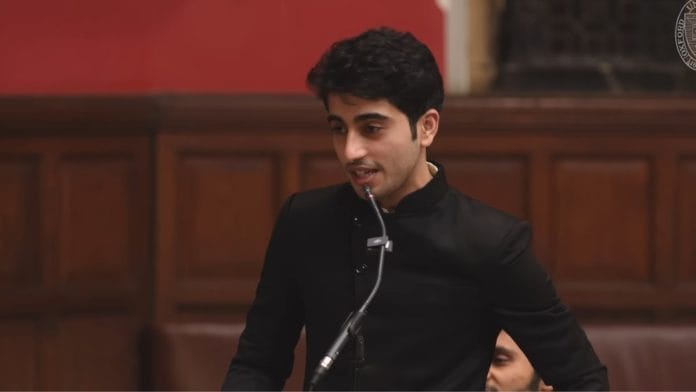



New Delhi: Viraansh Bhanushali didn’t expect to go viral, let alone receive rishtas—marriage proposals—directed to his mother. But ever since the Oxford Union Society uploaded the ‘India Vs Pakistan’ debate 12 days ago, the bandhgala-clad law student from Mumbai has been thrust into the limelight.
Even his career ambitions are now tinged with a bout of nationalism. He has a training contract with a law firm in the UK, but now may defer it for a year.
“I want to write the UPSC and maybe get selected for the Indian Foreign Service,” said 21-year-old Bhanushali. He admitted that civil service had always been at the back of his mind, but the love he received from his debate performance reignited his ambitions.
“Arguing for your country passionately can have an impact on how the average person in India views their country. It’s given me that extra bit of push,” he added.
Anchoring the opposition, Bhanushali used a potent mix of confidence, wit, and personal anecdotes to counter the house’s claim: India’s Policy Towards Pakistan Is a Populist Strategy Sold as Security Policy. Oxford Union debates are always widely watched, but nothing draws a crowd—and an online discussion—quite like a debate between India and Pakistan.
“Whenever it’s India and Pakistan, it’s always a blockbuster—whether in film, cricket or a debate,” said Moosa Harraj, the President of the Oxford Union who led the proposition. But outside the structure of the debate, Harraj and Bhanushali are friends.
“Viraansh is my chief of staff. When I was running for president, he was one of the main people helping my campaign,” Harraj added.
The two friends even engaged in a friendly roast during the debate—part of a tradition that was lost on the undiscerning viewer. Bhanushali joked that as his chief of staff, he wrote Harraj’s speech for him. Harraj quickly stood up and interjected with a ‘point of motion’.
“So, you are admitting in a chamber that what I just said was written by an Indian—you,” said Harraj with a wry smile. The audience burst into cackles and light applause. They were saving their energy for Bhanushali’s reply.
“I shall gladly admit that sometimes, it takes an Indian to clean up the incompetence of a Pakistani,” he said, marking one of the more viral moments of the debate—at least on this side of the border.
Camaraderie between the camps
Bhanushali may be widely celebrated in India, but the debate had been airing on Pakistani national television for nearly a month. Though it took place in late November, the Oxford Union uploaded it to YouTube only recently.
“Geo News and ARY News had sent representatives who recorded the entire debate and effectively livestreamed it. I’ve been getting bad press for a month,” said Bhanushali, chuckling at the hate comments directed his way.
Union debates are planned months in advance, typically during the summer, with topics finalised well before the term begins. Debates have featured politicians such as Shashi Tharoor and Nigel Farage, journalist Mehdi Hasan, and even civil rights icons such as Malcolm X.
“At a minimum, we will have two student speakers at least and they will both be members of the Oxford Union Committee, so they’ll know each other and be friendly,” said Harraj, adding that Indians and Pakistanis get along well when they’re abroad together. “We are all put in the same category of desis on campus.”
Harraj and Bhanushali had a dynamic well before the debate commenced. As chief of staff, Bhanushali—as Harraj’s main liaison—ensures that events on campus run smoothly and logistics are in place.
The two have had ‘conversations for hours’ in their offices about current events, including Indian and Pakistani foreign policy. “Even the other speakers [on the India side], are very dear friends of mine,” said Harraj.
While their debate online was met with rallying cries from both camps, behind the scenes is a sense of camaraderie—and even a shift in how the Union chooses topics for debate. Harraj wants to address topics pertinent to the “Global South”.
“Traditionally, a lot of the Union presidents were white, public school-educated men. And debates would cater to that group,” said Harraj. The India versus Pakistan debate wasn’t incidental—the topic was deliberately chosen.
“Representation is very important. That sets the discourse, the type of people we invite and the attendance we get,” added Harraj.
Also read: ‘Baba, baba’: After a Hindu father’s lynching in Bangladesh, a child keeps searching
Tensions at Oxford during Op Sindoor
Outside the historic wood-panelled halls where the Union’s debates take place, the relationship between Indian and Pakistani students on the Oxford campus can sometimes be strained. And ties between them are tested during military skirmishes such as Operation Sindoor.
“I lost a lot of Pakistani friends. Some even went up to Moosa and asked how he can be friends with me,” said Bhanushali, who was very vocal about Pakistan’s actions in May. “There’s a line that Moosa said that still sticks out to me: ‘I can’t make a man argue against his country’.”
A key driver of this tension—apart from nationalistic pride—was what Bhanushali called the ‘first post-truth war’. Indians and Pakistanis were viewing the hostilities through completely different lenses. “The fundamental starting truths of both sides were so vastly different that it became very difficult to reconcile for a lot of people,” said Bhanushali.
He admitted that hostilities rarely override personal relationships. Oxford draws academically inclined, open-minded students from across the world, so discussions and logic triumph over chest thumping and jingoism. And having clear-cut boundaries helps.
“Drawing red lines is very important. I don’t tolerate Moosa making fun of India, he doesn’t tolerate me making fun of Pakistan. We also have obligations to the institution,” said Bhanushali. The Union is a centre for dialogue; a platform where people can present their cases.
Harraj, back at his home in Lahore for the winter break, acknowledged that sometimes, emotions do seep in when discussing issues between the two countries. But at campuses such as Oxford, one can separate people from their government.
“When we debate, it’s not against Indian people but the actions of the state,” he said.
The debate is still racking up views. One of Bhanushali’s comments made it to headlines in India: “You cannot shame a state that has no shame.” In Pakistan, Geo News focused on the debate victory over the Indian team.
The more casual comments were found on YouTube and Instagram. “Bro has face card and sound logic at the same time,” said one of the most liked comments, a testament to the sudden rise in rishtas that Bhanushali has received.
For now, both students are basking in the adulation from their countrymen. They are viewed as ambassadors (or, as one comment put it, “Nehru versus Jinnah”) of their people.
“Someone said that this is the British doing what they’re best at—divide and rule, and making Indians and Pakistanis fight each other at the Oxford Union,” said Harraj, laughing at the irony.
(Edited by Prasanna Bachchhav)