








New Delhi: In a landmark ruling that greenlit passive euthanasia for Harish Rana, a 31-year-old from Ghaziabad who has been in a vegetative state for over 13 years, the Supreme Court turned to an unusual source: a 19th-century American preacher.
In its order, a bench of Justices JB Pardiwala and KV Viswanathan cited a line attributed to Henry Ward Beecher: “God asks no man if he accepts life, you must take it.” The bench noted that the words resonate when courts confront difficult questions about life, suffering, and the right to die.
The reference appeared in the court’s discussion on the ethical tension between preserving life and respecting dignity in cases where patients cannot make decisions for themselves. Passive euthanasia, withdrawal or withholding of life-sustaining treatment under specific safeguards, has been recognised in India through a series of Supreme Court rulings.
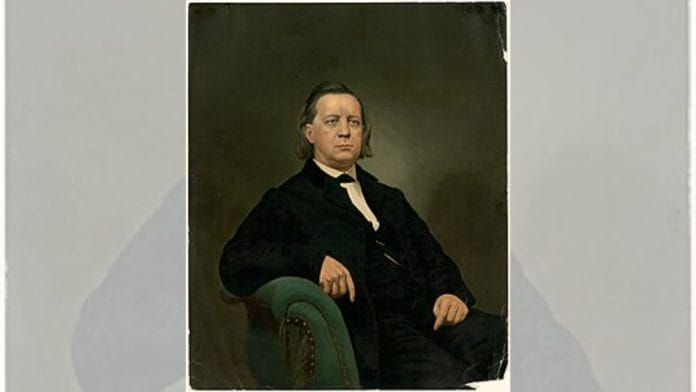
Who was Henry Ward Beecher?
Born in 1813 in Connecticut, Beecher was no ordinary cleric. He was among the most prominent protestant ministers whose oratory and social activism crowned him one of America’s most influential voices in the mid-1800s.
Beecher advocated what he described as a more compassionate and optimistic form of Christianity, emphasising human moral responsibility and the possibility of social reform over fear and fatalism. By 1847, he had become pastor of Plymouth Church in Brooklyn, New York, where his sermons attracted thousands of listeners and were widely circulated in newspapers and pamphlets.
Beecher’s activism defined his era. A fierce abolitionist, he used the New Testament to argue that slavery contradicted Christ’s teachings of equality and brotherhood. In the 1850s “Bleeding Kansas” crisis, he blessed rifles smuggled to anti-slavery settlers. The weapons were nicknamed “Beecher’s Bibles”, reflecting both his involvement and the moral framing he gave to the struggle.
He also publicly supported women’s suffrage at a time when the movement had little mainstream backing.
Beecher also courted controversy by defending Charles Darwin and arguing that scientific discoveries such as the theory of evolution did not necessarily conflict with religious belief.
Although his later years were marked by a highly publicised adultery scandal that damaged his reputation, Beecher remained one of the most widely known religious figures in the United States during his lifetime.
Also read: ChatGPT or Claude? People are busy doing their identical prompt experiments
The quote SC borrowed
The full quote invoked by the Supreme Court expands to: “God asks no man whether he will accept life. That is not the choice. You must take it. The only choice is how.” The quote appears in Life Thoughts, an 1858 compilation of Beecher’s reflections drawn from notes of his sermons at Plymouth Church. The book was compiled by writer Edna Dean Proctor, who recorded many of Beecher’s extemporaneous sermons through shorthand notes.
The passage reflects Beecher’s broader philosophical outlook, which stressed that while life itself may not be a matter of personal choice, individuals remain responsible for how they confront hardship, suffering, and moral dilemmas.
The SC bench also referred to Shakespeare’s Hamlet, invoking the play’s famous meditation on life and death: “to be or not to be”. Such literary references are not uncommon in constitutional judgments, particularly when courts grapple with moral and philosophical questions that extend beyond purely legal interpretation.
By invoking Beecher’s words alongside Shakespeare, the court framed the case within a broader reflection on human dignity and the difficult choices.
(Edited by Ratan Priya)