





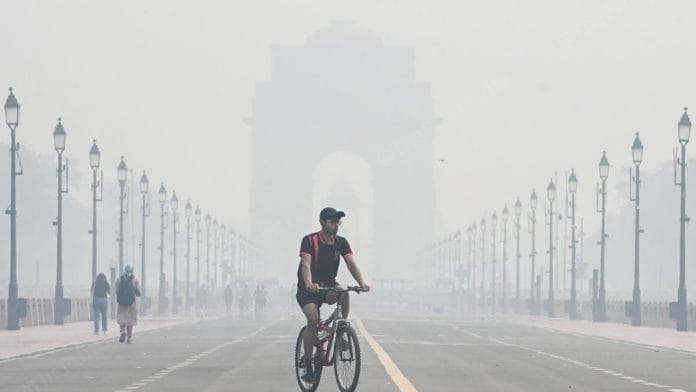



New Delhi: On a crisp November morning, Mahender Hari should have been at Delhi’s Major Dhyan Chand Stadium, clipped onto his bike, heart steady, waiting for the starter’s whistle with 5,000 other participants. Instead, the 33-year-old stood at home staring at a cancellation message. Weeks of training rides at dawn, new gear, and a long guest list of friends and family dissolved overnight—felled not by logistics or low turnout, but by the city’s air. Delhi’s pollution had spiked again, and the cyclothon he had been preparing for was rescheduled just hours before it was meant to begin.
GSI Cyclothon, the standalone cycling event organised by the Green Society of India (GSI), was set to take place on 16 November. The venue was finalised, a guest list prepared—from ministers to health experts—and media partners had already signed on. But organisers rescheduled it to February 2026, citing hazardous air barely a day before the event. On 15 November 2025, Delhi’s AQI was around 386.
“Everything was in place,” Hari said. “But I understand the organisers’ concern as well. This event was meant to promote a healthy lifestyle. We had already taken precautions—the age limit was lowered, most participants were in their 30s, and the route was shortened. Still, it had to be cancelled in the end.”
Due to the pollution emergency, the venue partner was compelled to withdraw venue availability at the last minute.
“While the postponement has caused unavoidable financial and operational setbacks for GSI, the decision was taken firmly in the interest of public health. As an environmental organisation, we believe safeguarding lives must take precedence over any loss,” GSI spokesperson said to ThePrint.
Hari’s disappointment is not uncommon. This winter, Delhi’s toxic air has pushed outdoor sport into a pattern of last-minute scrambles, route cuts, postponements, and abrupt scrapping of events, even as a handful of high-profile races, including one backed by the Supreme Court, pushed ahead despite ‘severe’ AQI readings. What was once an unthinkable scenario—a city too polluted to run, cycle or host international championships—has become a seasonal norm. Organisers now juggle athlete safety, commercial pressure and unpredictable pollution curves; participants weigh months of training against the possibility that their race may vanish overnight. Together, they are learning that in India’s capital, the question shaping an entire sporting calendar is no longer who shows up, but whether the air will let them. It is this toxic atmosphere that football legend Lionel Messi will experience on 15 December as he closes his GOAT tour of India at the Arun Jaitley Stadium.
“Once AQI shoots past 200 or 300, any certified race director is expected to cancel an event—that’s the rule. But commercial compulsions often push organisers to go ahead anyway. The truth is simple: When you run or cycle, your respiration rate rises sharply, and you end up inhaling far more pollutants than you would sitting at home. So the argument that ‘everyone is breathing the same air’ just doesn’t hold,” said P. Venkatraman, CEO, YouTooCanRun and India’s first US-certified Race Director.
Also read: India wasn’t always like this. Things have never been as bad as they are today
A string of cancellations
Neetu, who is in her thirties, worked day and night to make this event a success.
“We were working on it till Friday night, messages were coming on our WhatsApp groups, but suddenly they told us we need to cancel tomorrow’s event and postpone it to February. But it was for health reasons,” said Neetu.
Only 200 of the 5,000 participants had paid the registration fee in advance
“We didn’t return the money as the event will be held in February. Its the organisers whose money got wasted. We worked so hard and were waiting to celebrate a successful event,” said Neetu.
The New Delhi Half Marathon, organised by the Bank of India, was supposed to take place on 14 December, but that too was postponed.
“With the AQI levels rising to unsafe highs, we’ve made the difficult decision to postpone the 14th December New Delhi Half Marathon. Out of caution. Out of care. Out of respect for every runner who shows up with heart. New date dropping soon,” reads a pop-up banner on the website.
Apart from this, three other big events have been cancelled in Delhi this season. Organisers add that event schedules are being modified to take pollution into account.
“For example, the Vedanta Delhi Half Marathon, which used to be held in November, has been taking place in October for the past two years,” said one organiser, on the condition of anonymity.
All outdoor sports and competitions in schools, colleges and sports associations across Delhi-NCR have also been ordered to halt events in November and December as part of pollution mitigation measures, following warnings from the Supreme Court and the Commission for Air Quality Management.
Also read: The politics of air pollution—how they are fooling the citizens
Hurting international image
Hari has been participating in cyclothons for nearly a decade, and he said it has become increasingly difficult to hold such events in Delhi–NCR. “It wasn’t this bad a few years back, but every year the air gets worse,” he said. “Event companies need to think more carefully before organising. Cancelling a day before is not ideal—they knew the AQI trends well in advance.”
Yet, several endurance events went ahead despite hazardous air. The Supreme Court-backed marathon was held earlier this season, and the SHAHOTHON 2025: Grand Half Marathon took place on 23 November. Delhi’s AQI that morning remained firmly in the “very poor” to “severe” range.
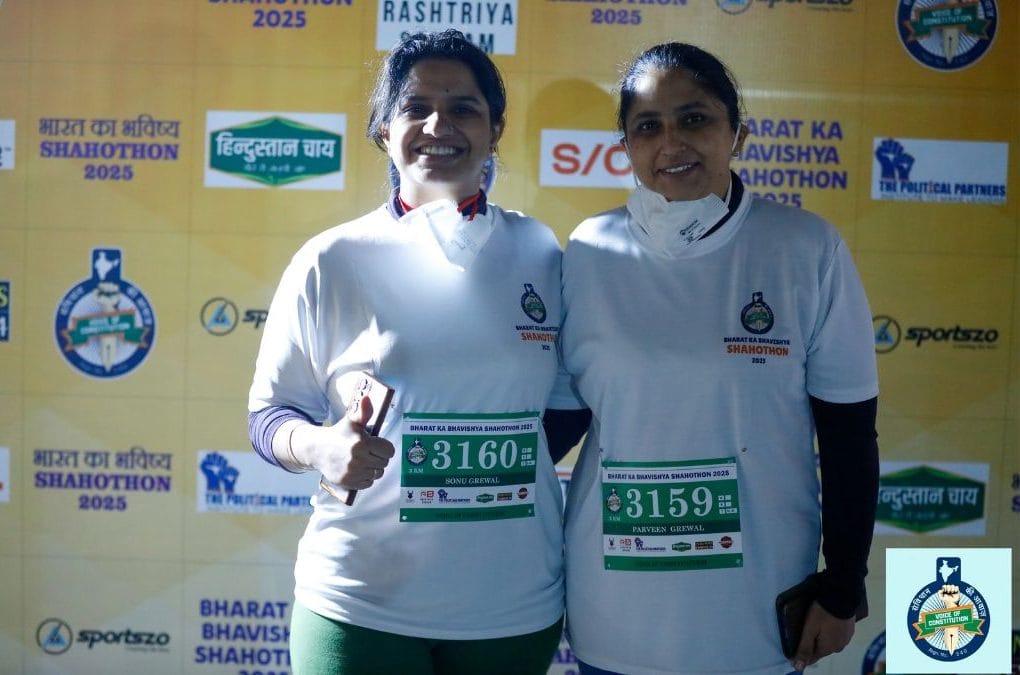
According to the organisation’s event brief, SHAHOTHON aimed to promote fitness and constitutional values, attracting runners from Delhi, Noida, Gurugram and beyond. But like many events held in peak pollution weeks, it had to make several adjustments, which race directors say are increasingly becoming the norm.
Rakesh Singh, president of Voice of Constitution, the organisation behind SHAHOTHON, said organisers made adjustments to reduce risk. “We took precautions—we shortened the route, reducing the half-marathon to repeated loops of a 5.2 km stretch,” he said. “Most of our registered runners were between 30 and 45, so we were careful about older participants not joining. We tried to make the event as safe as possible in the circumstances.”
The International Association of Ultrarunners (IAU) 50 km World Championships, set to be held on 7 December, was postponed two weeks before the event and rescheduled to 14 March 2026. It has exposed a gap in how India handles international sporting commitments. Unlike domestic races, global athletics events follow strict environmental risk protocols, and Delhi’s late directive left overseas teams—some of whom had already booked travel—without clarity. Several national federations privately expressed concern that India’s marquee events are now vulnerable to abrupt policy decisions triggered by pollution spikes, raising questions about the country’s preparedness to host endurance sports on the world stage.
For the IAU, the situation has also set a precedent: This is the first time the global ultrarunning body has postponed a championship solely due to air quality. Organisers now say future bids from Delhi will have to demonstrate contingency plans, cleaner-air venues or alternate hosting months before they are approved. The episode has quietly shifted conversations within the ultrarunning community—from celebrating India’s growing interest in the sport to debating whether its capital is simply becoming too unpredictable for elite competition.
Internationally, many sporting bodies rely on health-based AQI thresholds to decide when outdoor events should be curtailed. Guidelines used by global organisations such as Special Olympics International advise limiting strenuous outdoor activity once AQI crosses 150–200, and recommend that outdoor competitions should not be held when AQI exceeds 300, because high-intensity exercise dramatically increases pollutant intake.
For thousands like Hari who train at dawn, book their calendars and dream of finish lines, the question is no longer whether they can endure the race—but whether the city’s air will allow them to start it.
“Sometimes it’s weather, sometimes it’s unavailability of venues, and now it’s pollution. Everything has become difficult in this city; maybe we should change the city if we want to keep a few hobbies alive,” said Hari.
(Edited by Theres Sudeeep)