





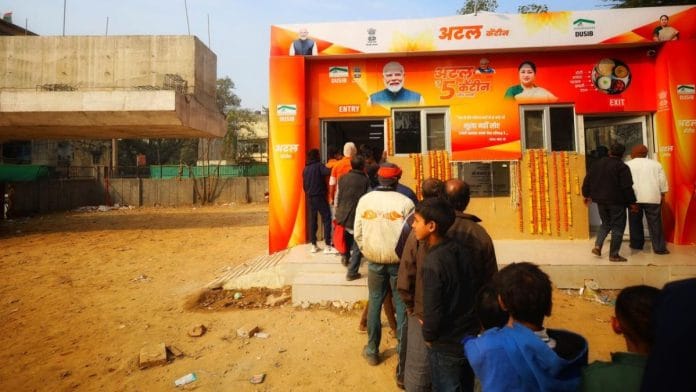



New Delhi: At 1 pm, the smell of hot dal and vegetables hangs heavy inside the Atal Canteen at Apna Bazaar in Delhi’s Lajpat Nagar. Aatma Ram, a ragpicker from nearby Sriniwaspuri, has been in the queue for over an hour. Anxious, he keeps checking the counter, worried the food will run out before his turn comes.
“This canteen is for us, poor and underprivileged people. Why is everyone – people with money – allowed to have food here?” Aatma Ram questioned, irritation creeping into his voice.
Aatma Ram’s impatience captures the first-week mood at Delhi’s newest, albeit repackaged welfare scheme – popular, chaotic, and already revealing its faultlines.
Atal Canteens were launched on 25 December by the Rekha Gupta-led Delhi government to mark the 101st birth anniversary of former prime minister Atal Bihari Vajpayee. The promise is simple: a full meal for Rs 5, served twice a day, seven days a week.
So far, 45 canteens are operational across low-income, high-density neighbourhoods – from RK Puram and Govindpuri to Narela, Bawana and Rajouri Garden. The government plans to scale this up to 100 locations. Lunch is served from noon to 2 pm; dinner from 6 to 8.30 pm.
“Atal Canteen will become the soul of Delhi, a place where no one should have to sleep hungry,” Rekha Gupta said at the launch on Thursday.
Five days in, that ambition is colliding with ground realities: long queues, confusion over timings, food running out early, and a visible mismatch between who the scheme is meant for and who is actually accessing it. While Tamil Nadu’s pioneering Amma Canteens and Rajasthan’s Indira Rasoi – where food is cooked on-site and distribution is decentralised – Delhi’s Atal Canteens rely on centralised kitchens and long road runs.
“We have supplied food for government restaurants and lounges, but this is the first time something on such a large scale is happening in Delhi,” said Mukesh Sharma, manager at Sanraj Hospitality Private Limited in charge of stations in South Delhi .
‘Time is money for us’
At the Kalkaji canteen, Sanjay Rao, an auto driver, stands patiently with his three-year-old son. His wife is resting at home. When someone told him about the Rs 5 meal, he decided to try it.
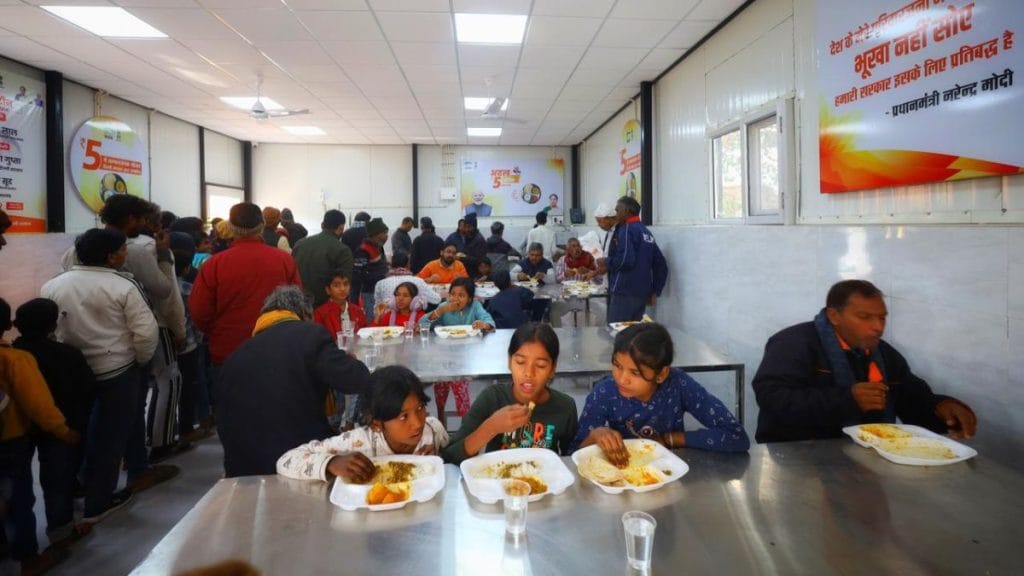
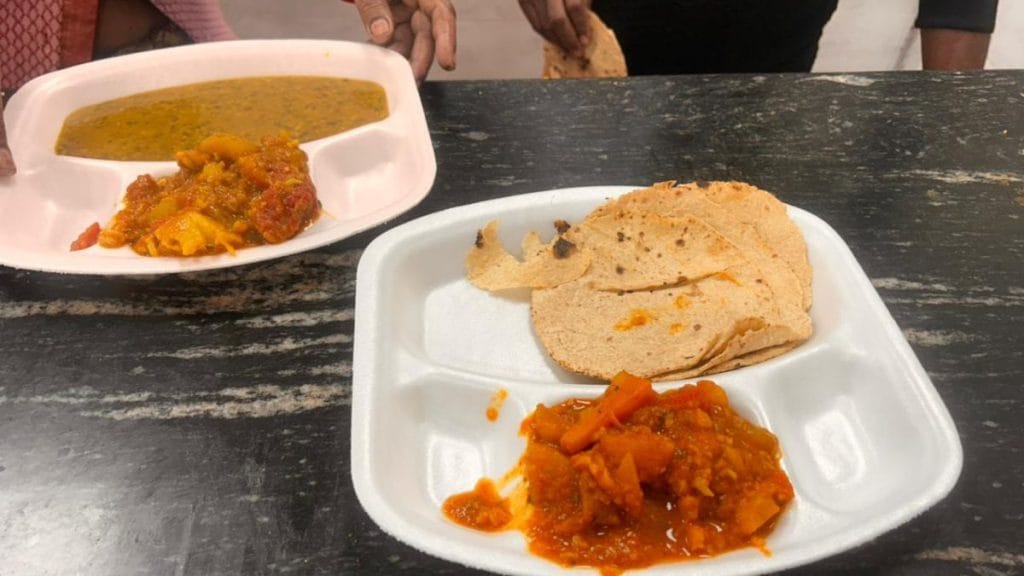
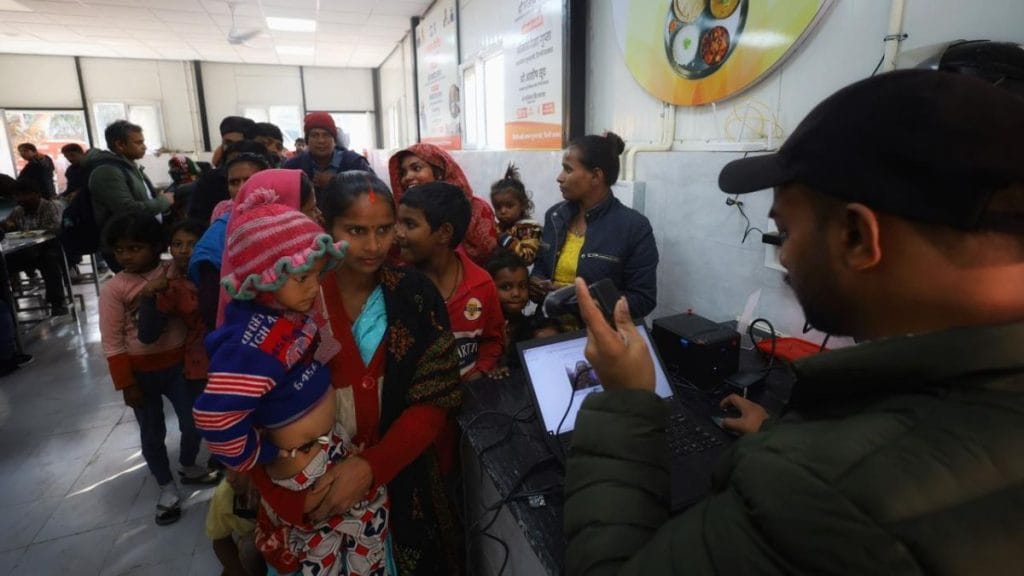
At the entry counter, his name is typed into a system, a webcam photo is taken, and he is handed a paper token. Half an hour later, he picks up a steel plate: four rotis, dal, vegetables and rice.
“For five rupees, this is good,” Rao said. “But I was expecting rice as well, and the rotis are a little dry.”
A few people behind him, the mood shifts. Gurudas Malakar, a 60-year-old migrant labourer from Chhattisgarh, shakes his head. “I probably won’t come again. We cannot afford to stand in a queue for so long for a meal,” he said, suggesting that coupons be distributed earlier to speed things up.
More than 2,000 rotis, 20 litres of lentils, three types of curry and four containers of rice are supplied to each station in South Delhi. There are three stations that are currently working – Nehru Nagar, Greater Kailash and Sheikh Sarai.
Each canteen is issuing around 1,000 coupons a day. On some days, demand spills over that number. By early afternoon, several centres, including Kalkaji and Nehru Nagar, have already exhausted their rice supply. At 2 pm sharp, doors shut. Those still in line return disappointed.
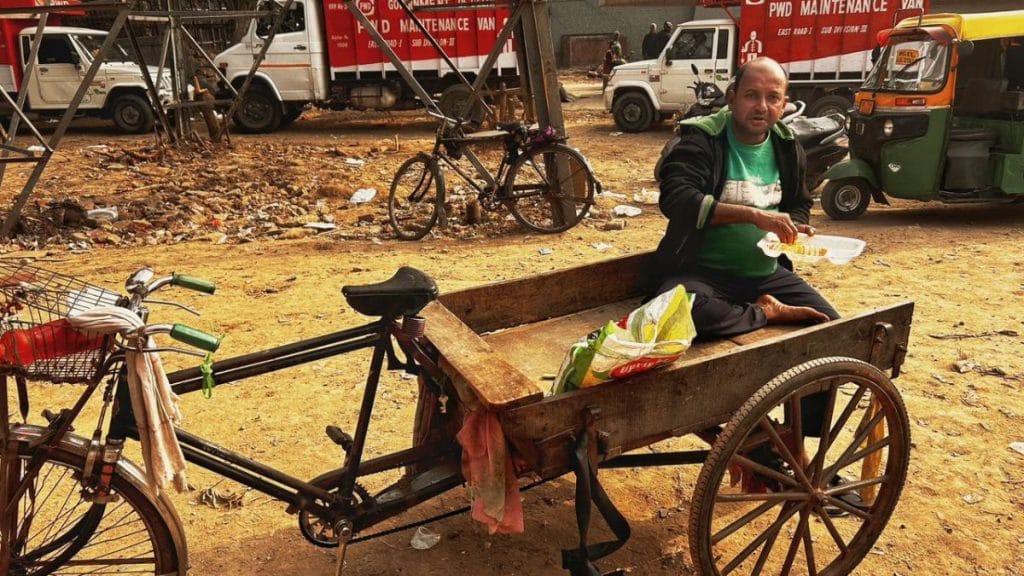
A worker eats his meal outside the Atal Canteen in Nehru Nagar. Manisha Mondal | ThePrint
A mixed crowd, and rising resentment
On Day 5, the crowd at Apna Bazar canteen is eager to see what’s on the menu.
Outside the canteen, serpentine queues form in front of large hoardings of Prime Minister Narendra Modi and Rekha Gupta. Inside, a photograph of Atal Bihari Vajpayee hangs on a bare, whitewashed wall.
Today’s offering is yellow masoor dal and rice. The dal is accompanied by a thick curry of brinjal, potatoes, and capsicum. All vegetables are smashed to give a perfect consistency. A mango pickle is served on the side. The rotis, however, are dry.
The reason for the overcrowding is obvious: the canteens are open to all.
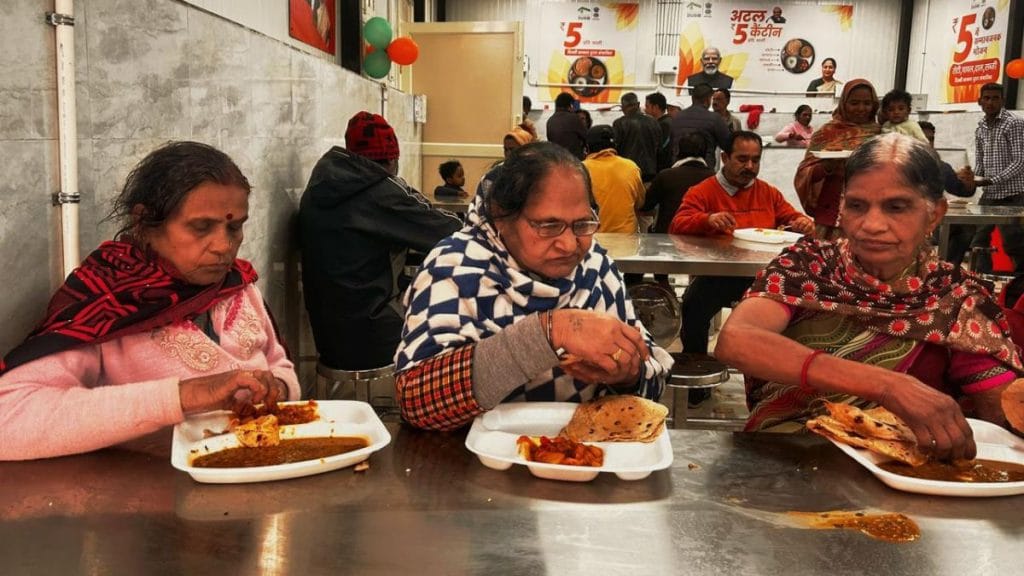
At Kalkaji DDA flats, three friends in their 60s – Kamla Devi, Godavari and Vidya Devi – decided to give the canteen a shot after hearing the buzz.
“I had cooked lunch at home, but we wanted to try the food. I liked the meal, especially the gobhi ki sabji (cauliflower curry),” Kamla Devi said. The canteens will offer a new curry every day.
That curiosity, however, is fuelling resentment among those who rely on the meal out of necessity.
“Yeh jagah Modi ji hum jaise gareebon ke liye banaye hai (Modi has built this canteen for the poor),” Aatma Ram muttered at Apna Bazaar canteen, as better-dressed diners – real estate agents, bank employees – walk past him. “Why are rich people eating here? They can eat anywhere.”
Adding to the confusion is misinformation. Several people, like Aatma Ram, say they were told by social media posts and local news that food would be available from 11 am. When they arrived, service was yet to begin.
Managing hunger, managing waste
Inside the canteens, staff are improvising. Separate queues are being attempted for women and children; people with disabilities are being prioritised.
“It’s difficult to manage so many people, but we are trying,” Ram Kumar, a helper associated with the Greater Kailash MLA’s team, said. “If we are too strict, there can be fights and arguments.”
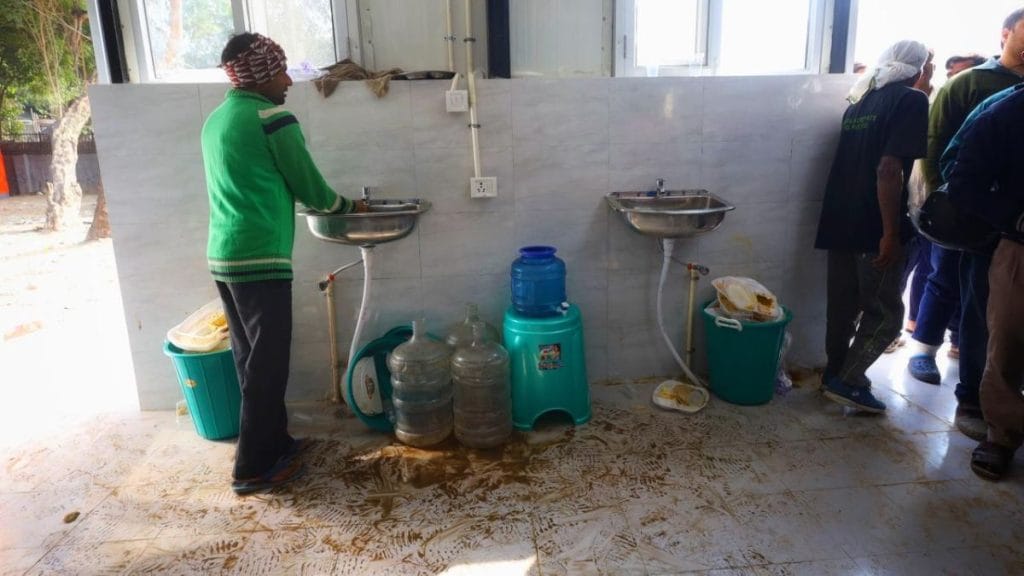
Outside, Lalit Kumar, a hospital housekeeping worker, points to overflowing bins stacked with use-and-throw plates and plastic cups. “Everyone will come to eat – kids, women, and men. But this place must stay clean,” he said, adjusting his mask as black footprints trail across the washing area.
Contractors say leftover food is being sent to nearby gaushalas (cowsheds). The plates, they add, will soon be replaced with steel ones.
“We don’t yet have washing facilities at all locations,” Mukesh Sharma of Sanraj Hospitality, which supplies food to several South Delhi centres, said. “For now, we have to manage with this.”
Old idea, new name
Subsidised canteens are not new to Delhi. The idea has been repackaged, rebranded and relaunched across governments. In 2010, the Sheila Dikshit-led Congress government introduced the Jan Aahar scheme, which offered two nutritious meals a day at Rs 15 a plate for poor and low-income residents. Menus were curated by the Nutrition Council of India, and the programme ran through select locations with modest uptake.
When the Aam Aadmi Party came to power in 2013, the scheme was rechristened Aam Aadmi Canteen. In 2015, then chief minister Arvind Kejriwal cleared a proposal prepared by the Delhi Dialogue Commission to expand subsidised meals to breakfast, lunch and dinner, priced between Rs 5 and Rs 10. But the initiative never scaled up meaningfully, remaining patchy and largely on paper.
The BJP government’s Atal Canteen is the latest iteration of that same welfare promise. At the scheme’s launch, AAP Delhi president Saurav Bhardwaj dismissed the announcement as largely symbolic, arguing that such canteens have repeatedly been announced without sustained execution.
Shailaja Chandra, a retired IAS officer who worked in the Sheila Dikshit government, said a food scheme cannot survive as a political gesture to pay lip service to manifestoes.
“The assumption that everyone in a slum is equally poor is flawed. Many women work long hours outside the home. Kids are in school. Treating slum residents as a homogenous ‘bottom tier’ ignores how urban life actually works,” she said.
She also said measuring the outcomes of such schemes must be done independently because the subsidies come from tax-payer money.
“Data on meals served, costs, quality checks and complaints must be placed in the public domain. Transparency, not slogans, is what sustains welfare schemes. CCTV footage and public show of ribbon cutting and applause is all political – lacking in substance,” Chandra said.
Lessons from other states
Delhi is not the first to try subsidised canteens.
Tamil Nadu’s Amma Canteen, launched in 2016 by former chief minister J Jayalalithaa, is often cited as the gold standard. Meals there are cooked on-site by women’s self-help groups, priced at Rs 1 for idlis, Rs 3 for curd rice and Rs 5 for sambar rice. At its peak, nearly 4.5 lakh people ate at Amma Canteens every day.
But Chennai-based author and political commentator R Kannan says the scheme has lost its sheen in recent years due to “little attention” from administrators.
“These subsidised canteens are the need of the hour. They will be successful in metropolitan cities, especially among the labourers and the unorganised sector,” Kannan, the author of The DMK Years, said.
Rajasthan’s Indira Rasoi, launched ahead of the 2020 Assembly polls, followed a similar decentralised model, serving crores of meals with kitchens located close to points of consumption.
Also Read: Delhi CM inaugurates Atal Canteens, offering Rs 5 meals
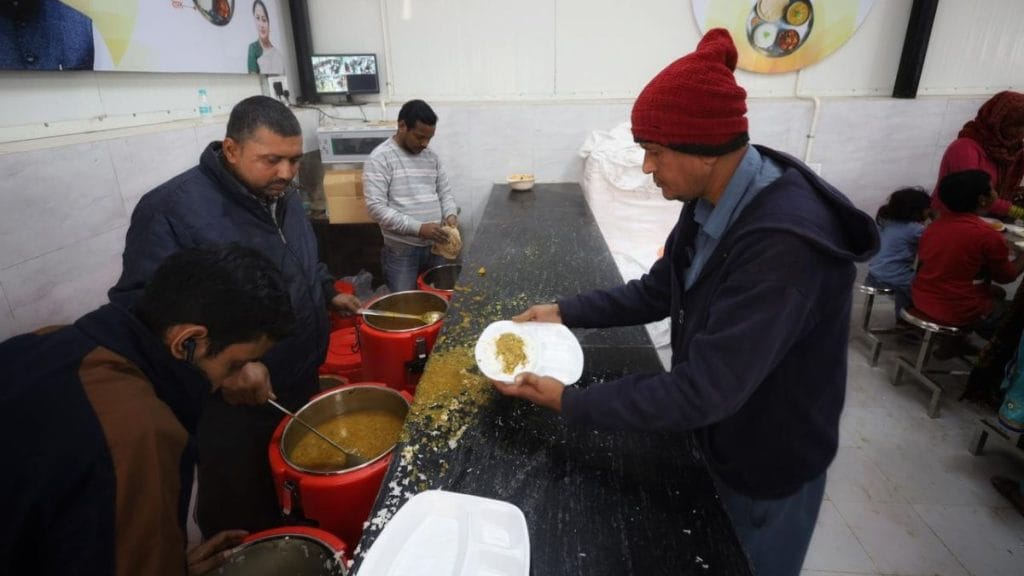
Delhi’s Atal Canteens, by contrast, rely on centralised kitchens. Food for South Delhi centres is cooked at a facility in the Mohan Cooperative Industrial Estate in Okhla and loaded onto tempos by mid-morning and transported across the city by 10:30 am. It is packaged well and mostly remains warm but transport adds cost and delays can be common.
“We have space in the canteen to cook food, if we are allowed we will start cooking in the centres,” Mukesh Sharma said. “We will not compromise on food quality, but it is feasible to cook at the centres.”
S Machendranathan, a retired bureaucrat from Tamil Nadu, who also worked with the Centre, said implementation on the ground is crucial and it’s difficult to determine so early whether Atal Canteens will be a success.
He also praised Tamil Nadu’s bureaucrats for how they implement schemes on the ground.
“The lower level bureaucrats, the lower middle bureaucracy have conscience. They manage the schemes really well on ground. When it comes to food, they do not cheat,” he said.
Atal Canteens have proven one thing beyond doubt: the hunger is real, and so is the need. Delhi has over 40 lakh labourers in the NCR and more than a lakh ragpickers. No canteen scheme can meet that demand without fine-tuning.
This story will be updated once the Delhi government responds to ThePrint’s queries.
(Edited by Stela Dey)