



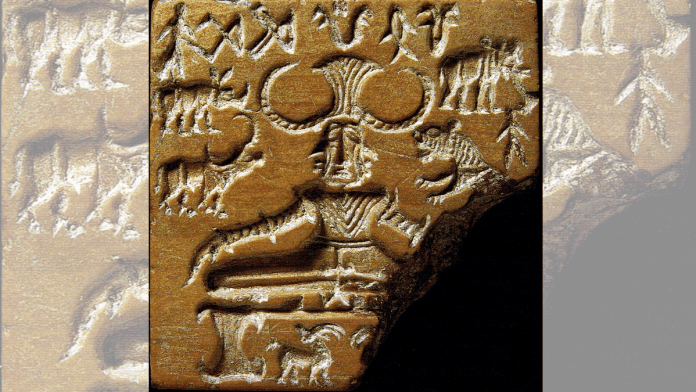
New: Ancient Indian history has always been a contested territory among scholars and historians. Two recent posts by the Ministry of Culture on the Indus Valley Civilisation are proof of it.
The 4,500-year-old Pashupati Seal unearthed at Mohenjo-daro is at the centre of a raging debate regarding civilisational continuity in India. The controversy focuses on whether the seated figure in the seal is an early, indigenous form of the Hindu deity Shiva or merely a deity from ancient Eurasian cultures.
The ministry’s post on the seal, which has been pinned to their X account, has reached a view of 1.5 million in the last five days.
Their recent social media campaign has thrust an old academic dispute into the public arena: whether the Indus Valley Civilisation can be linked directly to later Hindu traditions and Vedic culture.
“One of the most powerful symbols of India’s unbroken civilisational continuity,” reads the post, adding that the steatite seal was discovered at Mohenjo-daro in undivided India this. The seal shows a seated figure in yogic posture (Mulabandhasana or the Root Lock Pose), and surrounded by animals.
“From the Vedic period to contemporary Bharat, this civilisational thread has remained alive and unbroken—deeply embedded in our philosophy, rituals, and collective consciousness,” the post further reads.
On 31 May, the culture ministry posted about the Indus Dice, saying that the 4500-year-old terracotta piece from the Indus-Saraswati civilisation is a powerful reminder of India’s living heritage.
“Dicing is also mentioned as a popular game in Rig and Atharva Vedas (two of the four sacred Vedic scriptures),” reads the post, which got a million views in just a day.
“Civilisational inheritance is not just about geography or ruins; it is defined by living customs, symbols, rituals, and unbroken cultural consciousness. India is the enduring living continuity of the Indus-Saraswati Civilisation,” the culture ministry posted.
Also Read: Culture ministry responds to ThePrint report—‘courses, training held at archaeology institute’
What is the controversy?
The controversy erupted after American historian Audrey Truschke challenged the culture ministry’s interpretation of the Pashupati Seal, saying that it did not depict Shiva.
“It’s more likely adapted from proto-Elamite iconography, showing an Eurasian deity “Lord of animals”, Truschke wrote on X, adding that “Indian history is amazing, wonderful and fantastic. It’s well worth getting it right.”
Her comment fuelled scholars and cultural enthusiasts across the country, denying her claims on the seal.
In 1921, archaeologist John Marshall proposed that the figure represented a proto-Shiva, an early form of Pashupati. But among historians, his interpretation has been widely debated.
Refuting the claims of Truschke, historian Lavanya Vemsani said that the symbolism of Shiva pervades all of the Indus Valley Civilisation.
“Numerous Sivalingas, along with Siva-Pashupati, found in excavations leave no doubt about early Hinduism in India. In fact, just like modern India, Siva and Shakti are most popular and commonly found across all of the Indus sites,” Vemsani posted on X.
Historian Amish Tripathi, too, took a dig at Truschke. He said that ancient Elam was centred in southwestern Iran and elephants, water buffaloes and rhinoceroses are not native to ancient Elam.
“They are native to India,” Tripathi wrote on X.
Similarly, the ministry’s post connecting the Indus Dice with Vedic scriptures divided X users. But some were more concerned about the ministry’s beautifully crafted post.
“Please keep going. Best wishes to the team drafting these posts. Reclamation is not revision,” wrote an X user.
(Edited by Insha Jalil Waziri)
Amish tripathi is not an historian. If indus people were Hindus we are not Hindus or then the question would be a little the religion of aryans. Two ideas proposed by outsiders about the seal.
You are trying to shield against Dravidian hegemony, she is trying to push for ProtoElamite decipher (there is protoItalic left too, she’s Protestant). And for all the structural left, Elamite and Dravidian converge, go to Agarthia, again cave dwelling in Tibetan.
Author has not explained or eloborated about what is National identity crises as mentioned in Title.
Just connecting Indus civilization and Vedic Civilization is not a crime it is hypothesis that has been arrived by many historians and thats how we people of India connected with both civilizations.
Expected a better , more researched piece on this from The Print. From when did myth fiction writer Amish Tripathi become a Historian? please do not use words loosely. Please check with accomplished academic historians .