





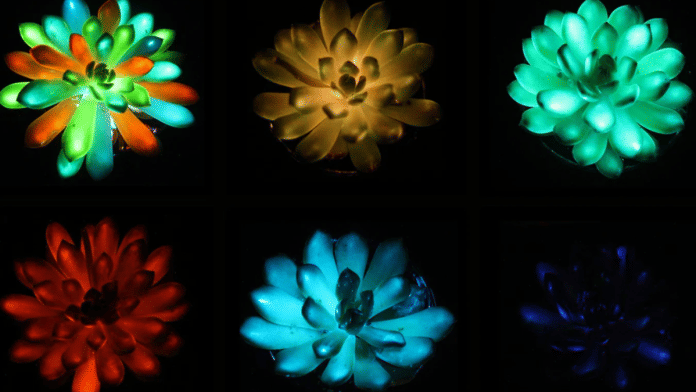



New Delhi: Chinese scientists have used gene-editing to develop Avatar-like glow-in-the-dark plants that could transform urban lighting, tourism and sustainable design. The bioluminescent plants emit a soft natural glow after researchers successfully transferred light-producing genes from fireflies and luminous fungi into plant cells.
So far, more than 20 species, including orchids, sunflowers and chrysanthemums, have already been engineered to shine at night.
The project is led by Dr Li Renhan, founder of Magicpen Bio and a graduate of China Agricultural University, who traced his interest in bioluminescence to his rural childhood.
“I was born in the countryside. Back then, my family didn’t have any money, so at night I could do nothing but lie in a hammock in my grandfather’s bamboo grove to cool off. Fireflies often landed on my arms,” Renhan told EuroNews.
Avatar-like plants
The plants were recently demonstrated publicly at the Zhongguancun Forum, where researchers examined experimental specimens and showcased flowers emitting visible light without external power sources.
During his studies, Renhan started exploring whether the bioluminescence mechanisms of fireflies could be transferred into plants.
“We wanted to transfer genes from animals, like those of fireflies, into plants so they could also glow at night. We’re dedicated to bringing this technology to cultural tourism and the nighttime economy. Imagine a valley filled with glowing plants in the dark, it would be like bringing the ‘Avatar’ world to Earth,” Renhan said.
This, however, is not the first instance of Chinese scientists delving into creating bioluminescent plants.
In 2025, a group of researchers at South China Agricultural University chose a different approach, injecting six-to-eight-micrometer phosphor particles into succulents that recharge via sunlight or LED exposure. This method creates temporary but brighter illumination compared to the genetic approach. The study was published on 27 August in the research journal Matter.
Led by Shuting Liu, researchers injected the succulent Echeveria Mebina with strontium aluminate, a material often used in glow-in-the-dark toys that absorbs light and gradually releases it over time.
The United States-based synthetic biology company Light Bio’s produced the USDA-approved Firefly Petunias, engineered with enhanced fungal genes for safer, mushroom-like luminescence available for commercial use.
These are outcomes of previous studies and experiments, like one conducted in 2018 by engineers at the Massachusetts Institute of Technology (MIT).
MIT researchers experimented on plant composition to perform diverse functions. These include plants that have sensors printed onto their leaves to show when they’re short of water; one that can record and transmit 3D images of its surroundings; and even a plant that can detect chemicals used in explosives in groundwater.
Led by MIT’s Strano Research Group, the scientists found that by embedding nanoparticles into watercress leaves, they could create a faint light for three-and-a-half hours.
Also Read: Magic glue to heal broken bones? Chinese scientists’ ‘3-minute’ fix
How bioluminescent plants are useful
The highly efficient and low-carbon plants developed by Renhan’s team only need water and fertiliser, and would save energy, reduce emissions, and light up cities at night.
While such plants could boost tourism, the research team’s focus is on more day-to-day uses. These plants could provide illumination for parks and public spaces without electricity, relying only on water and nutrients to function.
Researchers say similar techniques are already helping scientists observe how diseases develop at a cellular level, accelerating drug discovery and improving treatments for previously difficult conditions.
By editing susceptibility genes in rice, scientists have bred new strains resistant to multiple pests, providing a solid foundation for global food security.
(Edited by Insha Jalil Waziri)