





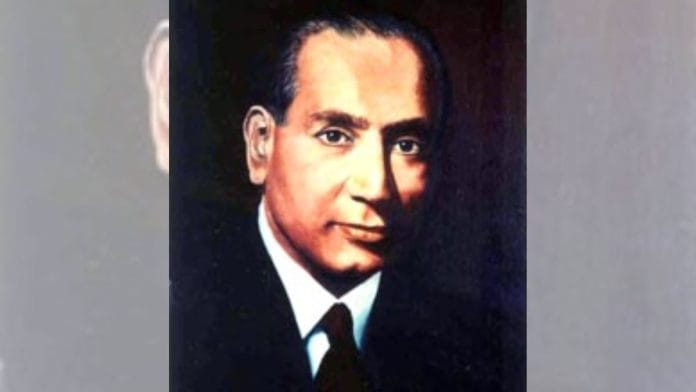



New Delhi: On 3 April 1949, Prime Minister Jawaharlal Nehru laid the foundation stone of Lucknow’s Institute of Paleobotany, the first of its kind in India. It was named after the genius paleobotanist Birbal Sahni, who had spent years establishing a foremost institution focused on paleobotany.
He had even planned to stock the institute with his personal collection of fossils from across the world. But when the institute finally came to life, Sahni could not be there to steer it to its new journey. The geologist died of a heart attack a week after the institute’s inauguration.
Known as India’s foremost paleobotanist, Sahni dedicated his life to studying plant fossils and discovering the secrets of the Earth’s history, from the Gondwana period 300 million years ago to even the Jurassic period 145 million years ago. Beyond that, he was also one of the biggest champions of science education in independent India, serving as the president of the National Academy of Sciences, India, and as the founder of India’s first institute of paleobotany.
The mantle of the institute was then taken over by his wife, Savitri Suri, who then ably handled its construction and establishment of what is now known as the Birbal Sahni Institute of Paleosciences (BSIP).
“Prof. Sahni’s work bridged botany and geology, laying the foundation for palaeobotanical research in India,” said Mahesh Thakkar, director of BSIP. “His legacy lives on through our institute’s research and discoveries, advancing our knowledge of the planet’s past.”
Early life and childhood
Sahni was born in 1891 in the town of Bhera in present-day Pakistan. In his biography written by Shakti M Gupta, historian and Birbal Sahni’s niece, it was said that his mother travelled from Lahore to Bhera for the birth of all her children, since all ‘auspicious’ occasions needed to be celebrated at one’s ancestral home. He belonged to a family of scientists; his father, Ruchi Ram Sahni, was a chemist and meteorologist, and his younger brother Mulk Raj Sahni was a paleontologist who also studied at the University of Cambridge alongside his older brother.
Birbal Sahni was one in a long list of Indian scientists who all trace their birth back to Bhera, a small village in pre-Partition Punjab. Other eminent Indian scientists and scholars from Bhera were Daya Ram Sahni, an archaeologist famous for the excavation of the Indus Valley site of Harappa, and also chemist Shanti Swarup Bhatnagar.
In a paper titled ‘Bhera, Pakistan: Birthplace of science in Punjab at the turn of the nineteenth century’, paleontologist Ashok Sahni wrote how a group of well-to-do Punjabi families in Bhera with access to education and ‘a spirit of competitiveness’ changed scientific education in India.
“If there is someone who played a major role in Birbal and Mulk Raj’s lives, it was their father, Ruchi Ram Sahni. He strove to get educated himself and was able to send all five of his sons abroad to study,” said Ashok Sahni, who is also a nephew of Birbal Sahni. “When it was time for me to choose a career – my father, grandfather, uncles, all were scientists. There wasn’t really a choice.”
Birbal Sahni’s early days were spent trekking in the Himalayas with his father and brothers, from Pathankot to Amarnath to Rohtang and even the Machoi Glacier. Shakti Gupta wrote that it could have been a reason for his interest in geology and fossils.
Ruchi Ram Sahni was a Professor of Chemistry at Government College, Lahore, and worked under nuclear physicist Ernest Rutherford in Manchester. Birbal, his second son, graduated from the University of Cambridge in 1914.
Also read: How Pakistani archaeologist Ahmad Hasan Dani uncovered the history of the subcontinent
Contribution to science
Birbal Sahni mainly studied fossilised plants from the Indian subcontinent, and helped build evidence for one of the biggest scientific theories of all time — the Continental Drift Theory. Proposed by Alfred Wegener, the theory suggested that all continents were once joined together as one landmass named Pangea.
One of the most striking pieces of evidence for this theory comes from paleobotany; fossils of the same plant found on different continents indicate that they were once joined together.
However, in the early 1920s, the theory was still considered dubious by scientists, especially geologists across the world, and botanical evidence alone was not enough to convince them. That changed when Sahni and his mentor, British botanist Albert Seward, published their report on Indian Gondwana plant fossils—a taxonomy of all plants that grew from 300 to 130 million years ago in the Indian subcontinent.
“Prof. Sahni was a rare combination of the botanist and the geologist and the unique position he held in both the sciences made him eminently suited to bridge the gulf that separated them,” said SR Narayana Rao, paleobotanist, in an article published on BSIP’s website.
But Sahni didn’t just study paleobotany; he practically built the field in India. After returning from Cambridge, Sahni took up the role of a professor at Banaras Hindu University, Varanasi, and then later at the University of Lucknow, in the departments of Botany and Geology.
This is where he established the Palaeobotanical Society with like-minded scientists and some of his own students in 1946. With the help of SS Bhatnagar and Nehru, who was a dear friend of the Sahnis, the idea to establish an Institute of Paleobotany came to fruition. Despite donning many hats, Birbal Sahni’s strength and passion lay in the field of paleobotany, to which he contributed the most.
“He was first and foremost a researcher. His main love was research in the subject he pursued, and he was an academic in the true sense. Everything else came later,” said Ashok Sahni.
(Edited by Ratan Priya)