








New Delhi: After half a decade of boom, Bihar’s Rs 3,000 cr makhana industry is struggling to increase its cultivation area, a stagnation that threatens the crop’s growth.
Between 2022 and 2025, the cultivation area of the aquatic crop in Bihar remained at around 35,000 hectares.
Bihar produces more than 85 per cent of the world’s makhana, and the crop has made waves in the global culinary scene. It has become a superfood sensation, with its popularity soaring.
According to the state Horticulture department data, between 2012-13 and 2021-22, the area under makhana cultivation increased by 171 per cent and the total crop production shows a growth of 152 per cent in the same period.
Stagnant acreage, erratic rainfall, labour-intensive farming, and slow mechanisation are choking expansion, even as demand soars and the government sets ambitious targets to double the cultivation area and jobs. The gap between policy vision and ground realities now threatens to blunt Bihar’s makhana momentum. More than 50 thousand households in the state are directly associated with it.
Makhana experts pointed out multiple factors behind the stagnation of the cultivation area of makhana.
“With challenges like climate change, limited technology, and labour-intensive processes, and its cultivation limited to the mallah community, the industry’s growth is hitting roadblocks,” said Indu Shekhar Singh, head and principal scientist at Darbhanga’s Makhana Research Centre (MRC).
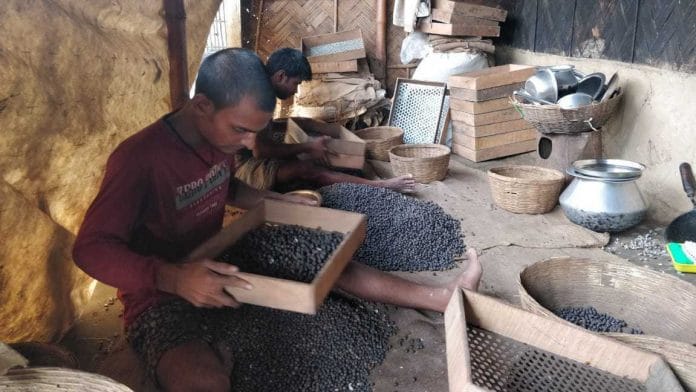
According to Singh, in the past few years, makhana’s expansion on the ground has become a challenge. “It will not expand until people other than the mallah community join this profession. Also, most of the work is still done manually, so the harvesting machines are a must,” he said, adding that work on the machines is underway and next year they will come to the market.
Bihar’s Economic Survey report tabled recently in the assembly also confirms the stagnation. The report suggests that between 2022-25, the cultivation area fluctuated between 27-28 thousand hectares annually with a production of around 58.8 metric tonnes.
However, experts said the government data is not correct. “For the last few years it is around 35k hectares. This is true that it is not expanding at a large scale,” said Singh.
In the Economic Survey, the government aims to double the cultivation area to over 70k hectares and generate five lakh jobs.
“Over the years 2026-30, the makhana roadmap plans to double the cultivated area to over 70,000 hectares, quintuple exports over the 2024 baseline, quadruple processing and storage capacity and generate five lakh suitable full-time jobs,” reads the report.
Also read: Where’s the makhana capital – Darbhanga or Purnea? Fight for Makhana Board turns political
Erratic rainfall also a challenge
The Makhana industry is driven by growing demand for healthy snacks and traditional delicacies. But for the water-intensive crop, the erratic rainfall poses the biggest challenge.
Professor Vidyanath Jha, pioneer makhana researcher and author of the 2003 book Makhana, explains that the quantum of annual rainfall decreased in Bihar. “It resulted in a reduction in natural waterlogging, which is a must for makhana cultivation,” he said.
Bihar shows average annual rainfall of around 1200 mm historically, but in the last decade, it experienced a deficit of up to 25 per cent.
Jha, a resident of Darbhanga, said that from 2018, the areas of Darbhanga and Madhubani, which were once the leading producers of makhana faces a water crisis. “It is something unprecedented that I haven’t seen in my last six decades. Small rivers and streams are drying up and due to less rainfall, the groundwater table is also not getting recharged,” he said.
However, to expand the area, the government’s focus is now on the wetlands. “Bihar possesses 9.12 lakh hectares of waterlogged land with makhana production potential,” said Anil Kumar, principal investigator, Makhana Development Scheme, also known as Makhana Man of India.
But according to Singh, using wetlands is not easy. “Most of the wetlands are under government control and some areas are privately owned. It needs government support; without that, the plan will not be successful,” he said.
In the last five years, makhana got the Geographical Index (GI) tag, the Bihar government organised the Makhana Mahotsava, and the Modi government announced the setting up of a Makhana Board.
“If Bihar’s makhana magic overcomes the hurdles, then it will continue to thrive,” Singh said.
The land is under illegal occupation of squatters – most of whom are illegal immigrants from Bangladesh.
Bihar just needs a CM like Himanta Biswa Sarma – and there would be ample land everywhere for the makhana industry.