








Kolkata: Ritwik Ghatak’s cinema hovered around the issues of famine, partition and forced migration. Fifty years after his death, the Special Intensive Revision exercise in West Bengal makes the auteur relevant again.
And global conflicts making people homeless and forcing them into mass migration give a whole new meaning to his socially realistic and politically charged movies like Ajantrik (1958), Meghe Dhaka Tara (1960), and Komal Gandhar (1961).
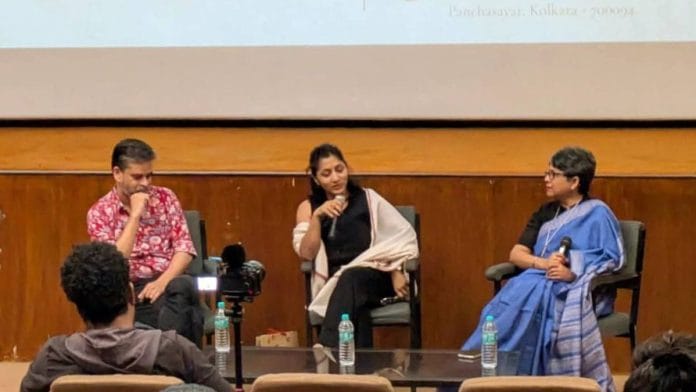
At a panel discussion titled ‘Ghatak at 100: New Interventions’ organised by the Kolkata Partition Museum Trust at the Satyajit Ray Film & Television Institute, discussants spoke about the enduring legacy of Ghatak’s mad genius.
Also read: When Soumitra Chatterjee punched director Ritwik Ghatak in the face
Fact, fiction, and much else
Shamya Dasgupta, who has edited a book of essays on Ghatak titled Unmechanical: Ritwik Ghatak in 50 fragments, said the late filmmaker was never as popular as Satyajit Ray. “If his 100 years were not celebrated, few would have had any issues. But it is being celebrated because Ritwik is as relevant today as he was during his time. Place your finger on the world map, and you will see conflict, human suffering, forced migration,” Dasgupta said.
If one were to look at West Bengal itself and the noise around the SIR exercise, Dasgupta said, one could make a film like Meghe Dhaka Tara all over again. “He was not just another filmmaker. Sudhir Mishra has said every time he takes a shot, he thinks about how Ghatak would have shot the scene. Martin Scorsese talks about him till today. Ghatak’s cinema is internationally relevant still,” Dasgupta said.
Dasgupta said he has always been fascinated by the auteur’s films and writings. But he has never thought of authoring a book on the filmmaker all by himself, given the vast extent of his genius. Instead, he edited a book of essays by 50 writers. “I was not aware there were so many people willing to write on Ritwik so many years after his death,” Dasgupta said.
The critical and the commercial success of the book, not just in Bengal, but in Delhi and Kerala, as well as the number of people who approached him after the book came out, made him think that he probably could have done a fatter book with 50 more writers.
For poet and writer Maitreyee Bhattacharyya Chowdhury, Ritwik Ghatak doesn’t just belong to Bengal. Growing up in the Northeast in a family that escaped the horrors of Partition, Chowdhury said that Ghatak, who has drawn from and produced such brilliant cinema about Partition and its aftermath, speaks to generations of East Bengal refugee families, even beyond Bengal. “Ghatak is Northeast’s jamai (son-in-law),” Chowdhury said, alluding to the filmmaker’s enduring popularity.
Chowdhury spoke about her upcoming literary fiction on Ghatak, titled Letters from the Asylum: Binoy Majumdar and Ritwik Ghatak, to be released early next year. It is based on the poet Binoy Majumder and Ghatak’s time together at the Gobra mental hospital in Kolkata in 1969.
“Mad geniuses both, Majumdar and Ghatak shared so many common traits. They were both intuitive and could see through other people’s bullshit, they had a great sense of humour and had the same Partition angst,” she said.
The Partition had affected Majumdar so much that he had walked across the Ichamati river that flows from Bengal to Bangladesh not once but thrice, Chowdhury said, once even managing to cross over to the other side without a visa and staying illegally for over a month.
Binoy Majumdar belonged to the Matua community.
“Creativity is often associated with madness. If not madness, then the freedom to be mad should be celebrated in the creative space,” Chowdhury said.
Also read: Ritwik Ghatak as FTII teacher: This is the only place in the world where people still want me
Not an easy man to know
Author and initiator of the Kolkata Partition Museum Project, Rituparna Roy, said Ghatak is far more than Partition and alcoholism. The genius who died at 50 needs to be constantly engaged with.
Speaking at the event, former professor and head of the film studies department of Jadavpur University, Sanjoy Mukhopadhyay, recalled how Ghatak used his camera like a pen.
He added that Ghatak was a man misunderstood, by critics, by lovers of Bengali cinema, neglected at home, and even expelled by the Communist Party of India.
And the filmmaker did not make it easy for himself. Mukhopadhyay recalled how Ghatak had once given an interview to the Hindustan Times, calling Swedish filmmaker Ingmar Bergman a fraud and an arch reactionary. Later, when FTII, Pune, organised a talk on Bergman and invited Ghatak to speak, the latter said: “Bergman was great. Great, like anything!” When a member of the audience pointed out that Ghatak had himself called Bergman a fraud before, the filmmaker reacted angrily and said, “So? It is between Bergman and me. For you, he is great!”
“You need a whole new system to understand Ghatak. I had called it Ritwiktantra,” Mukhopadhyay said.
(Edited by Theres Sudeep)