








New Delhi: Persia and Patliputra, now Patna, shared a connection over 2,300 years ago. So much so that the Achaemenids had an impact on the Ashokan architecture, according to historian and author Upinder Singh, who offered a detailed explanation based on epigraphs and inscriptions.
The Achaemenid, the first Persian empire, was the largest empire (550-330 BCE) of its time, stretching from the Balkans and Egypt to the Indus Valley.
“To understand ancient India, we need to understand the larger world that ancient India was a part of, especially Iran and Central Asia,” said the Ashoka University professor, delivering her lecture titled A Persian palace in Patna? Looking afresh at the Mauryas and Achaemenids at Delhi’s India International Centre (IIC).
The lecture was moderated by history professor Nayanjot Lahiri and joined by renowned historian and scholar Romila Thapar.
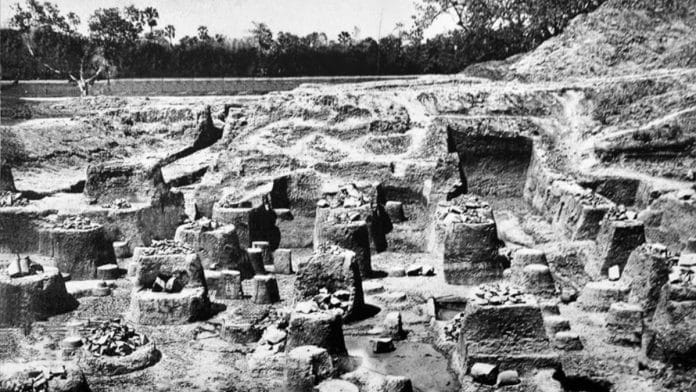
Singh’s 45-minute-long lecture discussed the hunt for the Maurya palace in Patna, with a special focus on American archaeologist and linguist David Brainerd Spooner’s conviction. Spooner was convinced that he had found a Persepolitan palace—a ceremonial capital of the Achaemenid empire—in Pataliputra. He also claimed a Zoroastrian connection between the two empires.
Even if these theories went too far, Singh said attention needs to be paid to Spooner’s larger point about the importance of migration connecting ancient Iran and India and the close interactions that must have taken place over the centuries.
“These interactions took many forms, political, economic and cultural. They began long before the Achaemenid and Maurya (321–185 BCE) periods and continued long after the demise of these two dynasties,” she said.
Also read: Satellite imagery is redrawing India’s archaeological map
Hunt for Pataliputra
The initial impetus for the hunt for Pataliputra, the capital of the Maurya empire (321–185 BCE), came from Greco-Roman sources—largely Indica written by Megasthenes. He was the ambassador of Seleucus Nicator to the court of Chandragupta Maurya, the founder of the Mauryan empire.
Singh said it was in 1793 that William Jones, a British Orientalist and James Rennel, a pioneering British geographer and the first Surveyor General of Bengal, identified Pataliputra as the modern-day Patna.
But several decades later, the publication of the French translations of the travelogues of Chinese pilgrims Faxian and Xuanzang created a sensation in the scholarly world and gave a fresh impetus to locating the ancient Maurya capital.
The explorations started. There were many individuals connected with this over time, including British surveyor Francis Buchanan, first ASI director general Alexander Cunningham, Scottish explorer LA Waddell and archaeologist PC Mukherji.
But Spooner was the real hero. “His main aim was to find Ashoka’s palace at Kumhrar,” she said.
The fresh exploration was funded by Parsi millionaire and philanthropist Ratan Tata and was the first large-scale private funding of archaeological work in India.
At the site, Spooner found numerous pillar fragments with a polished surface. The base of one of the pillars had certain symbols which seemed to be mason’s marks.
“Spooner thought that these were similar to symbols found at Achaemenid sites. There was no other structure of this kind in India,” she said, adding that he thought what he discovered was the hall of 100 columns.
Spooner’s theory was that the Mauryans had constructed a replica of Persepolis at Pataliputra.
He argued that the Mauryans, who introduced this, were Iranian in race and Zoroastrian in faith. Going so far as to claim that Chandragupta Maurya, Chanakya and Buddha were Persian.
His claims provoked widespread criticism and public outrage. Even ASI director general John Marshall suggested a break. “Go to the hills for some months and forget your excavations,” Marshall told Spooner.
“A Zoroastrian period of Indian history never existed nor indeed was any existence to be expected,” said Sanskritist AB Keith, criticising Spooner’s explanation.
After Spooner, Kumhrar was excavated by archaeologists AS Altekar and Vijayakant Mishra between 1951 and 1955. “They said the 80-pillared hall was probably designed and built by Ashoka’s predecessor, Chandragupta Maurya. They refrained from airing any views on possible Iranian influence,” said Singh.
Singh said every now and then, there are reports of the Bihar government’s plans to re-excavate the site and bring the palace to light. In January, Bihar CM Nitish Kumar urged the Modi government to improve the maintenance at the ASI-managed Kumhrar Park.
“The idea of an ancient imperial legacy is important for the state of Bihar and Bihari pride. The possible Iranian connections are not,” she said.
Also read: Nitish vs ASI in Bihar—save Kumhrar Park or smaller state-protected sites?
Epigraphs and inscriptions
Singh said the majority of Ashoka’s inscriptions are in the Brahmi script. However, in the northwestern part of the empire, which included areas of modern Pakistan and Afghanistan, the situation was different.
“Here, the Kharosthi script, Aramaic and Greek were used. Kharoshti and Aramaic inscriptions can be seen as part of the legacy of the Achaemenid interface with India,” she said.
Apart from the script, Singh compares the two empires with the epigraphic style. According to her, the Persian King Darius has long been seen in Ashoka’s epigraphic style.
Singh said Ashoka may have been aware of and adapted certain features of Achaemenid epigraphic practice, namely multilingualism and the use of the first person.
“We should also recognise the ways in which knowledge of Achaemenid epigraphic texts could have travelled from Iran to India,” she said, adding that there are stark differences between Darius and Ashoka’s visual expressions of power.
Singh said the figure of the King is central to Achaemenid art. “But in the Ashokan context, the figure of the king is completely absent, and it is his words that resound,” she said.
(Edited by Theres Sudeep)