








New Delhi: A lecture on India’s old maritime networks also became an homage to the late archaeologist BB Lal and how he viewed archaeology as a map of connected cultures.
Lal’s work was sometimes controversial, especially his claim in the 1990s that an earlier temple lay beneath the Babri Masjid, but the discussion focused on the way he viewed civilisation itself.
“He was among the first to emphasise that archaeology is not merely the study of isolated sites, but of networks—networks of people, ideas, technology, and cultural expressions that connected regions and civilisations. And this is becoming even clearer today. Archaeologists are increasingly focusing on these networks,” said Yadubir Singh Rawat, director general of the Archaeological Survey of India (ASI).
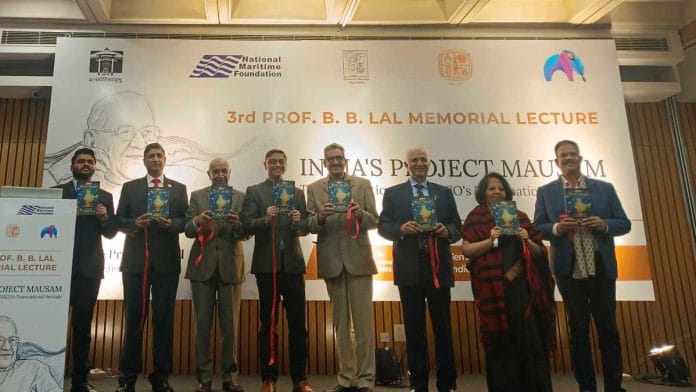
The occasion at Delhi’s India International Centre this week, attended by archaeologists, historians, and senior officials, was the third BB Lal Memorial Lecture on the Ministry of Culture’s Project Mausam, an initiative to trace old Indian Ocean routes and revive these connections. Titled ‘India’s Project Mausam and the geopolitics of UNESCO’s transnational heritage’, it also saw the launch of a new book, Operationalising Project Mausam. But the first item on the agenda was a tribute to Lal, who served as director general of the Archaeological Survey of India from 1968 to 1972 and authored 20 books.
Lal’s work was revisited through his excavations in Harappan and Ramayana-related sites, as well as his work to bring scientific discipline into Indian archaeology.
“He told us to be righteous, upright in integrity, honesty, ethics, and morality. He said there is only one way to do things, and that is the right way,” said his son, retired Air Vice Marshal Rajesh Lal.
The event was organised by the Prof BB Lal Memorial Committee in collaboration with the ASI, the National Museum, the National Maritime Foundation, and the Archaeological Society of India. Speakers included Rawat; Vice Admiral Pradeep Chauhan (retd), director general of the National Maritime Foundation; senior maritime archaeologist Himanshu Prabha Rey; and SK Manjul, additional director general of ASI, and Sanjeev Sanyal, member of the Prime Minister’s Economic Advisory Council.
While Rajesh Lal spoke about his father’s values and lifestyle, others turned to his scholarly work and its impact.
“He modernised excavation techniques, standardised documentation, and integrated geology, palaeobotany, and radiocarbon dating into archaeological work,” said Rawat.
Also Read: Ancient coins found in Rajasthan show India’s currency history goes back to 7th century BCE
A force in Indian archaeology, land to sea
Calling Lal “a visionary who reshaped understanding of western India”, Rawat recounted how his excavations at Hastinapur, Purana Qila, Ayodhya, and other major sites established foundational cultural sequences for India’s protohistoric and early historic periods.
“Through the Ramayana Sites Project and UNESCO, he expanded ASI’s global and interdisciplinary engagement. Equally important was his mentorship and the cadre of archaeologists he trained, who later led the ASI. Together, these contributions made him one of the institution’s most influential figures,” Rawat added.
The Ramayana project covered excavations at sites linked to the epic, including Ayodhya, Bharadwaj Ashram, Nandigram, Chitrakoot, and Sringaverapura. Lal’s work extended beyond India as well, including his role in a UNESCO campaign in Nubia in southern Egypt and Sudan in the 1960s to document sites threatened by the Aswan High Dam.
For BB Lal, archaeology was a way of life and his family was involved too. Rajesh Lal recalled how his mother, Kusum Lal, travelled with her husband on every excavation from 1941 onwards.
“She accompanied him to all excavations from 1941. Every excavation, every month, every time there was a camp — she was there,” he said.
The evening then returned to the theme of sea networks, with maritime archaeologist Himanshu Prabha Ray taking the stage. Project Mausam, aimed at reconnecting historical and cultural ties between India and 39 countries across the Indian Ocean, from Cambodia to Tanzania, is a way of reading the Indian Ocean as a shared cultural space.
Ray said India must adopt UNESCO-aligned methods that identify archaeological and monument sites along ancient trading routes and build a research-based maritime narrative.
“We need to identify monuments. We need to identify archaeological sites which connect,” she said.
She also stressed that Indian archaeology must widen its scope to include the histories and archaeologies of other countries to do justice to the project.
“We have not developed the expertise in the histories and archaeologies of other countries. We only do Indian history,” she said. “Project Mausam connects countries, connects communities, and brings this shared heritage to the global stage.”
(Edited by Asavari Singh)