





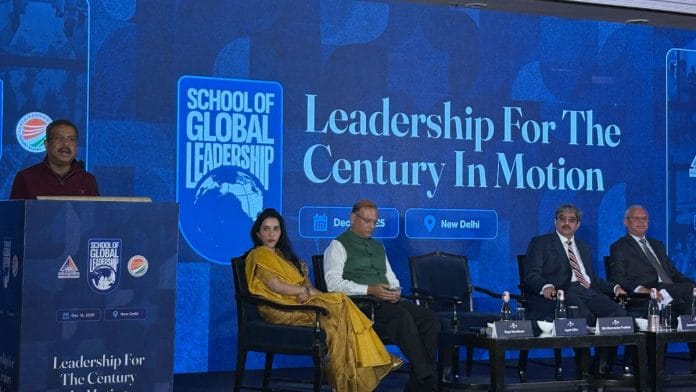



New Delhi: In a world where decisions taken in one country can send shockwaves across continents, leadership is no longer about authority but preparedness. Speaking on global uncertainty, former Minister of State for Civil Aviation Jayant Sinha outlined what he called the “four Ds” shaping today’s age of polycrisis: de-globalisation, technological disruption, demographic decline, and decarbonisation.
“But if we train people well and challenge them to confront these disruptions head-on, we can turn crisis into opportunity — as we did during COVID. That is the kind of leadership we seek to develop,” he said, during the launch of the School of Global Leadership (SoGL) in New Delhi on Tuesday.
The launch of the school was marked by a promotional film screened at ITC Maurya.
“The problems before us outpace the solutions we inherited. We can’t wait for leadership to emerge by chance. It must be deliberately cultivated. It must be forged in places where learning transcends classrooms,” said the narration in the film.
The school has been launched by BEST Innovation University (BEST IU) in partnership with the India Foundation, establishing itself as a practitioner-led, globally networked institution focused on real-world decision-making rather than abstract theory.
The launch positioned SoGL as an institution aimed at shaping leadership for what it described as a “century in motion.” It brought together senior policymakers, diplomats, and academics, united by a shared goal to create a new architecture of leadership.
Union Education Minister Dharmendra Pradhan attended as the chief guest, while the principal speakers included Rupa Vasudevan, Co-Founder and Chancellor of BEST IU; Jayant Sinha, former Minister of State for Civil Aviation; Gautam Bambawale, former Ambassador of India to China; and senior diplomat Jaideep Mazumdar.
“We are in the fifth year of the National Education Policy 2020, which calls for structural reform to elevate India’s education to global standards. As envisioned by the Prime Minister, NEP aims to internationalise education, make it multidisciplinary, and flexible. To further NEP’s vision, we are launching this Indian brand, School of Global Leadership,” said Pradhan.
Designing leaders, not graduates
For Vasudevan, the School of Global Leadership is the outcome of years of questioning what education should truly accomplish in the 21st century.
“What matters most today is not just how intelligent learners are, but how imaginative, ethically grounded, and courageous they can be in solving the world’s most pressing challenges,” she said.
She traced the intellectual DNA of the school to the ethos of BEST IU itself, a state government university in Andhra Pradesh, established in 2018. It now has more than 13,000 students across disciplines ranging from law and engineering to sustainable food systems. The idea, she explained, was never to replicate existing leadership programmes, but to reimagine them from first principles.
At BEST IU, she noted, faculty members are encouraged to see themselves not as instructors delivering content, but as designers of curiosity, architects of inquiry, and co-travellers alongside students.
“Unless faculty can spark wonder, it becomes difficult for learners to ask deeper questions. Leadership begins when a learner asks, ‘What problem do I want to solve, and what impact do I want to create?’” she said.
The same philosophy has shaped the structure of SoGL, which places mentorship, immersion, and interdisciplinary thinking at the centre of learning. Students are expected to engage directly with practitioners — diplomats, policymakers, business leaders, and technologists — who offer experience.
Ram Madhav, President of the India Foundation, laid the school’s intellectual foundation, with Jayant Sinha as chair and Gautam Bambawale and Jaideep Majumdar as co-chairs. The programme already works with 11 countries, showing its international reach.
Also read: India is growing, but not developing, says author Santosh Desai
Leadership in a polycrisis world
For Sinha, India’s trajectory over the coming decades will require leaders capable of operating confidently at a global level, not only in diplomacy, but across business, technology and governance. Rejecting the idea of a bipolar world order, he suggested that the future belongs to a G3 reality, with India emerging as a decisive third pole alongside the United States and China.
“If we want to make India a developed country, then we must create leaders who can give leadership not just to India, but to the entire world,” he said.
He explained how SoGL has been designed around immersive, hands-on learning that places students directly within global ecosystems of action — from Silicon Valley to West Asia and East Asia.
Pradhan turned to history to illustrate the moral weight of leadership. Recounting the legend of the Sun Temple at Konark, he spoke of sacrifice, foresight, and responsibility.
“Leadership is decisive leadership, ethical leadership, sacrifice-centric leadership,” Pradhan said. “Practical experience is always better than classroom learning. This is why such institutions matter.”
(Edited by Aamaan Alam Khan)