





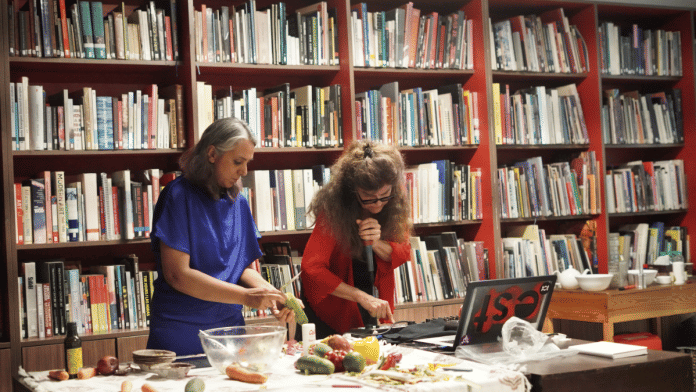


New Delhi: The reading room at the Foundation for Indian Contemporary Art in Lado Sarai doesn’t look like a performance space. There is no stage and no fixed seating. A table with audio equipment stands in the centre of a room filled with floor-to-ceiling bookshelves. People filter in slowly, greeting each other, taking their seats, settling into the room as they wait for something to begin.
Small conversations fill the room as people gather — about research, new jobs, exhibitions — before gradually quietening. A brief introduction follows, tracing the origins of the artistic collaboration between Manmeet Devgun, a Delhi-based performance and inter-disciplanary artist and art educator, and Heike Fiedler, a German-origin writer, and visual and sound artist. the first collaborated in 2015 with the performance of ‘T-able: Sound and Dialogues’ in Geneva, Switzerland.
Sponsored by Pro Helvetia, Swiss Arts Council, The Kitchen and the Self, a mixed-media performance artwork by Devgun and Fiedler, is built around a central idea — cooking as performance, and performance as cooking. Using sound, video, text and live action, the work returns to the everyday act of cooking and the structures around it.
Breaking the fourth wall
The reading room itself shapes how the work is experienced. As Vidya Shivadas, director of the Foundation for Indian Contemporary Art, said, the space is meant to hold work like this in a more informal setting.
“The idea is to create an environment where artists can show work without the pressure of a large venue. It allows for a more intimate engagement,” Shivadas added.
That intimacy carries into the performance. Devgun and Fiedler bring in tables, adjust their placement, and begin to arrange the performance space. It takes a moment to register that this is not preparation, but the work itself.
A tablecloth is pulled out from under a set of utensils, sending them crashing to the floor. Fiedler moves quickly to capture each sound on her mic. The clatter is recorded, looped, and fed back into the room. From here on, nothing disappears. Every sound, every gesture, returns in some form.
A projection runs alongside this showing close-up images of domestic spaces: the inside of a fridge, a spoon turning jam in a jar, scenes from Delhi streets and, elsewhere, a garden in Germany. These visuals layer with ambient sound and spoken fragments, building an environment that shifts across spaces without settling into a single narrative.
At the centre of it all, a salad is being made.
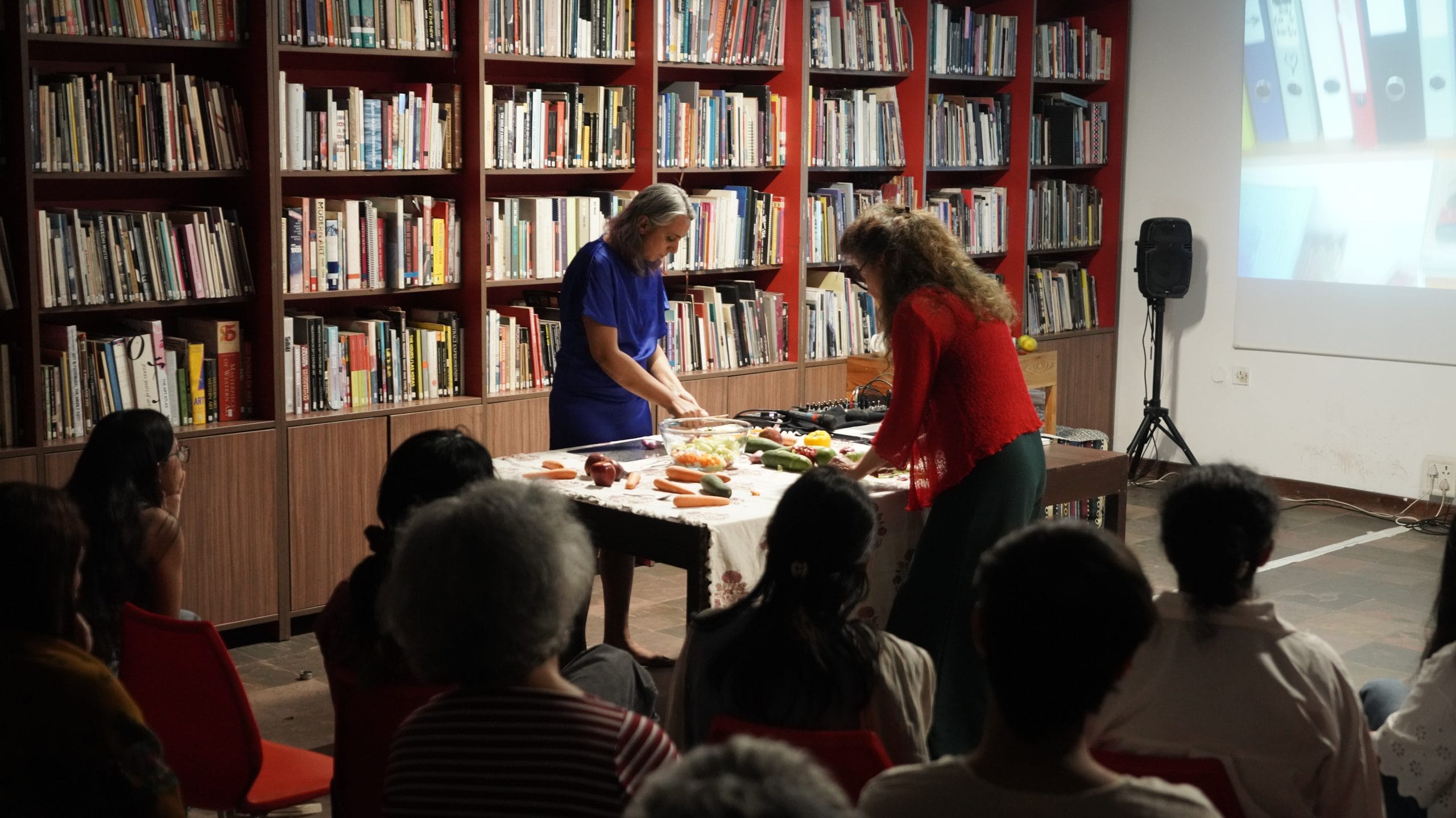
Devgun and Fiedler chop, peel and assemble ingredients while speaking in fragments that move between the practical and the political.
“Every kitchen carries traces of trade, colonisation, migration, gendered labour, and memory,’ Devgun says during the performance, before breaking off, almost mid-thought: “Do onions make you cry?”
“Everything in the kitchen makes me cry,” Fiedler responds.
For Devgun, the politics of the kitchen is personal.
“I’m a single mother. I didn’t love cooking. But you can’t escape cooking if you have a stomach,” she told ThePrint.
What began as a necessity has, over time, shifted in how she approaches it. She describes trying to learn a new recipe every weekend, a way to find some joy in the process, to take control of it rather than be defined by it.
On the other hand, Fiedler’s relationship to the kitchen comes from a different context. “When I was young, I was in the movement of the feminism, and our main idea was not to be in the kitchen, not to cook,” says recalled.
At the same time, she points to how, in practice, cooking remains unavoidable.
She describes finding ways to redistribute the work.
“How can we share the kitchen? Children lay the table, someone picks vegetables, someone cooks, someone cleans. It’s not just one person’s role,” Fiedler adds.
That tension — between obligation and choice, resistance and acceptance — runs through the work.
The audience is drawn into this space unevenly. When Devgun and Fiedler ask for help, there is hesitation. The boundary between performer and viewer is deliberately unstable. When someone eventually steps forward to join them at the table, the performance absorbs the moment without pause.
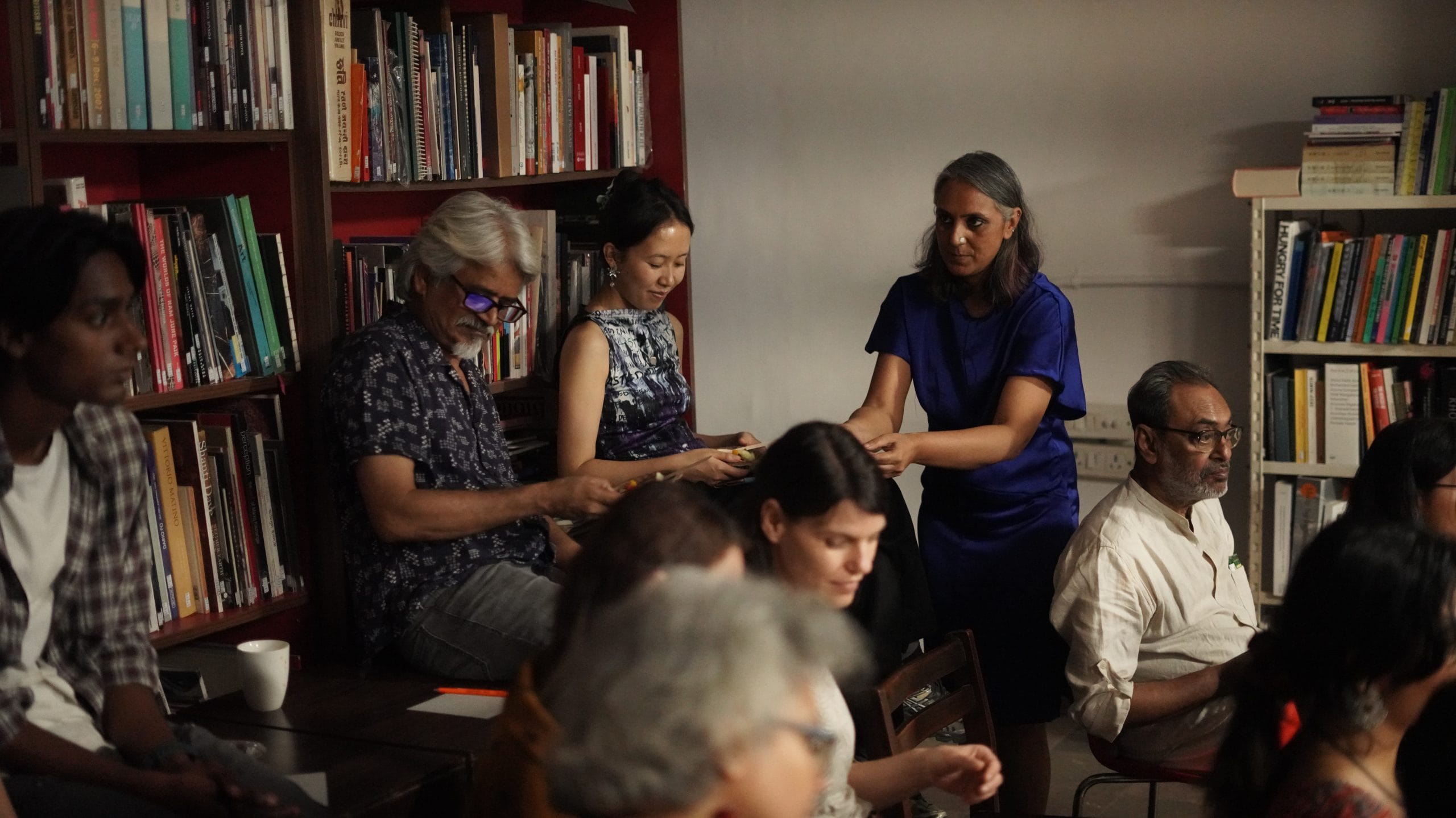
The act did not build towards a single moment or resolution. Instead, it accumulated — sound over sound, image over image, action over action. The salad continues to take shape through interruptions, and is eventually passed around the room, eaten while the performance is still underway.
What remains is less a sequence of events and more a shift in attention. The everyday realities of cooking — repetitive, necessary, often overlooked — are made visible. The Kitchen and the Self does not try to separate performance from everyday life. It stays with the ordinary and asks that it be looked at more closely.
Just as there was no clear point at which the performance began, there is no clear point at which it ends. By the time it settles, the distinction between watching and participating has already thinned.
It’s not possible to break the fourth wall when there never was one to begin with.
(Edited by Insha Jalil Waziri)