








New Delhi: Long before they were published papers or polished lectures, sociologist and academician André Béteille’s ideas often began as lines recited aloud on his morning walks. His lecture notes—meticulously prepared, repeatedly revised—were not just teaching aids but a lifelong discipline, and, as those who knew him recalled, among his most prized possessions.
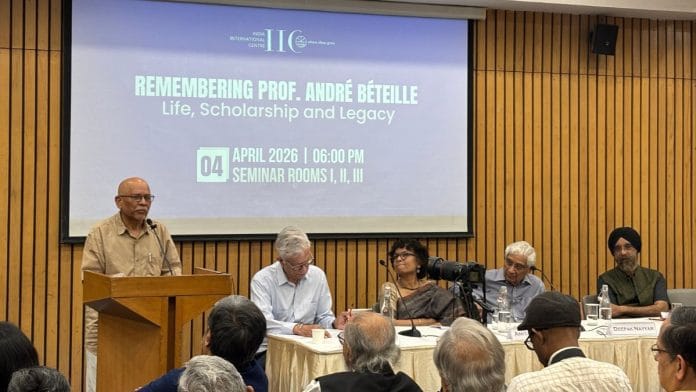
At the India International Centre on 4 April, that discipline became the thread through which a packed room remembered the man himself. Colleagues, friends, students and mentees filled the space, alongside younger scholars eager to listen in—drawn as much by Béteille’s intellectual legacy as by the stories that animated it. The discussion, ‘Remembering Prof. André Béteille: Life, Scholarship and Legacy’, chaired by sociologist Dipankar Gupta, unfolded as both tribute and reflection.
A Padma Bhushan awardee and one of India’s most influential sociologists, Béteille, who taught for decades at the Delhi School of Economics (DSE), was known for his work on inequality, caste, class and democratic thought. He died earlier this year, in February, at 91.
If there was a recurring motif through the evening, it was conversation—formal and informal, in classrooms and tea rooms, across disciplines and disagreements.
The long list of speakers included Romila Thapar, Professor Emerita and historian, sociologist Virginius Xaxa, sociologist Surinder S. Jodhka, economist and former Vice-Chancellor of the University of Delhi Deepak Nayyar, Amita Baviskar, Professor of Environmental Studies and Sociology at Ashoka University, Patricia Uberoi, sociologist and former Professor at the Institute of Economic Growth, Deepak Mehta, Professor of Sociology at Ashoka University, Gopa Sabharwal, Professor of Sociology and Former Vice Chancellor, Nalanda University, and Nandini Sundar, Professor of Sociology at the Delhi School of Economics. Each adding their own fragments to a portrait of a deeply inspiring man.
What emerged was a set of overlapping impressions: a scholar who valued clarity over jargon, conversation over proclamation, and teaching as a vocation rather than an obligation. In the end, it was perhaps fitting that Béteille was remembered not just through his books, but through his notes, his questions, and the many conversations that continue to carry his ideas forward.
Rock star of his time
Thapar traced her association with Beteille back to the early 1960s, when she had just joined Delhi University and was searching for an intellectually stimulating space. “I was beginning to give up,” she recalled, wondering where she would find “all these bright academics”. The answer, she said, was the DSE, especially its tea room. It was there, amid what she called the “rock stars” of the time, that she encountered Béteille.
“I was intrigued by his ideas on how societies function and the status of people within them. These were not easy ideas—they were useful, challenging, and made us want to know more,” she said. With Béteille, she added, “one was constantly pushed to think about society differently.”
What stayed with her were the quieter rituals: conversations that were “incisive and helpful”, often drifting across disciplines, with “a little bit of gossip thrown in”. “I recall these conversations with André with much pleasure. They were delightful,” she said.
That mix of rigour and groundedness surfaced in Xaxa’s recollection of a job interview with Béteille. Asked how he would recognise a peasant in a village, Xaxa remembered the answer was disarmingly simple: look at his hands–“if they are rough”. When Béteille retired, he handed over his lecture notes to Xaxa, who was struck by the care with which they had been prepared. Teaching, he said, was for Beteille not just a profession but a calling.
Xaxa also highlighted his work on agrarian studies and his pioneering engagement with the question of indigenous peoples in India. He described him as an institution builder who stood by colleagues “as a pillar” in difficult times.
Also read: There’s a shift from evidence-based history to belief-driven narratives, say professors
Sociology for good society
For Jodhka, who encountered Béteille first through his writings, what stood out was the “purposefulness” of his sociology.
“He was a scholar with a mission,” Jodhka said. That mission, he argued, lay in carving out sociology as distinct from both anthropology and Indology. Even when working on villages, traditionally the domain of anthropologists, Béteille resisted reducing society to kinship, instead approaching it through structures of inequality. He also broke from dominant frameworks of the time. Béteille was critical of Indological approaches that treated India as exceptional, and wary of rigid ideological positions. While influenced by both Marx and Max Weber, he resisted doctrinaire thinking. “He would say there is a difference between a ‘Marxiologist’ and a ‘Marxist’,” Jodhka recalled, arguing that belief could not substitute for social science.
Nowhere was this clearer than in his work on caste. Rather than treating it as static, Béteille examined how it changed over time, connecting it to class and power, and opening it up to both historical and sociological analysis. Crucially, Jodhka added, Béteille’s work was never confined to academia. “He thought sociology must engage with the larger society,” he said, pointing to Béteille’s writings in newspapers. For Béteille, sociology was not just about classroom discussion, but about contributing to the making of a “good society.”
That concern with communication echoed in Nayyar’s remarks on Beteille’s long association with the Economic and Political Weekly and the Samiksha trust. Describing the “multiple Andres” he encountered over decades, Nayyar spoke of a scholar who combined rigour with institutional commitment. Beteille, he said, was deeply wary of the growing “imperialism of economics” within the social sciences, and pushed for a more genuinely interdisciplinary space—one where economists, sociologists and others could speak to each other. Beteille, he said, was sparing with words but always precise, and remained attentive to the broader decline of academic standards, including at the University of Delhi.
Baviskar’s recollection brought the focus back to the classroom and what it meant to be taught by Beteille. For many students at DSE, Baviskar said it was also an initiation into a certain intellectual culture.
But it was his teaching that left the deepest mark. In the politically charged atmosphere of the 1980s, when many students were drawn to sharply ideological readings, Beteille insisted on something else: openness. He urged them to “put political certitude on hold”, to read widely, and to engage seriously with thinkers like Marx and Weber without reducing them to dogma.
His lectures, Baviskar said, were “the acme of lucidity”—-carefully structured, clear, and the result of years of refinement. “He never, ever missed a class,” she added. “Always prepared, always present.” And if students found themselves lost, his door was open—to anyone in what she called “intellectual distress”.
(Edited by Ratan Priya)