





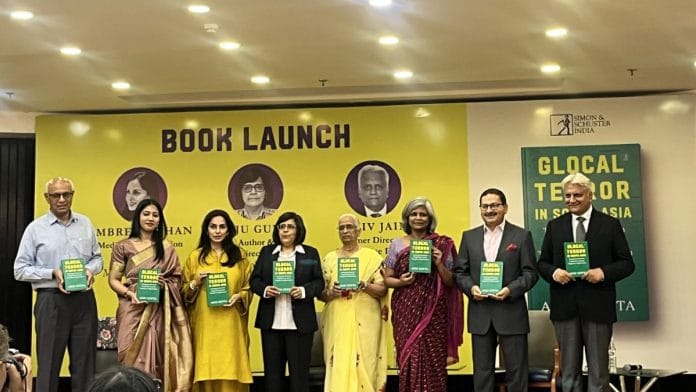



New Delhi: Terrorism can’t be understood just through the actions of extremist groups or “non-state actors”, former IPS officer Anju Gupta said Friday, arguing that global power politics, proxy wars, and geopolitical rivalries often create the very conditions in which violence emerges.
Speaking at the launch of her book Glocal Terror at the India International Centre, Gupta said that focusing only on terrorist outfits offers a narrow view of terrorism that ignores the international forces that sustain a conflict. In a discussion with former Intelligence Bureau director Rajeev Jain, she drew on decades of policing and intelligence experience to argue that countries such as Pakistan, Afghanistan, and Iraq show how strategic decisions determine the evolution of modern terror networks.
“We keep looking at the monsters, but we don’t look at what creates them,” said Gupta, a 1990 batch retired officer.
Speaking about the conflict zone, Gupta argued that terrorism is not solely the work of non-state actors but a product of geopolitical decisions and power struggles.
“What I have seen over the years is that we tend to assess security only in terms of non-state actors or rogue elements. But that is a very limiting view. It is actually the geopolitical wranglings that have contributed to the creation of these threats and their continued existence in our region,” said Gupta.
Also read: Swimming can help older adults age positively, says report. It studied a 99-yr-old patient
Iraq, Pakistan
As the conversation moved to Iraq, Gupta challenged popular assumptions about the “war on terror”.
“It is very easy to disrupt, but very difficult to rebuild. The war on terror in Iraq was fought through disruption—it dismantled systems and societies—but rebuilding them proved far more complex. That is why, within 16 months of the US withdrawal, a much bigger force like ISIS emerged, controlling territory in ways Al-Qaeda never did,” she said.
As the discussion moved to Pakistan, Gupta shared her blunt assessment. She called it an “epicentre of instability”, also highlighting the reasons behind it.
“The number of terrorist incidents that take place in Pakistan every year is in the hundreds. The casualties ran into hundreds, thousands of people… They have serious problems with the Afghan border. They have a serious problem with India. Their economy is in dire straits, and they are kind of balancing all the time between China and America… They are not completely in control of their own destiny,” said Gupta.
According to her, China is smarter.
“The Chinese are trying their best not to get entangled in any military conflict. They have built political and economic relationships all across the world. They operate silently. They are a technological and economic superpower, but they are using a different path,” Gupta said.
The discussion was followed by questions from the audience, which included IPS officers and Gupta’s friends and family. One question was about what lessons India should draw from global conflicts and the war on terror.
“Never invade any country to occupy it, don’t attempt regime change. It’s important to understand these networks of terror and also the geopolitical or domestic political factors which actually shape these security threats. There won’t be any shortcuts to establishing security anymore,” Gupta answered.
(Edited by Prasanna Bachchhav)