








New Delhi: Rashid un-Nisa wrote her novel at a time when women were barely allowed a public voice, let alone a byline. When Islah-un-Nisa,
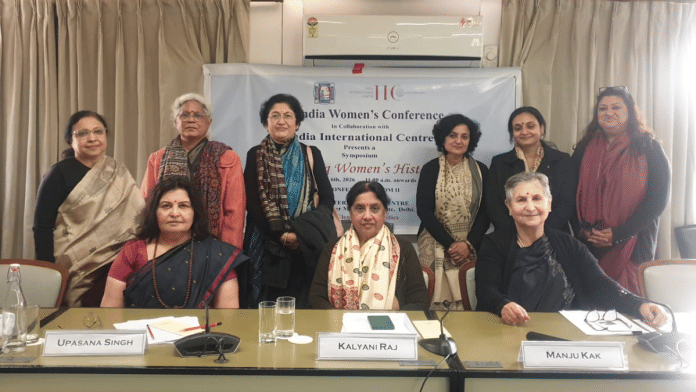
The All India Women’s Conference, on its centenary eve organised a symposium titled ‘Centenary Reflections’ at the India International Centre on 6 January to look back at the gender movement and reforms through women’s writings between the late 19th and 20th centuries. The seminar was to honour the “literary mothers” and pioneers who chronicled the female experience, with panellists Saba Mahmood Bashir, Meenakshi Malhotra, Rekha Sethi, Sanju Thomas, Usha Mudiganti, and B Mangalam.
“Even though she was the first woman novelist in Urdu literature, instead of her name on the cover of the book, it was written, ‘Mother of Barrister Suleiman, daughter of Syed Waheeduddin Khan Bahadur, sister of Imdad Imam.’ But the later editions of the novel had her name on the cover, and in due course, more women were writing,” said Saba Mahmood Bashir, poet, author and assistant professor at Jamia Millia Islamia University.
Bashir, who was presenting her paper on the 20th-century Urdu writer and translator Razia Sajjad Zaheer, said that for a lot of people from Zaheer’s generation, Rashid un-Nisa was a pioneer who opened the door of possibilities for women.
At the event, scholars and writers traced the period as one of intellectual awakening, where women began using autobiographies, novels, essays, and poems, usually in hostile social conditions, and to challenge social practices such as child marriage, widowhood, and the fight for education. From Rassundari Devi’s struggles to learn to read within the domestic space to Pandita Ramabai and Savitribai Phule’s fight for social justice and institutional reforms, women’s writings emerged alongside broader anti-colonial and social reform movements.
Chronicler of a changing nation
For Bashir, the relative invisibility of Zaheer in mainstream literary conversations is not accidental but symptomatic. Zaheer wrote history not through slogans or grand narratives, but through the textures of everyday life.
Known affectionately as “Razia appa (elder sister)” in Urdu literary circles, she created a vast body of fiction, translations and pen-sketches that captured the moral and emotional turbulence of her times, between the 1940s and 1960s, a period marked by the Partition and the emergence of a new India.
“Looking at her body of work, it feels strange that her works aren’t talked about or written with as much attention as they should be,” Bashir said.
Yet, as Bashir points out, Zaheer continues to be remembered primarily as the wife of Sajjad Zaheer, founder of the Progressive Writers’ Association, rather than as a writer in her own right, despite being a recipient of the Nehru Award in 1966 and the 1972 Uttar Pradesh Sahitya Akademi Award.
Her writing, Bashir argued, is quietly political.
“One notices how the social issues in her writings are not mentioned in an apparent manner, but are cloaked in the regular and mundane activities of life; they are always present, and are visible through the writer’s and reader’s sensitivity,” she said.
Women who stepped out of their inner domain
But it was not just women writers who were redefining realities in the late 19th century; women doctors were also changing the course of history.
When Meenakshi Malhotra, a professor at Delhi University’s Hansraj College, traced how early Indian women doctors unsettled rigid gender norms at a time when even Western societies resisted women’s entry into medicine, she found it surprising.
Women’s forays received discouragement and hostility as late as the 1840s and 1850s. Their entry into the medicine field emerged as an attempt to make women’s public presence respectable and legitimate.
Through letters, memoirs, and autobiographical writings, Malhotra shows how pioneers like Anandibai Joshi, Kadambini Ganguly, Haimabati Sen, and Rukhmabai Raut documented the costs of stepping outside the “abarodh” or barrier.
Malhotra said that in revisiting some of this literature, one finds that distinct motifs emerge and portray the challenges of stepping out of the inner domain — the “abarodh” — and the responses the female doctors met with both in the private and public domain.
Be it Hoshi’s letters from America, revealing her life of isolation and fragility in the Western atmosphere, or Rukhmabai’s public challenge to child marriage, Malhotra argued how women not only entered forbidden professions but also rewrote the boundaries of respectability and female agency in modern India.
Recalling the resistance faced by early reformers, Sherina Joshi, associate professor at Delhi University, reminded the audience that institutions such as Pandita Ramabai’s Sharda Sadan were built against all odds. They were built at a time when women who stepped outside prescribed boundaries were met with punishment, when widows were forced to shave their heads and shunned for bearing the consequences of desire.
“Every step women took was hedged in. The freedoms available to women today are not inherited casually, but earned through struggle. And today, if you have freedom, you owe it to them,” she said.
(Edited by Insha Jalil Waziri)