





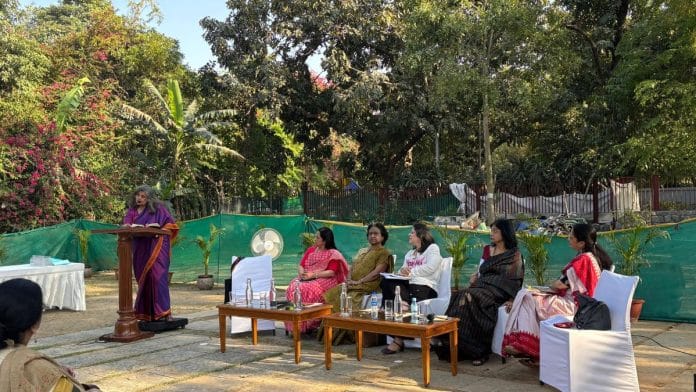



New Delhi: On the eve of International Women’s Day, forty-odd chairs set up under the clear blue sky at Delhi’s India International Centre welcomed audiences to celebrate an evening of Indian women’s poetry, fiction—and the women themselves.
Between the fresh pink blossoms of bougainvillaea and a looming ancient peepal tree sat women who had just entered womanhood and those who had long experienced what that means. The gathering felt like a quiet conversation between generations, reflecting on the enduring nature of sisterhood.
As the audience filled the open courtyard, the hum of Delhi traffic slowly faded away, giving way to the voices of poets, authors, scholars and young writers.
The evening began with writer Achla Bansal, who said the new spring reminded her of her own first book, and the journey of a writer trying to embed a bit of truth in her stories. She read an abridged version of a short story from her collection Vanilla Ice Cream & Chocolate Sauce.
Writer and filmmaker Sagari Chhabra followed with a dramatic reading from one of her plays. It explored what she described as the “banality of evil” in the context of a man-made war—one in which women’s value is limited to their womb, the environment has deteriorated, and yet residents keep repeating “we are free now.” The refrain, Chhabra emphasised, echoed contemporary political realities. The story unfolded outside a bomb shelter as history seemed to pass by its characters, recalling moments when those we now revere as revolutionaries were once punished—Socrates to MK Gandhi. It explored historic tragedies such as Auschwitz and Hiroshima, ultimately urging audiences to reflect on the need for collective responsibility for world peace.
In a quieter moment, in an ode to the women who shaped her and the men who supported her, KE Priyamvada, author, poet and deputy editor of IIC, recited poetry dedicated to her grandmother and father.
Writer, social worker and bibliotherapist Bindiya Bedi Charan Noronha brought a lighter energy to the evening with poems about Women’s Day itself.
“Woman, you’re magical, of immense magnanimity, amplitude, to be loved, nourished like sweet everything, day in and out, you win, and the world wins with you,” she recited.
She continued with reflections on accepting ageing as a woman, describing it as a promise to herself to keep writing. “Anguish to prove a point is long gone, leaving the calm acceptance of all that is. Every moment is more precious, a wrinkle here, a crease line there, will not dim my passion,” she read.
Also read: A French artist is transforming LSR wall. Sarojini Naidu meets Annie Emaux
Who makes decisions?
Artist and poet Sangeeta Gupta left the audience in eerie silence when she began her recitation by asking the women in the room a series of uncomfortable questions.
“You take pride in saying you are a homemaker. Ask yourself, are you also the decision maker? Within the four walls of your home, are you a consultant, a participant in the process of decision making?” she read.
Reading from her poem Three Nights of a Woman’s Soul, she recited: “The dark night is the only refuge where you cannot see, however hard you try, then the only choice left is to give up seeing. And only then you begin to heal your own body, your soul, you realise you cannot brush aside so much raw, intense passion.”
She ended with a quieter invocation: “Sing my angel, sing my angel, sing the song of hope, love, light. Earth and skies both need to hear your singing. The cosmos is craving your kindness all the time.”
Payal Nagpal, professor in the English department at Janki Devi Memorial College, Delhi University, spoke about the importance of remembering the women before us who fought through centuries of labour and social movements to make the present possible—so that 8 March could be lived every day. “We remind ourselves today that the struggle continues,” she said. She then recited poems from her collection Memory Keepers.
The offerings ranged from a Hindi poem revisiting the Ramayana from Sita’s perspective, questioning whether the real “Raghukul reeti” lay in abandoning one’s partner, leaving the audience visibly stirred, to a student reflecting on the dilemma of being a writer in a ChatGPT world, drawing laughter from the crowd.
The evening concluded with an ode to the women who came and fought before us, leaving the gathering with a message of rage and revolt—one strengthened by the shared feeling of community and sisterhood.
(Edited by Theres Sudeep)