





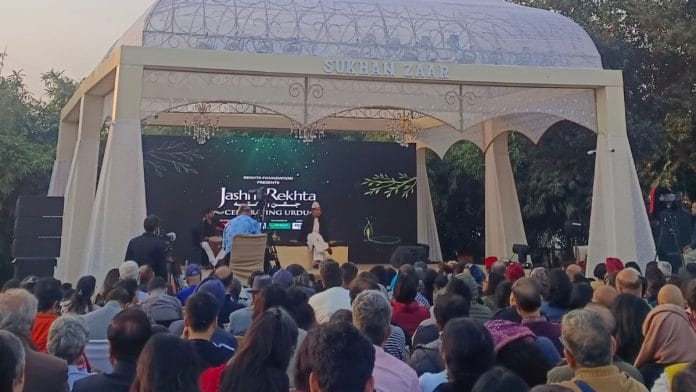



New Delhi: A lesson on the evolution of Urdu is not the sort of session that usually electrifies a crowd. But on Day 2 of Jashn-e-Rekhta, poet and theatre director Danish Husain turned it into a spellbinding performance. Through Dastangoi — part theatre, part oral history — the storyteller traced how Urdu travelled across empires, faiths, and centuries to become a language of poetry, politics, and shared cultural memory. The session quickly turned from a linguistic journey to a meditation on identity, resistance, and the emotional force of words capturing the spirit of a festival marking a decade of celebrating Urdu’s richness.
The second day of Jashn-e-Rekhta stood as a resounding celebration of Urdu’s timeless charm — a grand tribute to its cultural richness through theatre, poetry, music, book discussions, qawwali, and dance.
“New ideas, poetic imagination, and the desire for freedom — this language tells the story of different lives coming together through culture, music, and expression,” said Husain on Saturday, as he began his Dastangoi performance titled Dastan: Urdu Hai Jiska Naam.
Jashn-e-Rekhta, one of the largest celebrations of the Urdu language, art, culture, and history, is an event held over three days. The 2025 edition, scheduled from December 5 to 7 at Delhi’s Baansera Park, marks 10 years of the festival.
The event features performances by renowned poets, musicians, writers, theatre artists, and singers. The second day saw a mushaira that included acclaimed names such as Wasim Barelvi, Javed Akhtar, Vijendra Singh Parwaz, Hilal Fareed, and Shariq Kaifi. It was followed by a play, Ek Lamhaa Zindagi – A Love Story 1938–1979, performed by Juhi Babbar Soni, a soul-stirring qawwali performance by Dhruv Sangari, and two book launches — Mera Kaha Hua by Shariq Kaifi and Wasim Barelvi’s Mohabbat Na Samajh Hoti Hai. The evening concluded with a dazzling musical showcase led by Salim-Sulaiman.
The festival’s activities unfolded across multiple stages — Mehfil Khana, Dayaar-e-Izhar, Sukhan Zaar, Bazm-e-Khayal, and Aiwan-e-Zaiqa.
Husain, dressed in his signature Dastangoi attire — a white kurta-pajama, a white topi, and a black coat — took the Sukhan Zaar stage. As he began narrating the story of Urdu — a language born from love, shaped by rebellion, and celebrated through centuries of poetry and passion — the full-house audience repeatedly broke into applause and cheers, responding warmly to the verses he performed.
“Jis roshni mein lutthi ki ap ko sujhe, Tehzib ki main isko tazalli na kahunga.
Lakhon ko mita kar jo hazaron ko ubhare, usko to main duniya ka taraqqa na kahunga. (The kind of light in which exploitation appears reasonable to you, I will never call that refinement or civilisation.The progress that uplifts a few thousands only after destroying millions, I can never call that the progress of the world.)” Husain recited this verse by poet Akbar Allahabadi to highlight how languages evolve, and how every cultural shift or new development comes at a cost.
A long journey of Urdu
As the December sun went down, the story of Urdu began with a reminder that nearly 2,500 years ago, the languages spoken across North and Central India were Pali and Prakrit, while the language of the royals and scholars was Sanskrit. During this period, a young prince renounced his kingdom and set out on a spiritual journey — Siddhartha, who later became Gautam Buddha. Seeking a language that ordinary people could understand, he chose Prakrit instead of Sanskrit to spread his teachings, because Sanskrit was the language of the elite and not accessible to the masses.
Buddha’s ideas spread far beyond the subcontinent. People from distant lands travelled to India to learn more about its knowledge traditions. Among them was Al-Biruni, who visited India around the 11th century, learned Sanskrit, and documented Indian sciences, culture, and philosophy. His arrival symbolised an era of cultural exchange — of ideas, religions, and languages — which contributed to the development of Apabhramsha, an important linguistic stage between Prakrit and modern Indian languages.
By around the 10th century, languages such as Braj, Awadhi, Maithili, and Khari Boli began developing in northern India. Soon after, Iranians, Turks, and Afghans began arriving in India. They brought not only new foods, architectural styles, music, and poetry, but also their languages — Persian, Turkish, and Arabic — which gradually blended with local dialects.
As Husain continued his Dastangoi, he reached a turning point in the story — the Bhakti and Sufi movements after the 12th century, when a profound linguistic and cultural transformation took place. The audience grew even more attentive as he narrated how saints and poets, in their devotion, began expressing their feelings in Khari Boli, enriched with vocabulary from Turkish, Arabic, and Persian.
“It felt like a history class, but in an interesting and fun way — something you wanted to listen to, without dozing off,” said 32-year-old Sakina Fatima, seated among the audience.
Urdu soon came to be known as the language of poetry, literature, and court culture in the 18th century. Poets like Mir Taqi Mir, Mirza Ghalib, Sauda, and later writers in Lucknow and Delhi enriched its classical tradition and gave the language its enduring grace.
Taking a playful dig at Delhiites, Husain remarked that no matter what the rest of the country does, people of Delhi will always live in their own style — after all, they were the first to call the language “Urdu”, while others still knew it as Hindavi.
“Dil ki virani ka kya mazkur hai, yeh nagar sau martaba luṭa gaya,” recited Husain, quoting Mir Taqi Mir’s famous verse, while expanding on Delhi’s long history, its many upheavals, and how the city has repeatedly witnessed destruction, change, and rebirth.
Also read: Curtain raiser for Crime Literature Festival goes looking for stories—injustice against men
Urdu and religion
Language is never born with a religious identity — not in India, not anywhere in the world. Urdu, too, was originally a shared language of culture, knowledge, administration, literature, and poetry, said Husain. It played a foundational role in modern education, contributing to the creation of institutions like Aligarh Muslim University, Jamia Millia Islamia, and Osmania University, where Urdu was an important medium of learning.
However, in the 19th century, debates over scripts, education policy, and administration began to divide languages along communal lines. Urdu (written in the Perso-Arabic script) gradually became associated with Muslims, while Hindi (written in Devanagari) became associated with Hindus. This association was social and political, not linguistic or cultural.
“It was never the language of a community — Urdu was, is, and will always remain the language of love, poetry, and knowledge,” Husain said.
Recalling the spirit of Urdu, Husain ended his Dastangoi with Daagh Dehlvi’s celebrated lines: “Urdu hai jiska naam, hum hi jaante hain, Hindustan mein dhoom hamari zaban ki hai.”
(Edited by Aamaan Alam Khan)
Pakistan slowly on its way to embrace Sanskritic, Dharmic heritage (e.g., see the news from LUMS).
Meanwhile, we in Bharata are stuck with an undying love for toxic Urdu.