





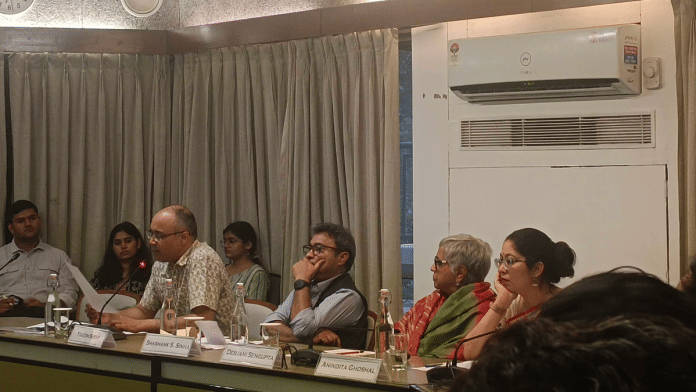



New Delhi: A discussion at the India International Centre on 17 March emphasised that the Partition was not just about bloodshed and borders, but also about kindness, second migrations, and decades-long struggles for survival.
“A process… where the present and the past intersect so closely and so visibly,” said author and Publishing Director (South Asia) at Routledge, Shashank Shekhar Sinha, who moderated the discussion.
Titled ‘Recalibrating Partition’, the discussion brought together perspectives from Punjab, Bengal and Northeast India to rethink the division of India in 1947 through themes such as borderlands, locality, displacement, rehabilitation, belonging, as well as lived experiences.
It focused on marginalised communities and everyday acts of empathy amid the widespread violence, the panel examined questions of citizenship, caste, gender and ethnicity — highlighting how the Partition continues to shape the contemporary Indian subcontinent.
“Partition is not just an event. There are so many different kinds of things happening either simultaneously, in co-succession, or in the aftermath. It also has a long afterlife,” said Sinha.
The panel featured Yogesh Snehi, Associate Professor of History at BR Ambedkar University Delhi; Debjani Sengupta, Professor at Indraprastha College for Women, University of Delhi, and author of The Partition of Bengal: Fragile Borders and New Identities (2016); along with Anindita Ghoshal, Associate Professor of History at Diamond Harbour Women’s University in Kolkata.
“The effort is to shift focus away from violence to acts of empathy and kindness or everyday lives in between all that was going on,” Snehi said.
“What is the story that small towns invoke? It is a story of how a town emerges, how it gets populated, and how it experiences the effects of Partition,” Snehi questioned the dominant narratives that focus only on large cities and violence.
“The rupture in the life that we associate with these big cities is not always an experience of a small town,” he added, highlighting how Partition was lived differently across the country.
Also Read: ‘India’s water policy has suffered from disciplinary silos,’ says PK Mishra
Rethinking Partition
Instead of talking about maps or statistics, research-based storyteller Snehi shared his family’s experiences during the Partition — what he called “Doosra Palayan,” or the second migration.
The story he heard countless times from his grandfather and father was not only one of loss but also of kindness, regardless of one’s religious identity, at the height of communal tensions in the country.
Snehi recalled how his grandfather sheltered a young Muslim man during the violence.
“My grandfather, Ramchand Swami, hid a Muslim boy in his house for 20 to 25 days. When the violence subsided, he helped him safely migrate to Pakistan,” the historian said.
He added that years later, the man returned with his son and told Swami, “This life is a gift from Ramchand.” Through this example, Snehi highlighted how empathy and moral choices coexisted alongside violence, complicating simplified narratives of communal hatred.
But he did not romanticise these acts of kindness. Snehi revealed that such acts often created tensions within households and communities, such as when his grandmother resisted hosting the man after the Partition and even threw away the utensils used to serve him food.
Yet even here, Snehi mentioned the ethical stance taken by his grandfather: “He is a human being,” he insisted, choosing humanity over division.
“Resilience functioned in the midst of rupture, and shared neighbourhoods shaped lives built around Hindus and Muslims,” he added.
If Snehi moved the lens to small towns and everyday ethics, Sengupta expanded the frame to Bengal’s vast and uneven rehabilitation landscape. Picking up from migration, she focused on what came after — the long, exhausting process of rebuilding lives.
“The result of a complicated succession of historical forces, circumstances, desires, and machinations that led to the loss of homes for millions, while countless others perished in the months leading up to independence and even after it,” she said, foregrounding not just the moment of rupture but the prolonged aftermath in which survival became the central concern.
Through detailed examples, Sengupta showed how this aftermath played out in Bengal.
“Overcrowding, unsanitary conditions, disease, high death rates, and corruption in the refugee camps, as well as the demoralising delays in the dispersal of relief,” she noted, citing newspaper reports from the 1950s.
Her most striking examples came from the experiences of the lower-caste refugees, particularly the Namasudras, who were systematically marginalised within rehabilitation policies.
“In Bengal, the Partition’s effects have been long-term and insidious,” she said.
Also Read: People think about their sex lives in terms of jargon. Agents of Ishq wants to change that
From refugees to foreigners
For Ghoshal, the story of Partition is most vividly preserved in the northeast India and West Bengal, where its effects continue to unfold in everyday life. She reflected on how the event persists across generations, reaffirming that it has an enduring “afterlife.”
Ghoshal observed how the refugees were repeatedly categorised according to their religion, caste and class.
“First, they started categorising the refugees as religious persons. Then they started saying that they are evacuees. And then they later started saying that they are illegal immigrants… and after 1971… they started categorising these refugees as foreigners,” Ghoshal claimed.
She also added that the absence of stable policies and the precarious position of those living in border areas highlight how their voices remain largely absent from mainstream histories.
“We often talk about the long Partition, but we don’t get to hear their voices,” she said.
Ghoshal’s fieldwork brought personal accounts from Assam, where she described individuals caught in bureaucratic uncertainty, where categories like “doubtful voters” determine their political and social existence.
In Tripura, her interviews with tribal communities exposed a longstanding resentment at losing control over their land and way of life, questioning imposed environmental and administrative changes.
“We did not cross the border — the border crossed us,” she said.
Ghoshal added that, in reality, Partition never truly stopped after separating lands and people; it remains an ongoing process shaping identities, borders, and belonging even today.
“At the ground level, we see a very different kind of theatre,” she said, adding that on the ground, the stories of marginalised and unheard people are always different.
(Edited by Insha Jalil Waziri)