





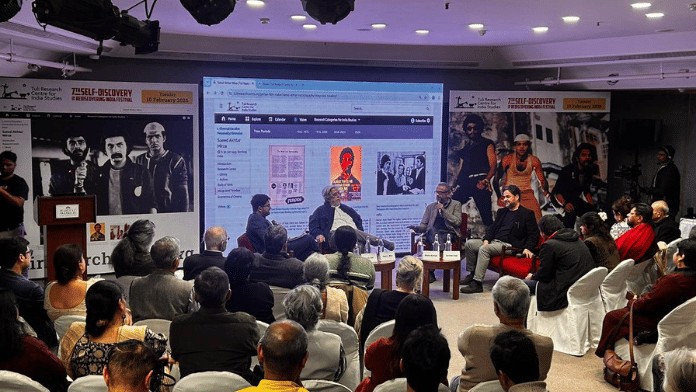



New Delhi: There is a belief nowadays that it is the “freest” and “best” time to make films, but for filmmaker Saeed Akhtar Mirza, this belief is a “tragedy”.
“Freedom is an offer that is largely limited to how much violence and sex you can show”, he said at a panel discussion at the India Habitat Centre in New Delhi on 10 February. The discussion largely focused on the cinema and the changes it has witnessed over the years.
The Tuli Research Centre for Indian Studies, in association with Khwaja Ahmed Abbas Memorial Trust and the National Film Development Corporation of India (NFDC), presented a curated series of programmes within its India Studies research as a part of the 7th Self-Discovery via Rediscovering India Festival.
The evening started with the distribution of pages detailing Mirza’s work and ended with the screening of Salim Langde Pe Mat Ro (1989), a 1-hour and 51-minute film directed by Mirza. Filmmakers Dibakar Banerjee and Gurvinder Singh were also a part of the panel. The panellists discussed dissent, authorship and responsibility within the public sphere.
Absence of provocative movies
The conversation that lasted for a little over an hour critiqued the absence of parallel cinema. Banerjee spoke about how film censorship has changed over the years and how there is a strong cultural censorship.
He pointed out that the presence of “pandering films” is not an issue; it is universal. “The problem is that earlier, alongside them, there were films that provoked, questioned, and shook us”, he said.
“We shouldn’t be looking at the pandering films — we should be asking what else is no longer allowed to exist”, he added.
Banerjee brought examples from the time when he was learning about cinema. He gave credits to Albert Pinto for his success as a filmmaker and cited examples from his days in the Film and Television Institute of India when Mirza taught a class there.
The Khosla ka Ghosla (2006) director reminisced about the days when the film school was democratic and drew people from every class, caste, village, and background; however, he added, “today, that diversity is narrowing”.
He appreciated Mirza for being a mentor, when Banerjee was questioning his future as a filmmaker.
“We finally got mentoring and care as students, before that it was constant bickering with authorities, fighting for facilities and for what we believed was right”, he said.
Also Read: SRK taught us how love works in an economy
The OTT circus
The intense discussion ended with Banerjee throwing light on the lack of state support for cinema today.
“There was a time when funds were formed, risks were taken, and no one was telling filmmakers, ‘Don’t provoke’,” he said.
Mirza agreed on the minimal state control and added, “I want you to remember that the state did have stakes as an idea on culture”.
Mirza called the content on OTT (over-the-top) streaming platforms a “circus”. He appreciated them for producing new content and for generating jobs and work for technicians. “But is that the solution”, he asked.
However, the filmmaker is hopeful that there will be changes. He cites Zohran Mamdani, who was elected as the first Muslim Mayor of New York last year.
“He stood up, spoke about justice and equality, and he won. People understood that their lives, humanity and individuality were at stake, so they voted’, he said.
(Edited by Insha Jalil Waziri)
Will someone explain explain why films with Muslim themes are not made in india any more. It appears there is an invisible ban on Muslim themes and characters. Whereas Hindu bashing goes on unabated. In Bollywood a Hindu is an orphan whereas a Muslim is the Zamindar. Yet the sane refrain, AAj kal Bahut restriction hai. It’s in the mind. Polarization is so total each side shuts the other. Did it happen only after 2014? Wake up😭👹