





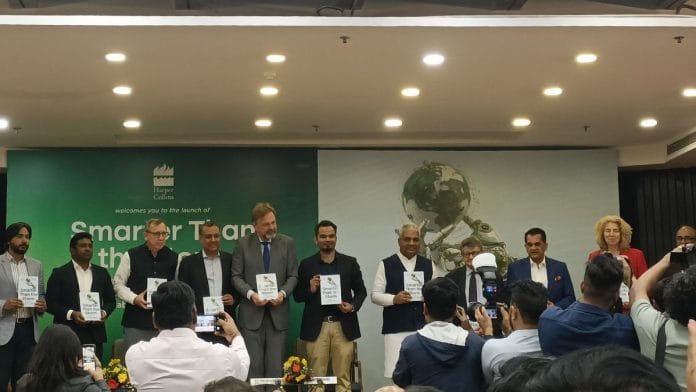



New Delhi: Even as the AI Impact Summit and the Delhi Climate Week took the capital by ‘storm’ in February, a new book threw light on the underlying conversations—it was, literally, “smarter than the storm.”
This is how Siddharth Sinha introduced his and Amitabh Kant’s book at the India International Centre, to thunderous applause, in February. Smarter Than the Storm – Championing the AI-Climate Nexus for a Truly Sustainable Future, was launched in Delhi in the presence of the Union Minister of Environment, Forests, and Climate Change, Bhupendra Yadav and international delegates, including the ambassadors of Germany and the Netherlands. The book is published by HarperCollins Publications.
The former G20 Sherpa and former CEO of Niti Aayog, Amitabh Kant, and Siddharth Sinha, associate Vice-President of the Greenko Group, offer a keen insight into 2026’s latest buzzword, AI, and all of its complexities and challenges, especially in the context of climate change.
“Just like there can be no artificial intelligence without real human intelligence, there can be no human future without the future of the planet on which human life exists,” said Bhupendra Yadav, while delivering his keynote speech at the event.
The address set the tone for the evening’s discussions, which positioned artificial intelligence and climate change and sustainability as twin policy problems, rather than as separate domains. While acknowledging the powerful nature of artificial intelligence, Sinha and Kant both admitted right off the bat that its impact on an already vulnerable global climate and on resources such as land and water cannot be ignored.
Also read: AI is a silent spectator to hate speech. It doesn’t know how to moderate regional languages
India’s decade
This challenge, the authors noted, was merely an opportunity to build a world where AI worked in tandem with climate action, and not against it. This is where India’s future role was highlighted.
“AI today consumes more energy than the country of Japan,” said Kant, stressing that the resource requirement of artificial intelligence models is only set to increase in the coming years. “The battle of tomorrow will be won by those who use sophisticated software with less computing power and less energy,” he added.
Accompanying Kant and Sinha on the dais were speakers, including Abhishek Singh, CEO of IndiaAI Mission, Samir Saran, President of Observer Research Foundation, Philip Ackermann, German Ambassador to India, and Marisa Gerards, Netherlands Ambassador to India. After Yadav, Sinha and Kant’s address, the audience saw an invigorating discussion on issues of India’s artificial intelligence ecosystem, renewable energy transition, and integrated climate-AI solutions pioneered in India.
One of the most prominent themes that emerged during the discussion was that while AI can worsen climate change through its increased energy consumption, it can also help mitigate the climate crisis—through accurate prediction of extreme weather events and higher efficiency in mitigation strategies.
In fact, even in the energy sector, artificial intelligence is increasingly being used to optimise grids and integrate renewable energy, so that different sources of energy and different demand timings don’t end up overburdening the electricity grid.
The discussion among the speakers was both a reflection of the questions on AI and climate tackled in the book, as well as a reminder of why these questions were pertinent.
India, according to the authors, is standing at the precipice of development and sustainable ambition, and this decade is going to be “India’s decade.”
“I believe this is India’s decade and India’s century in the making,” said Kant. “Our average age is 29 — if we cannot seize this moment now, we never will.”
(Edited by Theres Sudeep)