








New Delhi: Mohan Rakesh captured India’s unfolding new modernity in Hindi literature like no other writer, especially during the decades when the nation hadn’t yet fully embraced the idea of city life as the redeemer. Rakesh decoded urban loneliness and emotional trials of modern individuals in his Hindi novels and plays half a century ago.
Many of those conflicts haunt Indian lives today, and his 101st birth anniversary became an opportunity to re-read his work with a new AI-era 21st-century critical lens.
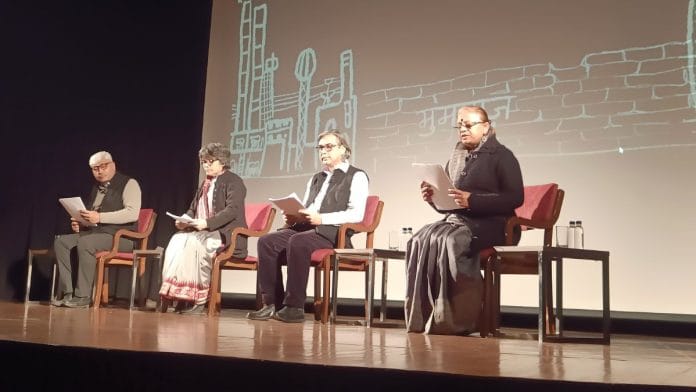
In Delhi’s India International Centre, the CD Deshmukh Auditorium was packed with professors, writers and students who came to experience the performative reading of Rakesh’s three stories—Aadmi Aur Deewar (Human and the Wall), Ek Thahra Hua Chaaku (A Still Knife) and Faulad Ka Aakash (The Sky of Steel) on a chilling winter evening.
Rakesh was one of the pioneers of the Nayi Kahani (New Story) literary movement of Hindi literature in India. The award-winning Ashad Ka Ek Din was the first modern Hindi play.
“The interest in his stories lies in the characters and intellects of a person’s mind, not in solving them, but in understanding them,” said Apoorvanand, Hindi professor at Delhi University, who was at IIC for the reading.
The reading was scripted by Sanskrit scholar Purwa Bhardwaj, and along with her, the readers included writers and professors such as Alka Ranjan, Apoorvanand, and Raza Haider.
In his calm and captivating voice, Apoorvanand says, Rakesh’s stories deal with relationships between a person, a woman and a man. A woman’s relationship with herself, a person’s relationship with history, society and the state, and a man’s search for himself among them, he added.
Rakesh was one of the pioneers of the Nayi Kahani (New Story) literary movement of Hindi literature in India. He brought forth the realities of the Indian middle-class love through his characters.
A Sangeet Natak Akademi awardee, Rakesh was born on 9 January 1925 in Amritsar. His notable writings are Ashadh Ka Ek Din (1958), Lehron Ke Rajhans (1963), Adhe Adhure (1969) and Na Aane Wala Kal (1968).
“He is one of the few playwrights in India whose plays have been played in many languages for generations. But his first identity among the Hindi audience is that of a storyteller,” said Apoorvanand.
Also read: How Mumbai evolved, and those who influenced it: DAG CEO Ashish Anand
Performative Reading of Rakesh’s stories
The stories chosen for the reading portray the struggle of the modern individual to find an authentic voice, the loneliness of the individual in a world governed by impersonal state institutions.
In Ek Thahra Hua Chaku, Rakesh captures the psychological tension and fragmented experience of a man in a suspenseful and uncertain situation.
It is a story about a man named Basshi experiencing distorted time and anxiety as he waits for something, while his past actions haunt him, reflecting themes of guilt, waiting and inner turmoil.
Rakesh’s story focuses on the inner lives of individuals facing societal pressures and existential crises.
His stories also took a dig at society narratives.
In one of the lines in Aadmi Aur Deewar, Rakesh wrote that how many writers are there in this country. The one who can write four lines considers himself a writer. In other countries, such people are not even asked.
Faulad Ka Aakash is one of Rakesh’s famous stories, which portrays the relationship of men and women, loneliness and the realities of the modern world in an industrial ecosystem.
Rakesh’s literary world is largely populated by the newly emerging middle-class individuals of India, whose lives come to be shaped by the state and the market and their constant struggle to preserve an authentic core of the self.
According to Rakesh, there was a sort of restlessness among us to capture the mood of our time.
“Nayi Kahani became a symbol for our effort to alienate the short story from what it was after Premchand,” he said in an interview to the Journal of South Asian Literature, published in 1968.
The reading was dramatic, conversational and held the audience throughout the event.
At the end, Yusra Naqvi sang the Faiz Ahmad Faiz Urdu couplet Ye daag daag ujala, ye shab-gajeeda shehar, vo intezaar tha jiska, ye vo shehar to nahi (this stained tainted light, this night bitten dawn, that we were waiting for, this is not that morning) to conclude the event.
(Edited by Saptak Datta)