





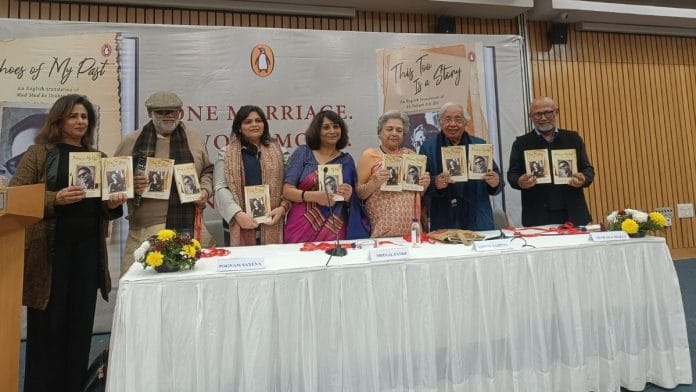



New Delhi: Authors Rajendra Yadav and Mannu Bhandari broke new ground in the Hindi literary world by writing on stories from small towns of India post-Independence. Now, English translations of the late writer couple’s memoirs titled Echoes of My Past (Mud-Mudke Dekhta Hu) and This too is a Story (Ek Kahani Yeh Bhi), delving into their marriage and careers, were recently launched at Delhi’s India International Centre.
“Until the 1950s, there was much more philosophy in Hindi writing, but this duo wrote frankly,” said Mrinal Pande, author and journalist, at the launch on 6 February. Pande was joined by translator Poonam Saxena, poet and critic Ashok Vajpeyi and author Akshaya Mukul, who moderated the event. Among the audience were Hindi writers Anamika, Mridula Garg and Prabhat Ranjan. A dramatised reading of the memoir had also occurred.
The late couple, married for decades, had a difficult relationship.
“I wanted to translate both books so that readers could read both and see their relationship, their writing, their marriage, the times they lived in,” said Saxena, who had also translated both memoirs from Hindi to English.
‘Rajendra aadmi thik nahi’
Pande’s mother Shivani was a well-known Hindi author. Several writers, including Bhandari, frequented her house to meet her.
Pande said writers were lovely to meet individually or in twos. “But as a group, it was like meeting a pack of hounds. They mostly bitch about others or discuss royalties and their publishers,” she recalled.
Yadav was one of the people who had a mischievous habit of encouraging gossip and nasty talk. Pande recalled her mother’s words — Rajendra aadmi thik nahi hai, par likhta acha hai (As a person, Rajendra isn’t good, but he writes well).
Vajpeyi recalled his days with Yadav, where the latter persuaded him to write fiction rather than poetry. “I know cricket is a more advanced and complex game than kabaddi. But I know how to play kabaddi. You can’t ask me to start playing cricket,” he said, adding that Yadav had a dusht buddhi (evil mind) while Bhandari was a kind of reticent person.
“She wrote very candidly but quietly,” he said, adding that Yadav became a public figure not through his fictional writing but because of Hans, a Hindi literary magazine.
“He (Yadav) had a very good, timely sense of promoting two kinds of writing which had emerged in Hindi. One was the Dalit writing and the other was women’s writing. These two got such a big editorial support from Hans,” said Vajpeyi.
Pande said that despite a very superficial understanding of feminism, he gave a huge forum to these writings. She also called out his alleged inappropriate behaviour with women. “I occasionally punched him and slapped his hand off, and I told him keep your hand off me. Don’t you dare touch me,” recalled Pande. Yadav’s reply was ‘badi feminist banti hai’.
Comparing Yadav and Bhandari, Pande said while the former had a keen eye for writing, the latter was an excellent editor. “Mannu was very straightforward, and she was laying bare the inner emptiness of a working woman’s life in her writing,” she said.
Also read: ‘OTT platforms are a circus,’ says filmmaker Saeed Mirza
Change in Hindi readership
In her childhood, Hindi literature lovers waited for magazines, Pande recalled. But now the readership has changed.
“Now, a new kind of relationship television has given to Hindi, which is very poor,” said Pande.
Vajpeyi also described the changing literary culture in Hindi. “The writers were well-read in modern literature,” he said, adding that Yadav and Nirmal Verma were among the most well-read fiction writers in Hindi.
Vajpeyi said, it’s a sad situation that most young writers in Hindi are very poorly read.
“They don’t know sometimes that what they are saying has already been said much more memorably and much more succinctly by someone else,” said Vajpeyi, adding that there is a loss of cultural memory which is part of the larger framework of the Hindi belt.
(Edited by Saptak Datta)