





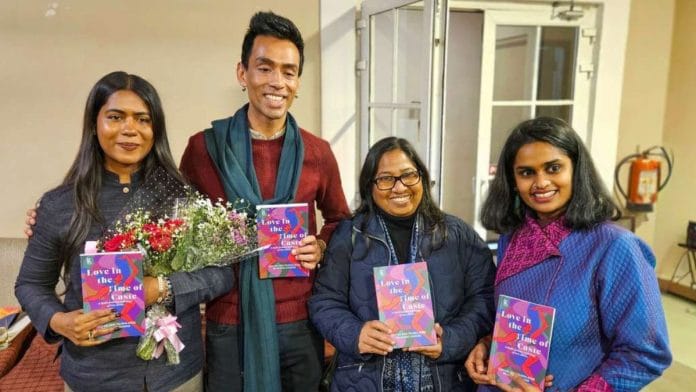



New Delhi: During a discussion on the book Love in the Time of Caste in Delhi, an audience member posed what sounded like a deceptively simple question: “Is caste an ideology?” The panelist argued that conversations on caste should move away from such frameworks that reduce it to a Marxist, economy-based lens and on ‘haves and have-nots’.
Originally written in Hindi, the book, edited and translated by Nikhil Pandhi, is a collection of 17 short stories by Dalit writers who examine love beyond heterosexual romance and Bollywood idealism, locating caste in desire, intimacy, family, language and everyday negotiations that refuse to disappear.
The launch in a thickly packed room in Gulmohar Club, Green Park Saturday was followed by an intense discussion on love and caste.
“Caste never goes away”
An audience member also questioned the very premise of the discussion. She asked, “Why are we having a forum on caste?” The intervention left many Dalits and allies in the room visibly uncomfortable and unsettled.
Anita Bharti, a Dalit writer and activist, addressed the elephant in the room with her sarcasm and wit. Responding to the audience member, she shot back, “Jaati hai ki jaati hi nahi hai.” (caste is inevitable and it does not ever go away). Bharti pointed out that the very existence of caste is repeatedly questioned, often as a way to evade confronting its realities.
While Bharti quipped, Pandhi answered in an assertive manner, saying that the book is urging everyone to think about caste beyond politics, reservation and constitution. “The book treats caste in a deeply complex way, and to get to that complexity, it is required that we talk about caste”, he said.
“The book is pushing us to think about what all is encompassed, within the affective spectrum, and the atmosphere of caste, where caste can become both a material reality, it can become a spectral placeholder, it can become a kind of intimate thing that two people talk about”, he added.
Pandhi started working on the book in 2022; it took him nearly four years to publish it. According to Bharti, Love in the Time of Caste is an answer to everyone who accused Dalit literature of not having touched upon love from the angle of caste.
The book talks about how Dalits are denied full agency and freedom of choice, inter-caste love, and intra-caste love. It states that love is not just a feeling, but a nuanced, negotiated, and deeply political experience.
“Inter-caste or intra-caste love operates differently. While the former have the additional burden of glorification, which becomes a double-edged sword, the latter is premised on shared experiences,” said Kamna Singh, a scholar and the moderator of the session.
Also read: When JLF discussed what women don’t want and eldest daughter syndrome
Dalit women writers
The book has created a space for Dalit men and women who had never shared their stories in writing and had long left them sitting in drafts.
The discussion also focused on Dalit women and literature. Bharti argued that Dalit women are often portrayed as weak, voiceless, or merely victims, even by Dalit male writers. In contrast, Dalit women’s writing presents women as powerful, unapologetic voices with their own language and names. The characters confront society and caste head-on.
“Women in Dalit literature speak a different language; they raise questions and confront the bitter truths,” said Bharti.
She shared a personal example from her life, recalling how her kids were questioned about their surnames at school. In her inter-caste marriage, the children took their father’s last name, while Bharti chose not to change hers after marriage. The difference became a point of contention among classmates and her decision not to adopt her husband’s surname led to her children being teased.
“I was shocked to find out how kids are talking about surnames,” said Bharti. She highlights and questions these nuances through her story, Blue Mountain and Red Sun, featured in the book. The story is a personal reflection, where blue stands for Dalit and red for Marx. Bharti, a Dalit who has experienced an oppressed life, marries a man who follows the ideologies of Karl Marx.
The story, through fictional characterisation, traces the journey of two lovers who come from different social backgrounds and how they deal with it.
Blue Mountain and Red Sun was translated from the Hindi Neela Pahad, Lal Suraj. Soumya Shailendra, a scholar, noted that rather than offering a happy ending, the story highlights the tension between two desires — the revolutionary and the romantic — as they struggle to find a language of their own.
(Edited by Ratan Priya)