





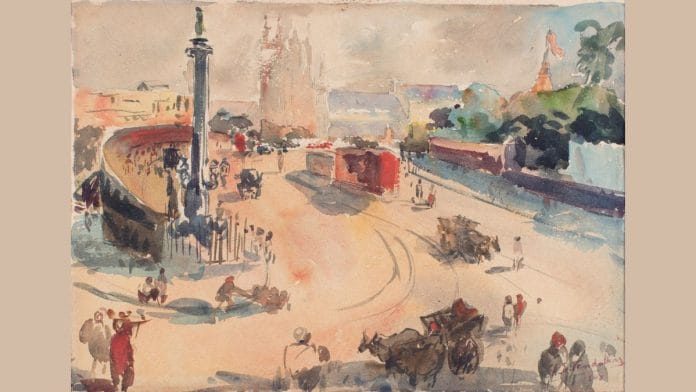



Mumbai: A life-sized cast iron statue standing atop a forty-foot column, surrounded by four water spouting mermaids and four gas lit glass lamps installed in the 19th-century looks over Mumbai’s Byculla. Once at the centre of a quiet but remarkable act of defiance against colonial authority, it was one of the first few statues of Indians to ever exist. Now it’s overlooked amid the city’s growing traffic and flyovers.
Installed in 1867, the statue was formally named Cursetjee Fountain and is popularly known as ‘Khada Parsi’, or ‘Ubha Parsi’ in Marathi, which translates to Standing Parsi. It was commissioned by Manockjee Cursetjee in memory of his father.
Two paintings on display at the DAG’s Bombay Framed exhibition at the Taj Mahal Palace in Mumbai, one from 1948 by AS Tendulkar and the other by AS Mali, depict the stature of the Khada Parsi in the city at the time.
On Wednesday, at a talk organised by the DAG, the second one under the banner of ‘Bombay Framed’, historian Murali Ranganathan noted that the proposal courted controversy and sparked resistance from British authorities.
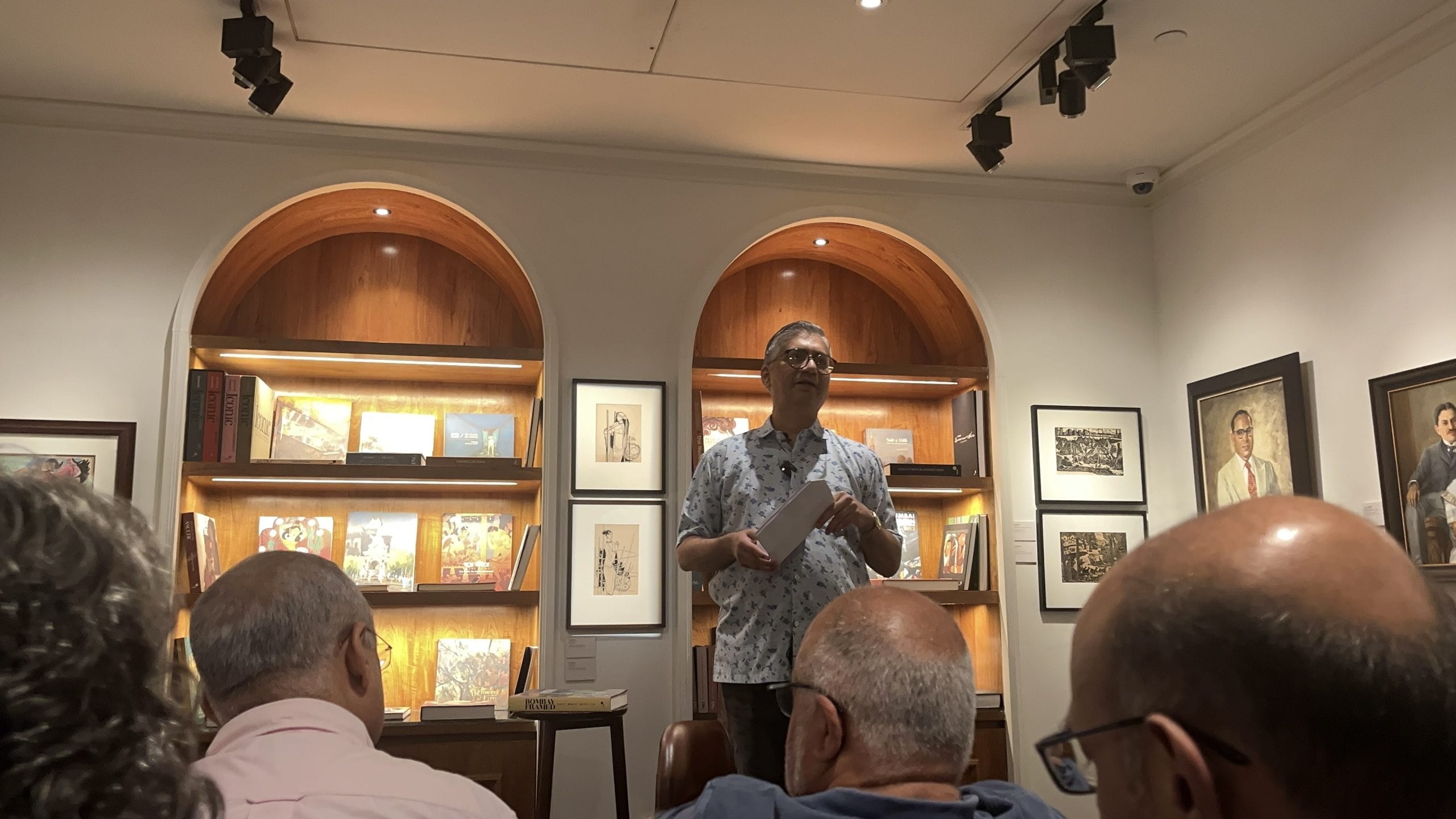
“At a time when even statues of prominent Indians were rare and contested, the idea of erecting one’s father’s statue in a public space was unprecedented,” he said.
Manockjee Cursetjee was a judge at Bombay’s Court of Small Causes and son of business philanthropist Cursetjee Manockjee, who founded the Alexandra Girls English Institution, one of the first schools for girls in the city.
Manockjee travelled to London in 1862 and visited an international exhibition. There he saw a fountain from Chile on display with four waterspout mermaid fountains surrounding an ancient goddess. That was when he decided to erect a similar statue in memory of his father.
As the story goes, when municipal officials objected, Manockjee took matters into his own hands. Having earlier donated a piece of Byculla land that the family once owned, he reclaimed it and went ahead with the installation independently.
He went to London a second time in 1865 with his daughter Serene and commissioned the structure from a fountain maker John Bell and installed it in Bombay without formal approval. Ranganathan noted that this was an unusual act in colonial Bombay.
It was only the third statue of an Indian in Bombay after Jamshedji Jeejeebhoy and Jagannath Shankarseth.
Also read: Umaid Bhawan to CST Mumbai—how foreign architects shaped India’s buildings
An object of worship
In his essay titled ‘The Peripatetic Statue: Khada Parsi In A City On The Move’, mentioned in the ‘Bombay Framed’ book, historian Ranganathan describes the statue in detail—“An extravagantly moustachioed man clad in jama-pichori, the traditional flowing robe adopted by the Parsis, with a shawl draped over his right shoulder.” He holds two pieces of sandalwood in his left hand and a book in his right hand, signifying Zoroastrian scriptures.
A plaque identifies him as Cursetjee Manockjee. Born 19th August 1763. Died 7th May 1845.
The life-sized statue of Cursetjee was placed on top of a forty-feet pillar, which Ranganathan said resembled the pillars erected by Ashoka about 2,100 years before that and which were in turn influenced by the Persepolitan columns of Achaemenid Persia. Both styles had animals placed on top of pillars.
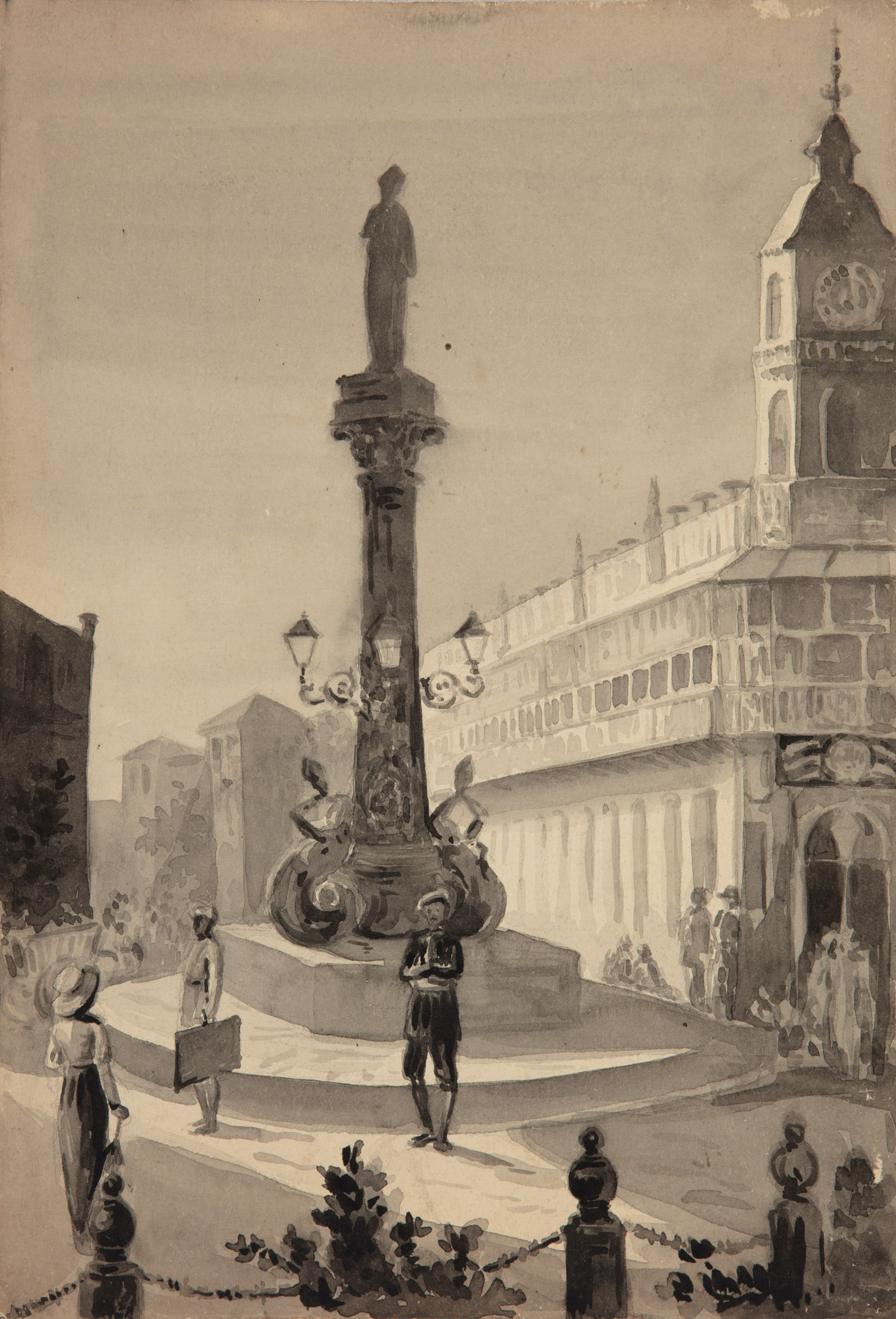
In the case of Khada Parsi, at the base of the pillar, “were four mermaids blowing conches, from which jets of water fell in an arc into a trough, which, in turn, was surrounded by four lamps; a little further up the column were four more lamps powered by gas,” Ranganathan said.
Far from being just a memorial, the Khada Parsi was also a showcase of emerging urban infrastructure. By the 1860s, Bombay had begun to modernise with piped water and gas lighting. The fountain at the base of this statue incorporated both.
The fountain drew water from the Vihar Water Works, while the four gas lamps used gas supplied by the Bombay Gas Company. These elements made it both functional and ornamental, illustrating how public monuments were also used to signal progress.
Manockjee spent Rs 20,000 on the fountain. It was brought to Bombay in 1866 and assembled at the site in Byculla. In early 1867, after much debate with government officials and after acquiring the land, Manockjee failed to organise a formal inauguration in the presence of a dignitary.
That statue, Ranganathan noted, took on unexpected meanings. Citing early chronicler Govind Narayan, Ranganathan said locals began treating it “almost as an object of worship, offering coconuts and prayers.”
Locals would fill up their vessels with the water from the fountain and the lamps became streetlights. With time the Cursetjee Fountain became the Ubha Parsi or Khada Parsi.
Also read: Bombay’s modernism was driven by the middle class, not elites
The statue survives
The Khada Parsi reflects Bombay’s shifting geography. Byculla, where the statue stands today, was not always central. “In the 1830s, it lay beyond the main town. But it soon developed into Bombay’s first suburb,” Ranganathan explained. Wealthy residents built bungalows in the area, and institutions like the Byculla Club and JJ Hospital came up, turning it into a prestigious neighbourhood.
Over time, however, the character of Byculla changed. By the late 19th century, industrialisation had taken hold. Mills and factories replaced elite homes, and the once-prominent Khada Parsi fell into neglect.
In 1870, as the focus of the city shifted to Malabar Hill, a new abode for the rich, Manockjee sold off all his properties in Byculla, gave the land and the fountain statue back to the municipality and shifted to Malabar Hill. From being a tony suburb of Bombay, Byculla began a slow descent into a run-down urban neighbourhood in the early 20th century.
“By 1915, there were complaints about its deterioration, the missing lamps, dry fountains, and general disrepair,” Ranganathan said.
But the Khada Parsi’s journey did not end there. Like many of Bombay’s statues, it was eventually relocated as the city expanded and reconfigured its spaces.
“It survived, though not without challenges,” Ranganathan said, noting that the structure was moved and restored several times over the years.
From one end of the Clare road where it was first installed, it moved to the other end, at the base of the Byculla bridge in 1928. Now, the Khada Parsi stands sandwiched between two arms of a Y-shaped Byculla flyover at the Byculla-Nagpada junction.
“It remains as both a symbol of survival and movement, much like the city itself,” Ranganathan said.
(Edited by Theres Sudeep)