





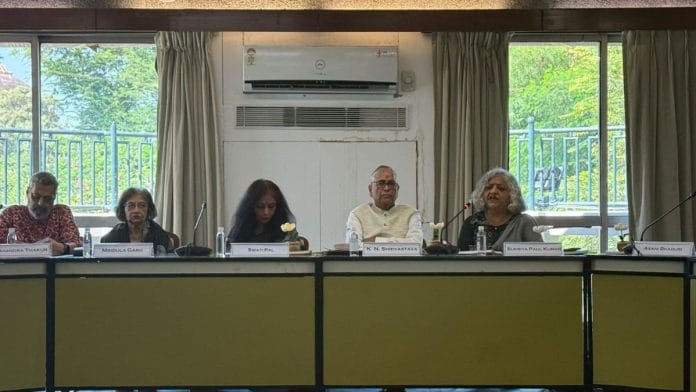



New Delhi: In a quiet hall at the India International Centre, the air suddenly filled with the sound of palms striking in unison, ‘clap, clap, clap’. Padma Shri awardee and renowned Kathak exponent Shovana Narayan led the audience around a round table through an unusual exercise.
“One-two-three, one-two-three… now one-two-one-two…” she directed, guiding the rhythm as people stumbled, laughed, and found their beat.
The playful group activity had a hidden lesson: the mathematics hidden in dance, the “fractions and decimals embedded in rhythm”, the science that underpins art.
It was Narayan’s way of illustrating the theme of the symposium “Humanities Matter”, held on 24 September. Drawing from her own journey, from being a physics graduate to one of India’s most celebrated Kathak dancers, she demonstrated how the boundaries between disciplines are not as rigid as they seem.
“Even emotions, the navarasas (the nine emotions in Indian arts), have been studied and dissected,” she said, pointing out how practitioners of the arts explore what science seeks to understand, though in different ways.
“Where is the ability to integrate the two?” she asked, underscoring the heart of the discussion: sciences and humanities do not merely coexist, but need to engage in dialogue. Each enriches the other and the Humanities as a discipline is as important as any other science subject.
The symposium at IIC, which brought together academics, researchers, economists, artists and former bureaucrats, was organised by poet and academic Sukrita Paul Kumar. She was also the convenor of the discussion, along with Swati Pal, professor and principal of Janki Devi Memorial College, University of Delhi, and Asani Bhaduri, assistant professor at the Cluster Innovation Centre, University of Delhi.
The three-hour session with 12 speakers often felt like a long lecture, leaving little time for audience interaction despite a turnout of about 70 people.
Rethinking interdisciplinarity
Professor Manindra Nath Thakur of Jawaharlal Nehru University’s Centre for Political Studies cautioned against careless use of the word interdisciplinarity. “It actually divides the disciplines first and then brings them together,” he explained. He suggested that researchers focus instead on studying real-world phenomena directly, rather than forcing multiple disciplines to fit together.
“I meet my economist friends only in seminars and most of us don’t talk to each other. So this division of disciplines probably doesn’t work,” he added.
If Thakur focused on how academic disciplines are divided, Vandana Madan, associate professor of sociology at Janki Devi Memorial College, reflected on cultural divisions, especially the stigma attached to studying the humanities.
“Many of us carried the thought that we were failed science students,” she said, referring to how sociology in its early years had struggled to prove itself “scientific” through sociologists like Emile Durkheim and Max Weber.
But Madan’s own classroom experiences convinced her otherwise. Teaching medical students once, she was confronted by a student who threw a book on her desk, saying it had “no aim, no proof, no theory.”
Her response was simple: “But it has empathy.” That, she argued, remains the humanities’ greatest strength, something Artificial Intelligence can never replicate. Today, Madan tells her students that education must “bounce off the walls of a classroom like a squash ball,” not remain trapped in books or algorithms.
Ram Ramaswamy, former JNU professor and now visiting fellow at IIT Delhi, argued for a deeper kind of integration between disciplines. Like Madan, he felt interdisciplinarity should begin early—at the school level.
He warned that the way it is structured currently in Indian educational institutions reduces students’ choice instead of expanding it. Humanities courses in IITs, for instance, are compulsory yet tightly regulated, leaving students little room to pursue what truly interests them.
The National Education Policy, he said, must be used to grant real academic freedom to teachers to design courses, and to students to move beyond isolated streams.
What he stressed most, however, was reciprocity. “Humanities matter to all other disciplines, including the sciences,” he said, “but science also matters to the humanities. We must occasionally ask ourselves: what scientific or mathematical disciplines inform us?”
He noted that methods like statistics are often used to study Indian history and Sanskrit poetry, yet students in those departments rarely learn these mathematical tools.
Also read: Not everybody can learn from MF Husain. Art should be accessible: MAP founder Abhishek Poddar
Caste and humanities
Author Mridula Garg insisted that any discussion of the humanities in India must begin with caste. “That permeates everything,” she said, pointing out how inequities continue to shape who can freely access education, literature, or the classical performing arts.
For Garg, the real contest is not humanities versus science, but “humanities against technology and greed.”
Yet, she said, art persists. “Literature does nothing, and yet we write it. We are not totally stupid.” Its value lies in cultivating empathy, compassion, and even unease. “Anxiety propels me to write, and it is what I bequeath to my readers, that they may never feel secure only for themselves, but insecure for everyone around them.”
Garg recalled how she was once arrested after a fellow writer complained about her 1979 novel Chittacobra, a book branded “obscene” at the time. Years later, when she was invited to one of the IITs to discuss her works, students were instructed not to bring up that very book.
“If you want to ask about that book, ask,” Garg had said to those students.
She found the students brilliant but, in her words, “emotionally unformed”.
When a 23-year-old dismissed her work as unsuitable for the young, Garg remarked, “At 23, Bhagat Singh was hanged. And you think you’re too young?”
Instead of hiding “yellow journalism” under their pillows, she urged them to confront real literature.
“If you read my book, you will understand what sexuality is. So learn to make love properly, yaar, if you can do nothing else in life,” she said.
(Edited by Ratan Priya)