





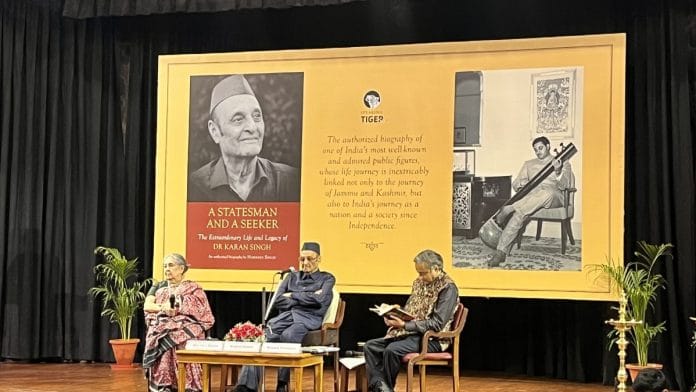



New Delhi: “My dear Tiger”—That’s how Jawaharlal Nehru used to greet Karan Singh, a young prince from Jammu and Kashmir, who grew up to be a union minister, a scholar, diplomat and environmentalist.
Karan Singh recalled those letters sent by Nehru when speaking at the launch of his biography, A Statesman and a Seeker, written by Harbans Singh, at Delhi’s CD Deshmukh Auditorium on Friday evening. “Tiger happens to be my nickname,” said Singh as the hall filled with laughter.
“There’s a whole volume of Panditji’s letters to me, and every one begins, ‘My dear Tiger’.”
The discussion revolved around the journey of Karan Singh, who had a political and intellectual ringside view of India’s initial years, someone who played a key role in forming the country.
From former bureaucrats to scholars and students, many had gathered to listen to this conversation. The hall was packed, with latecomers sitting on the floor, and some leaning against the wall.
Shashi Tharoor and Malvika Singh, publisher of Seminar magazine, were present on the stage to discuss the decades of Indian political history covered in the book— from the early years of Independence to the Emergency and beyond.
The conversation opened with Singh’s formative years in Kashmir and the huge influence Singh had on two powerful personalities—Jawahar Lal Nehru and Sardar Vallabhbhai Patel.
“I grew up reading his books when I was in school—Discovery of India and his autobiography,” Singh said. Meeting Nehru in person only deepened that admiration. “He had a charismatic personality… young people like me were greatly enthused by him.”
Singh remained close to Nehru for fifteen years. From receiving letters to breakfast at Teen Murti House, Nehru used to talk to Singh about his vision for a new India and the challenges facing a newly independent nation.
Patel left a very strong impression, too.
“He gave you the feeling that he could deal with anything,” Singh said, describing India’s first home minister as a steady, commanding presence. Together, he suggested, Nehru and Patel formed a partnership that helped hold the fledgling nation together. “Had both not been there after the British left,” he remarked, “India might have broken into pieces.”
Also read: Karan Singh’s Hinduism definition has space for none—Modi’s India or anti-Sanatani Stalin
Building a new India
Karan Singh began his political career in Jammu and Kashmir. Singh described the turbulent politics of the state in the 1950s and the towering presence of Sheikh Abdullah.
“He was a very impressive leader—you may or may not agree with him, but he was impressive,” Singh said, recalling Abdullah’s physical and political stature with a hint of humour.
The period was fraught with tensions between different political visions for Kashmir, and Singh acknowledged the difficulty of navigating those years.
Singh also mentioned his personal crossroads about whether to remain aligned with feudal traditions of his royal background or to join democratic politics.
“I realised feudalism was fading out,” Singh said. What attracted him instead was the “exciting adventure of building a new India”.
By his early thirties, Singh had already served as Regent and later Sadr-e-Riyasat of Jammu and Kashmir, but the confines of regional politics eventually began to feel limiting. “I was getting bored,” he joked, drawing laughter from the audience. “I thought I couldn’t spend the rest of my life sitting in J&K opening assemblies every year.”
Shashi Tharoor steered the discussion, highlighting a few moments of Singh’s long public career. He recalled his early interest in Hindu philosophy.
“I first met you at the United Nations, I think in the men’s room, after you had just spoken at an interfaith conference in the late 80s or early 90s,” Tharoor recalled. “Among the many affinities I claim with you—apart from our birth dates—is this shared interest in Hinduism in a particular form of it.”
Singh was clear that what he believed in is a Vedantic Hinduism. “Hindutva tends to be exclusionary — that is the only difference,” he said.
Singh, who served in Indira Gandhi’s cabinet, also spoke about the pressures of that period, some of the blemishes of India’s political past. Singh talked about the controversial family planning drive associated with Sanjay Gandhi.
“In those days, there were certain targets for vasectomies and tubectomies,” Singh said. “I had selected some very reasonable, doable targets for all the states. Unfortunately, Sanjay Gandhi took that as one of his programmes and started raising the targets—and that is where this forced sterilisation took place.”
(Edited by Theres Sudeep)