





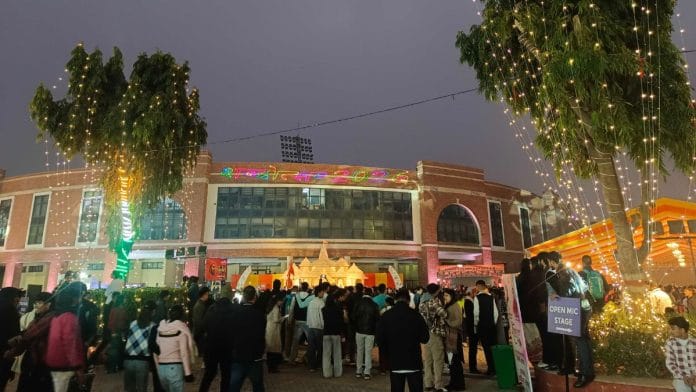



New Delhi: The Delhi government has organised the capital’s biggest cultural event, Delhi Shabdotsav, where words, ideas, art and culture have been brought together on a single platform with hundreds of artists and speakers.
Organised by Suruchi Prakashan with the support of the Hindi Academy, the festival was inaugurated by Delhi Chief Minister Rekha Gupta, who lit the ceremonial lamp alongside Union Minister of State Harsh Malhotra, Delhi’s Minister for Art, Culture, Language and Tourism Kapil Mishra, Art Secretary K. Mahesh, and senior cultural figures including Sunil Ambekar, Rajeev Tuli, and Harshvardhan Tripathi.
“Shabdotsav is not an ordinary literary festival. Stones, guns and bombs originate in the mind before they appear in the hand. Naxalism, terrorism and ideological violence are rooted in ideas. Delhi Shabdotsav is a surgical strike against this ideological terrorism,” said Cabinet Minister Kapil Mishra.
The event brings together writers, scholars, artists, thinkers and cultural enthusiasts from across the country, the festival has emerged as a grand celebration of India’s civilisational journey, artistic heritage and intellectual traditions.
“Shabdotsav reflects India’s dialogue with its past, present and future,” said Rekha Gupta, the Delhi Chief Minister, at the inauguration ceremony on Friday.
The event is themed “Bharat Abhyudaya.” Gupta said that Shabdotsav reflects the spirit of a future-oriented India that is firmly rooted in its civilisational foundations.
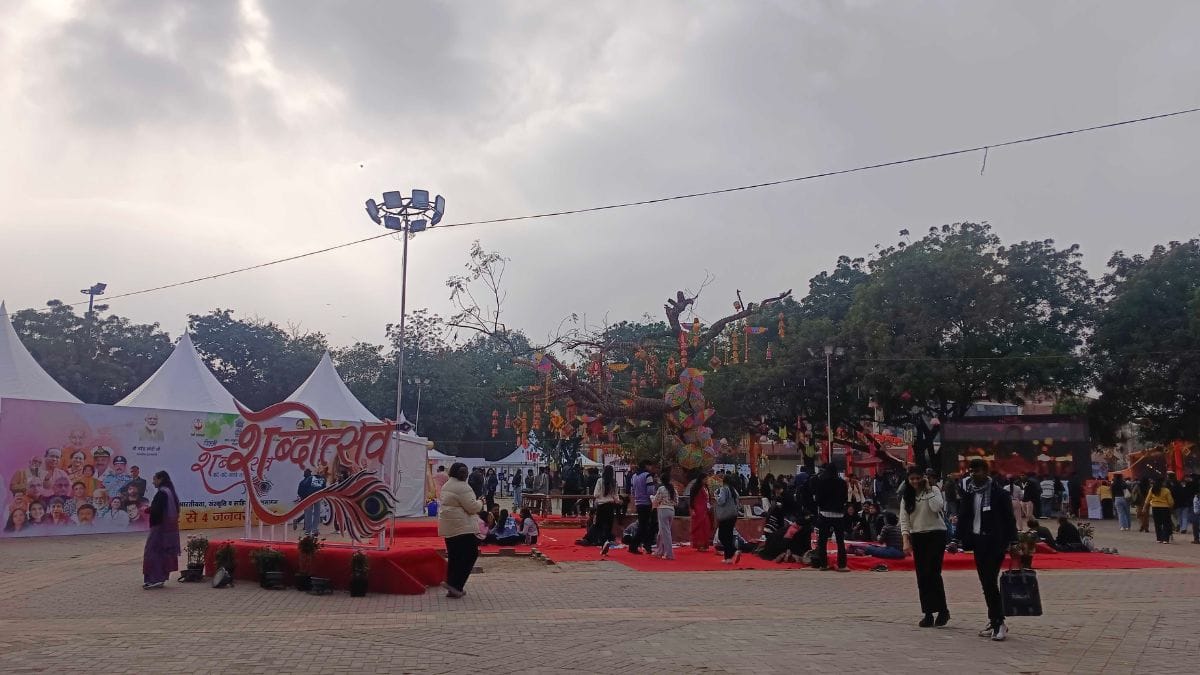
The three-day event, held from 2 January to 4 January, is being organised at Major Dhyan Chand National Stadium, Delhi, with free entry for visitors. Over 100 speakers attended the festival. More than 40 books were released, along with six cultural programmes and two poetry events.
Students from over 40 universities across the Delhi-NCR region participated in different events at the festival.
In her address, Gupta spoke about the importance of balancing modernity with traditional values, emphasising equal importance for science and culture.
“Science and development must go hand in hand with culture. Shabdotsav will provide a platform for the younger generation to connect with India’s traditions,” she said.
Also read: Maharashtra’s folk music inspired Shailesh Srivastava — ‘it has a song for every occasion’
More to explore
One of the major attractions at the festival was a replica of the Ram Temple of Ayodhya. A large conch shell (shankh)-shaped installation was decorated with flowers, allowing visitors to stand and take photographs. An open-mic stage added to the vibrancy of the venue, while a large sitar cut-out was set up as a photo studio. The festival also featured food stalls, paan stalls, art and painting displays, along with book stalls representing different genres.
“Shabdotsav is more than a literary festival; it is also a display of India’s ancient cultural heritage,” said Harsh Malhotra, Union Minister of State.
The festival also provided opportunities for artists to display their artworks.
A pottery sculpture by a Fine Arts student from Delhi University presents a fascinating blend of humanity and nature. The figure depicts a woman with a smile, her eyes closed, and flowers adorning her hair, adding a softness to her expression. The woman’s body is a tree trunk.
“The sculpture depicts the connection between nature and humans,” one of the students explained to the crowd.
The photographs featured in the ‘Live Photography’ section include diverse works, from a sunset at the Ganga Ghat, to a veiled woman sitting in a room in Rajasthan, to farmers plucking paddy in the fields of Punjab.
“This festival has given a platform to artists who are otherwise unknown. This is happening for the first time,” said Meenakshi, an artist at the festival.
Five different stages were set up for book launches, speaker sessions, poetry events and musical performances. According to Kapil Mishra, more than 60,000 registrations were made on BookMyShow for the event. The crowd turnout was so large that the main entry gates had to be closed on Saturday evening to manage the gathering.
The speakers included Air Chief Marshal (Retd.) Rakesh Bhadauria, former Chief of Air Staff; Ajit Doval, National Security Advisor of India; actors Tej Sapru, Aditya Om and Bhasha Sumbli; and political leaders such as Sudhanshu Trivedi, BJP spokesperson and senior political commentator, and Vijay Sharma, Home Minister of Chhattisgarh.
As Sudhanshu Trivedi began his session titled “Dakshinapath”, a full-house audience welcomed him with loud applause. Trivedi spoke about national unity and took a jibe at opposition parties for attempting to create divisions between North and South India. He also urged Gen Z to always be aware of the incidents happening around them and the attempts by the opposition to create division.
“Gen Z must remain alert to polarization based on caste, language, or religion,” said Trivedi.
He also recited some phrases urging the new generation not to believe everything the opposition says.
“Kehni hai mujhe ek baat is desh ke pehledaro se, sambhal ke rehna apne ghar mein chupe gaddaro se,” he added. Be careful of the traitors hiding within your own homes.
During the discussions, questions were raised on issues such as Hindus in West Bengal, population growth, the functioning of state governments, the electoral process, and the importance of Sanatan Dharma.
Trivedi said that the southern part of the country has been deeply connected to Sanatan Dharma and Hinduism.
“The day people in South India begin openly discussing Hindutva, the world will realise its true strength,” he said.
(Edited by Ratan Priya)