





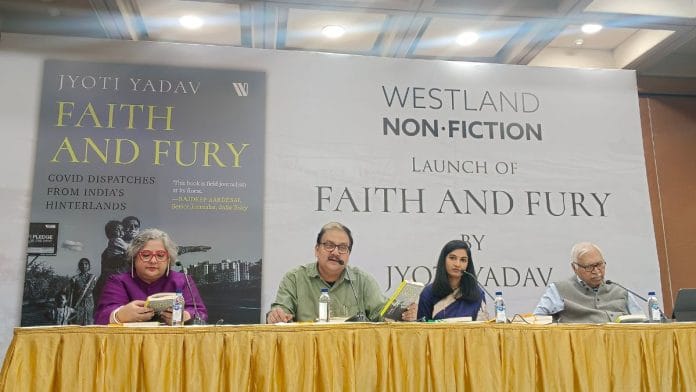



New Delhi: The launch discussion about a book on Covid began with a central, troubling question. Do we really want to read a book about Covid?
It reflects the collective, willful amnesia about the pandemic, arguably the most documented global event this decade. There is a mix of fatigue and forced forgetting that is at play.
Journalist Jyoti Yadav’s book Faith and Fury: COVID Dispatches from India’s Hinterlands – based on her extensive reportage for ThePrint—is a work that militates against such an urge to forget. In that sense, it is a Milan Kundera-esque endeavour—a struggle of memory against forgetting.
Yadav’s book recounts stories of migrants walking endless miles, families unable to say their last goodbyes, and patients gasping for breath amid collapsing health systems. It draws from her on-the-ground reporting during Covid, documenting the lived realities of ASHA workers, hospital staff, crematorium workers, and families of victims — the invisible people who held the country together during its darkest hours.
Published by Westland Books, the book was released at the India International Centre on Monday. The event featured parliamentarian and author Manoj Jha, former Chief Election Commissioner SY Quraishi, and was moderated by author and journalist Kaveree Bamzai.
Calling it “a moral manifesto for our republic,” Manoj Jha said the book stands apart from other pandemic narratives as a deeply reported, non-fiction account that brings the unheard voices into the national record.
The book is more than a memoir for Yadav herself. For her, it is not something to be treated merely as history or a living-room conversation about how we had to clean for ourselves or revisit old hobbies. More importantly, it is her way of showing the stark difference between the urban and rural experiences during the pandemic, which she witnessed firsthand.
“This book is about the subaltern history of Covid. When we talk about Covid, I am a part of those very same circles, urban centres, who talk about how we were deprived of our servants, how we had to cook, how we had to clean, cinema was disrupted. This is our conversation. But who will talk about the cycle girl of Darbhanga? Not to pity them, not to exaggerate the misery, but to tell the story the way it is,” she said.
Revisiting the stories
The fully packed hall, filled with journalists, friends, family members, and former colleagues exchanging greetings, made the book launch event even more engaging. Praise continued throughout the evening as Yadav thanked her editors and former colleagues.
The book is not just a collection of testimonies or old stories that Jyoti covered as a journalist five years ago. Instead, she revisited the stories she had captured in her reports. She returned to the village where children who lost their parents during the pandemic were living. She spoke to the other families in Uttar Pradesh and Bihar.
“The main reason for bringing out the book after so many years is that I did not want to simply repeat what was already there in my reports, but to revisit what happened to the stories I had covered,” she said. She found that the girl who had lost her parents during the pandemic had been married off at a young age, and another boy had gone to work somewhere to earn a living.
As the conversation evolved, Yadav revealed the story behind the title of the book. It highlights the paradoxes of rural India during the pandemic. While people displayed extraordinary faith and solidarity, there was also fury.
“The title reflects what I witnessed on the ground,” she said. “Even in the worst of times, there were sources of faith among the people helping strangers, migrants taking their only means of transport, and frontline workers risking everything. At the same time, there was fury against neglect, against injustice. These are the two emotions that defined the hinterlands during Covid,” she added.
The conversation also touched upon the role of the government and alleged negligence. Jha said that it was a failure of the system. He criticised the government for once declaring that there was no data on how many deaths had occurred, even though the country lost millions of people during the pandemic.
The panelists also questioned the accountability of the government in controlling the data and managing the pandemic.
“We still do not know how many people died. If we do not have data, how will we make policies? The government is the enemy of data. They have a lot of trouble with data,” said Bamzai.
During the discussion at the launch, Yadav spoke about one of her favourite photographs of migrants sitting in a truck with their bicycles tied to it as they traveled home. She explained how small details, like the bicycles carried by migrants, became powerful symbols of survival.
“The cycle was more than just a possession — it was their lifeline, their means of survival. When people left for home, they carried it with them because it represented faith: faith in reaching their village, faith in returning to some semblance of normalcy,” Yadav said.
Also read: From death to life in 72 hours — my 10 days on the road covering Covid through UP, Bihar
Life of a woman journalist
The conversation also explored the challenges of reporting from the field during one of the most dangerous periods in recent history, when no one knew when or how infection could strike. As the stage opened for audience questions, many expressed interest in Jyoti Yadav’s experiences as a journalist and a woman working on the frontlines.
“I never wanted to leave in the middle of reporting. I wanted to trace every aspect of the story — from the people traveling by truck from Delhi to UP, to the members of the Dom community who are associated with cremation work continuously, who didn’t even have time for interviews,” she said.
She was also asked about the particular fears a woman journalist faces, prompting her to recount one of her most harrowing experiences in the field.
“During one of my assignments in the second wave of Covid, I wanted to return to Delhi not because of the pandemic or my work, but because two men tried to harass me when I was stuck in an isolated place,” she said. She added that, as a woman in the field, sometimes one must fight harder than men to claim a space and ensure personal safety.
“During reporting from the grassroots in Bihar and UP, was there ever a moment when, as a journalist and as a human being, you had to act more as the latter?” one audience member asked.
“In times of crisis, we do try to help, but there is also a balance — as a journalist, you have to balance your work with your duty as a human,” she added.
(Edited by Ratan Priya)