





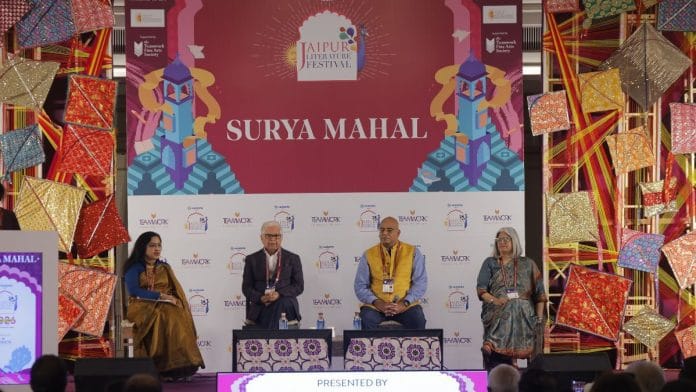



Jaipur: When two Indian lawyers and a sitting American judge came together at the Jaipur Literature Festival, there was more talk of various Indian constitutional, moral and legal crises and less of what’s going on in the United States under the Trump administration.
Lawyer Ashwani Kumar said that law must yield to justice when the two contradict each other. Kumar was speaking in a session titled ‘The Measure of Justice’, in conversation with Judge Ketu Shah, and lawyer-activist Vrinda Grover, moderated by journalist Sudha Sadhanand at the JLF 2026.
Grover, when asked about her role as a “lawyer-activist,” said that one’s role as a citizen is not just to cast the vote but to fight for democracy within the country, “it is about combining your professional and your civil role”.
Shah, on the matter of how political eco-chambers impact the judiciary, said that judicial review is proof that judges are human. “We make mistakes. We strive to be neutral and fair and unbiased. Sometimes, we meet that measure and sometimes we don’t,” the federal judge said.
‘We know where you live’
Sudhanand quoted the 2024 year-end report by US Chief Justice John Roberts that highlighted the threats to judicial independence, and mentioned the increased violence, intimidation, disinformation, and defiance of judgments. Shah agreed, saying that these threats have increased at an exponential level.
He gave the example of when a litigant was unhappy with the verdict, he came to a federal judge’s house and shot her husband and son. The son died. This and other such instances, he said, send a clear message to judges: “we know where you live”.
“This kind of atmosphere has made us very concerned about the rule of law and how we implement justice. The idea of justice evolves as a community thinks of justice. When both of our constitutions were made, some things were not considered but today we have a different idea of justice,” Shah said.
With standing room only, the hour-long conversation was incisive and covered the major topics concerning the Indian judiciary, democracy and governance.
Sadhanand asked Grover to address the elephant in the room, referring to the Supreme Court’s judgment on the Umar Khalid and Sharjeel Imam case.
“The elephant in the room is not the Umar Khalid and Sharjeel Imam case, or the journalists languishing in prisons in Kashmir, but the abuse of power and the misuse of criminalisation laws. What this has done is allow Khalid and Imam to be incarcerated for longer,” Grover said.
She also questioned the judgment’s phrase that “their speeches destabilise everyday life”, arguing that to take terrorism and terrorist attacks out of the violent space is the problem. “Here, the problem is their ideas and thoughts. It is something that the ruling powers do not like, but that does not make it terrorism.”
Grover questioned the Citizenship Amendment Act, 2019 (CAA), which resulted in widespread public discontent and even fuelled the Delhi riots in 2020, calling it “unconstitutional”. “Can we not protest or speak out about it or anything that we disagree with the government on? What is happening to the judiciary, where is the link between these speeches by young Muslim leaders and the violence in Delhi? The judgment is not about violence but about democracy in India,” Grover added.
Kumar said that no one can disagree that the apex court’s judgment is “unjust”. “There is absolutely no reason to deny bail, without the trial having been commenced. It goes against the first principles of criminal justice. Indian democracy is not just a libertarian democracy but is above all a dignitarian democracy anchored in freedom, liberty, free speech and inclusion,” he explained.
Sadhanand asked the panel to shed light on the National Herald case and the recent controversy surrounding Justice Yashwant Verma of the Delhi High Court, while also questioning the notion that “gossip is gospel”.
While Grover did not comment on Justice Verma, she did ask why certain cases and controversies
that were never lodged and remain hidden in the shadows.
“Let’s talk of the hate speech cases that were never lodged following the Delhi riots. It is sometimes the omission of such cases that is equally important. Those hate speakers are now my ministers in Delhi just because they belong to the ruling party, the BJP,” Grover said.
She recalled the hate speeches and the vulgar language used by politicians in the 1984 anti-Sikh riots, citing the example of Sajjan Kumar and emphasised how many lawyers and activists persisted for years to get him behind bars. “These politicians should remember that some of us will be pursuing these matters for a long time.”
Also read: The Supreme Court is losing its credibility. It should frighten us all—Maneka Gandhi
In defence of people’s lives
Grover traced the similarities between the colonial laws and the Bharatiya Nyaya Sanhita (BNS), despite the latter’s claim of redefining Indian laws to fit the Indian context. She highlighted the lack of anti-torture laws in the updated manual. “Torture is still rampant in the country and is predominantly used by the police, but there is no law against it. Why? Does it benefit the government to not pass such a law, even though it will benefit the people?”
Kumar added that justice should not be measure by the number of judges appointed but by judgments delivered and the cases still pending. He said that he has been pushing for a law to criminalise torture in the country but those petitions are yet to be heard.
“Do not leave all your liberties and pin all your hopes in any one institution of India’s democracy. That must be in the quiet assertion of the people of India in favour of their life,” he said.
ThePrint is a media partner for the Jaipur Literature Festival 2026.
(Edited by Ratan Priya)
Am I the only one who is never found a satisfactory reason from the left about CAA ? These people say it excludes some group but it’s only Muslim and Muslims are excluded for a reason which is pretty simple : why should India accept Muslim refugees from Muslim majority countries ? FFS the country was split in the name of religion and now we should accept them back ? There is a reason why Christians are accepted because they are minorities in these three countries.
No. Never. Leftist are so stupid in their cause of empathy that they lose their rationale.